

National Transport Authority promises 'complete transformation' of Limerick city bus services
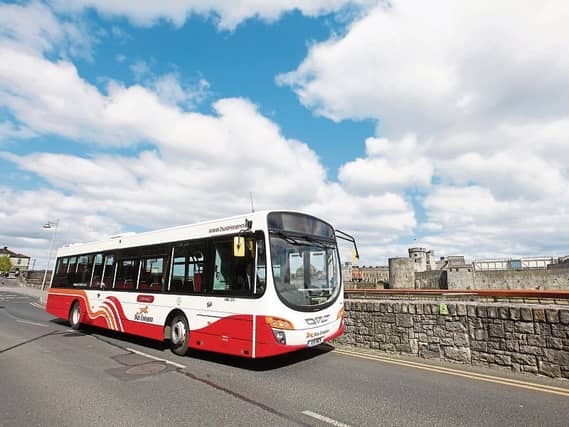

THE NATIONAL Transport Authority (NTA) has promised a complete transformation of Limerick city’s bus service in the next five to eight years.
Speaking at a Travel and Transport Special Policy Committee (SPC) meeting, NTA officials revealed their ambitions to completely re-imagine and re-structure Limerick’s existing city bus service.
“We need to reconsider and re-envisage what we mean by bus in Limerick. It’s not the network you have today, it’s not the service you have today, it’s a completely transformed service.
“In Limerick it is lacking at the moment, in terms of journey times, reliability and frequency,” Transportation Planner at the NTA, David Clements, told elected members present.
Mr Clements, who was making a presentation on a revised draft of the Limerick Shannon Metropolitan Area Transport Strategy (LSMATS) promised a completely new system as part of the 2040 plan.
“Whatever you think of when you think of buses in Limerick city, forget that. There is something completely different coming in the next five to eight years,” he stated.
The NTA’s commitment, as set out in the LSMATS, details a high-frequency, reliable system with buses arriving every five to ten minutes, with full priority throughout the city, Mr Clements added.
This priority, he stressed, will be achieved either through bus lanes, bus gates, bus only links or by removing some car traffic and parking throughout the city.
The LSMATS promises to change the transport culture of Limerick, NTA officials present at the SPC meeting outlined, adding that there is “no limit” to the development of transport in the city.
Mr Clements also highlighted the transport plan’s intention to cut social disadvantages in the city and “enable people to get from disadvantaged areas into work in the city.”
“Already, bus frequencies to Regeneration areas have doubled in the last year.
“This plan sets out how to do this in the future. These are the areas where access to cars is significantly lower than the average, so it is really important,” Mr Clements concluded.