

Uncovering the rich history and remarkable residents of Summerville House in Limerick
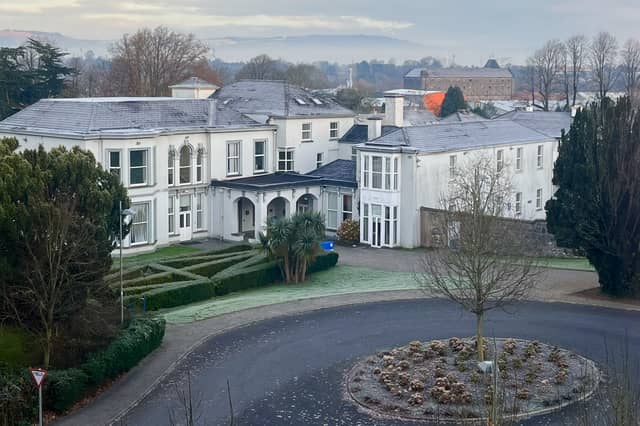

IF WALLS COULD TALK: Dr Paul O’Brien steps back in time at one of Mary Immaculate College’s most historic buildings
IT is easy to pass Summerville House today and think of it simply as part of the Mary Immaculate College (MIC) campus. Yet behind its walls lies more than two centuries of Limerick history, intertwined with merchant wealth, Quaker enterprise, scientific achievement and the expansion of the city.
Summerville was built in 1786 by Joseph Massey Harvey, a member of a prominent Quaker family. Harvey had come to Limerick to work with the Fisher Flour Mills on Francis Street, one of the city’s most important industries.
Like many prosperous merchants of the period, he chose to build his residence beyond the city, enjoying the advantages of the country while remaining within easy reach of his commercial interests in Limerick. Harvey also served as agent to the Marquis of Lansdowne, whose estates extended across much of Limerick. Joseph Massey Harvey was married to Rebecca Mark (1761-1834), daughter of Thomas and Mary Mark.
Summerville’s location says much about the expansion of late eighteenth-century Limerick. Wealthy merchant families began constructing villas in what were then the city’s outskirts. An advertisement from 1835 described Summerville as a ‘very desirable town and country residence’, situated beside the river, commanding fine views and lying less than five minutes’ walk from the Crescent.’ Other houses in the area included Laurel Hill, Ashbourne, Prospect, Richmond, Knapsack Lodge and Little Summerville. So many Quaker families settled in the townland of Courtbrack that by the 1830s, the area became known as Quakers’ Fields.
The Harvey family remained associated with Summerville throughout much of the nineteenth century. Reuben Harvey, one of Joseph Massey Harvey’s 11 children, was born in the house in 1789. He inherited the family’s interests in the Fisher Flour Mills and later leased the mills at Plassey from the Maunsell family. He also developed Harvey’s Quay on land leased by his father from Viscount Pery in 1791. His life was not without complication. Having married his first cousin, Hannah Christy, he was temporarily disowned by the Society of Friends before eventually being reconciled with the Quaker community.
One of Summerville’s most distinguished residents was William Henry Harvey (1811-1866), the internationally renowned botanist and leading authority on algae and mosses who described more than 750 new species. Born at Summerville on February 5, 1811, the youngest of eleven children, Harvey developed an early fascination with botany while attending Ballitore School in County Kildare.
In 1835 he travelled to South Africa, where he assumed administrative duties following the death of his brother Joseph. Returning to Ireland in 1842, he became curator of the Trinity College Herbarium and later Professor of Botany with the Royal Dublin Society. Between 1853 and 1856 he undertook an extensive scientific voyage across South Africa, Ceylon (Sri Lanka), Australia, New Zealand, Tonga, Fiji and Chile, publishing important works on the flora of South Africa and North America. Harvey left the Society of Friends in 1846 after joining the Church of England. He married Elizabeth Lecky Phelps in 1861 and died of tuberculosis in Torquay, Devon.
The last Harvey family member to reside permanently at Summerville was Hannah Christy Harvey. Following her death in 1874, the house changed hands. In 1879 it was sold to James Fitzgerald Bannatyne for £3,000. A 1792 deed preserves evidence of the house’s earlier connections to another influential Quaker family, the Unthanks, illustrating how closely the histories of Limerick’s merchant dynasties were intertwined.
Architecturally, Summerville remains one of the most impressive surviving houses in this part of the city. At its core is a late-Georgian, five-bay, two-storey residence. Later alterations introduced fashionable Italianate elements, giving the building a distinctly Victorian character. The south-facing bay window and the large rear bay, with its striking tripartite arched window, add both grandeur and light to the interior. Inside, much of the craftsmanship survives. The entrance hall is decorated with stylised pilasters, ornate plasterwork and decorative cornices. Particularly impressive is the staircase, rising from a half-landing before dividing into two flights.
Another significant chapter began in 1901 when Gerald E Goodbody purchased Summerville. The Goodbodys were among Ireland’s most successful Quaker industrial families, with extensive interests in manufacturing, milling and commerce. Senator John Patrick Goodbody lived at the house during the early twentieth century and remained associated with it until his death in 1952.
Its survival was ultimately secured through adaptation. Following Senator Goodbody’s death, the property was acquired by the Sisters of Mercy and later became part of MIC.
Summerville House will be open for a guided tour by Dr Paul O’Brien as part of Culture Night 2026. Meet at main reception of MIC at 4.15pm on Friday, September 18. No booking is required. This tour is wheelchair accessible.