

Then & Now: Summer school to be in session
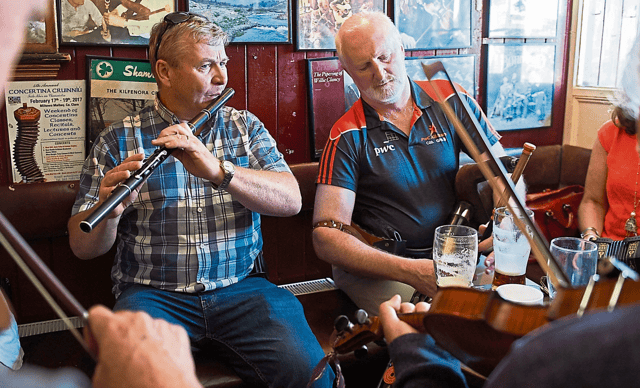

A GOOD number of readers will be aware of the Willie Clancy Summer School that is held each July in Milltown Malbay in West Clare.
For one week the town and surrounding area plays host to thousands of musicians, singers and dancers from all parts of the world. From early until late an overflow of people throng the workshops, pubs, halls and spill out onto the streets for outdoor entertainment. Many people take their yearly holidays to coincide with the festival and stay in local accommodation. It attracts a large following from Limerick interested in traditional music song and dance. Many may not be aware of the man that it is called after and his career in music. Willie was a musician who played the Uileann pipes, Irish flute and tin whistle.
Willie Clancy was born on Christmas Eve December 24, 1918 into a musical family in the outskirts of Milltown Malbay, Co Clare. His parents (Gilbert Clancy and Ellen Killeen) both sang and played concertina, and his father also played the flute. Willie grew up in an atmosphere of music, singing and storytelling. He was greatly influenced by his grandmother, by his father and by Garrett Barry, the legendary blind piper from Inagh.
Garrett Barry who died in the workhouse in Ennistymon at the close of the nineteenth century. His piping style was passed on to Willie by his father Gilbert. Willie was aware that Garrett Barry possessed a heritage of music unique to himself. The music of Garrett Barry is known and cherished today because of Willies determination to pass on this treasure.
Willie started playing the whistle at age five, and later took up the flute. Willie was 17 years old when he encountered the great travelling piper, Johnny Doran in 1936. It was the first time he saw a set of pipes and he obtained his first set of pipes two years later. His influences included Leo Rowsome,, Seamus Ennis,, John Potts, and Andy Conroy.
By the early 1940s Willie had mastered the basic piping techniques and in 1947 he won first prize at the Oireachtas competition.
Unfortunately, he could not make a living from his music and he was forced to emigrate to London, where he worked as a carpenter. While there, he continued with his music and made contact with other notable players, including Seamus Ennis.
With the death of his father in 1957, he returned to Milltown Malbay and married Doirin Healy in 1962. Willie recorded some influential 78 rpm recordings for the Gael Linn label - among them the classic reel selection 'The Old Bush/The Ravelled Hank of Yarn.' The next decades he stayed in Milltown Malbay.
He developed a highly distinctive and individual style of piping. From 1957 until 1972 the summer music sessions in the West Clare town became widely renowned, with Willie Clancy as one of the main attractions. Pipe-making, reed-making and all things connected with the instrument were explored and advanced by the Clancy influence. He gave many performances on both radio and television as well as live sessions in his local area.
His sudden death on January 24 1973 at the age of 54 was widely mourned among friends and musicians alike. He is buried in Ballard Cemetery just outside the town of Milltown Malbay.
As a tribute to this extraordinary man and gifted musician, it was decided to set up an annual summer music school in Willie's home town. The Willie Clancy Summer School was established in his honour in 1973, by Clancy's friends Junior Crehan, Martin Talty, Sean Reid, Paddy Malone, Paddy McMahon, Frankie McMahon, Jimmy Ward, JC Talty, Harry Hughes, Michael O’Friel, Séamus Mac Mathúna, and Muiris Ó Rócháin. The school quickly established a name for good music and high standards in tuition, a fitting tribute to a fine musician.
Willie was also the subject of a major television documentary "Cérbh É? Willie Clancy" on TG4, first broadcast in November 2009. In this programme, one of a series in which major figures in contemporary traditional music, profile and pay homage to a master of their craft from a bygone age, Peter Browne traced the life and legacy of Willie Clancy.
I have often visited his grave in Ballard Cemetery high above the town he has helped to put on the entertainment map. Now 50 years later his legacy lives on bringing likeminded people together to enjoy themselves and his festival is a major boost to the economy of the west Clare area.
Curlews
THE HAUNTING cry of the Curlew (An Crotach as Gaeilge) is one of the most evocative and memorable sounds of the marshes and uplands in summer.
However, we need to act now to ensure it doesn't become a mere memory. Sadly, Curlews, along with other breeding waders, have almost disappeared from our countryside. These iconic birds have been suffering severe decline for many years. In March 2014 Birdwatch Ireland estimated that around 80% of the curlew breeding population had been lost since the 1970s alone, and perhaps only a few hundred pairs remained.
Whilst they are still a regular sight along our coasts in winter when migrant birds from northern Europe come here to take advantage of our relatively mild winters, feeding in our estuaries and wetlands in large numbers, it is our resident breeding population that is now in danger of extinction.
Curlews can nest in a range of habitats in Ireland, from wet grasslands to marginal hill land. They favour damp pastures that are grazed lightly by cattle, with a scattering of rush tussocks for nesting in and some wet areas to provide insects for their chicks to feed on.
Huge changes in the uplands, such as the destruction of peat bogs, forestation, more intensive management of farmland and the abandonment of some lands, leading to encroachment by scrub, gorse and dense rushes, have all affected Curlew breeding habitat. In the lowland, drainage of wetlands and intensive management of grasslands have destroyed much of their habitat. Curlew and other waders are now among our most threatened breeding birds, with your help, Birdwatch Ireland hopes to carry out a programme of work to bring these birds back from the verge of extinction.
People can visit www.birdwatchireland.ie to see how you can help out.
It is predicted that the curlew will become close to extinction as a native breeding bird after 2025. The continued loss of its natural habitat is one reason for its decline over the past 30-40 years, plus the dangers posed by predators which take their eggs and young chicks from the curlew nests.
In recent years a nest protection system to keep out the fox, mink, magpies and hooded crow, has been put in place in a number of sites and this has proved to be a success.
The aim is to give the birds a better chance of surviving between the hatching and the time the young chicks leave the nests.
The curlew is a beautiful but lonely bird of the bogs and seashore with a haunting call.
Norman McCaig describes his voice: ''trailing bubbles of music over the squelchy hillside''. He describes the curlews song thus: ''Music as desolate, as beautiful as your loved places, mountainy marshes and glistening mudflats by the stealthy sea''.