Search


12 Mar 2026
Search
12 Mar 2026

Please allow ads as they help fund our trusted local news content.
Kindly add us to your ad blocker whitelist.
If you want further access to Ireland's best local journalism, consider contributing and/or subscribing to our free daily Newsletter .
Support our mission and join our community now.
To continue reading this article, you can subscribe for as little as €0.50 per week which will also give you access to all of our premium content and archived articles!
Alternatively, you can pay €0.50 per article, capped at €1 per day.
Thank you for supporting Ireland's best local journalism!

Gambling support counsellor Dylan Johnston is based at the Southill Family Resource Centre two days each week - on Thursdays and Fridays

ANYONE who watched the darts, or indeed any other sporting event over Christmas would have been struck by the sheer number and visibility of gambling advertisements.
And with adverts for casino games finding their way into telephone apps for clothing and supermarket shopping too, it’s perhaps no surprise that problem gambling is on the rise, particularly among young men and women.
But it’s still a hidden struggle, according to Dylan Johnston, who for the last nine months has been offering free counselling support for those hooked on gambling, and their families in Limerick.
READ MORE: 'Someone saw their opportunity and they took it': Cars left unlocked targeted in Limerick thefts
Based two days a week at Southill Family Resource on the southside of the city, there has so far been limited interest in his sessions.
So much so that when he held an information event back in November, nobody came.
“That empty room told the real story: problematic gambling harm is still one of Limerick’s most hidden struggles, wrapped in shame and silence,” he said.
Dylan admits this experience has given him a lot of cause for thought.
“I think it’s a very hidden secretive addiction. People don’t feel very comfortable. With other addictions, there are physical symptoms, you can see it,” he said.
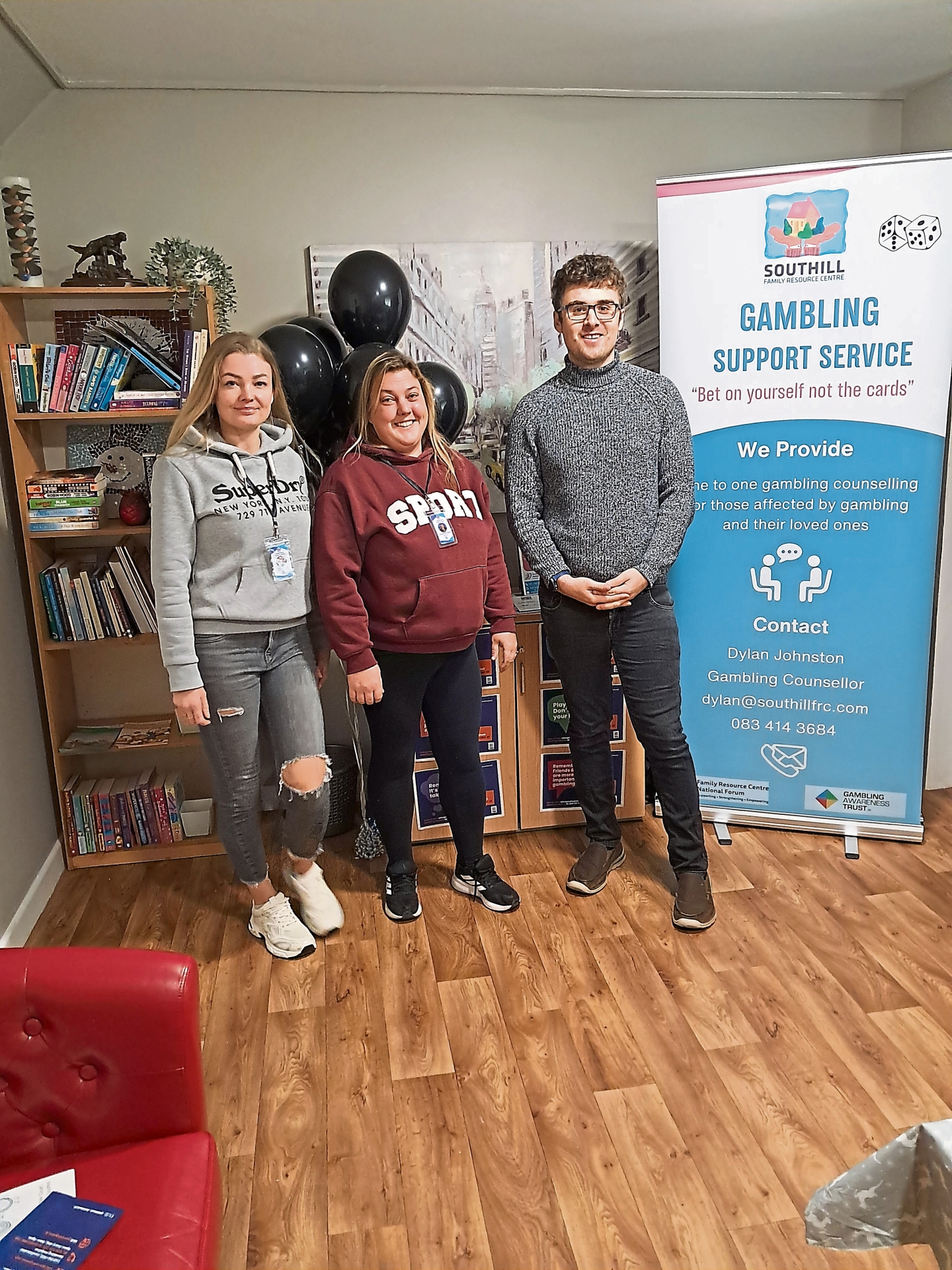
Below: Gambling counsellor Dylan Johnston is pictured at Southill Family Resource Centre with administrator Kristina Lunis and family support worker Jane Aylmer
He says families are sometimes relieved to learn that the problem is gambling — not because it is harmless, but because the truth can feel less terrifying than the silent, unanswered question of what might be wrong.
“I’ve spoken to family members and they knew there was something wrong with the person, but they’d never would have thought it was gambling. It’s often relieving to them when they find out it is gambling,” he explained.
“They are spending time in the bathroom, avoiding things, they hide their phone, they hide their laptops. Partners often think they could be cheating or something or something like this.”
Dylan outlines how problematic gambling harm usually smarts small - a €5 bet just this once, followed by €10, €20 and €50.
In his six years of experience, he has seen some lose huge sums to gambling.
“The quantity of money can be overwhelming. I’ve met 19-year-olds that have put €1m through their account and lost €100,000. I’ve met people who have lost €300,000 to €400,000,” the counsellor explains.
“Gambling is quite chaotic. You’re up and down, and up and down. It’s not a nice way of living - it’s very intense,” he said.
It is important to note that when Dylan refers to putting €1m through an account, it does not mean having €1m to spend.
It refers to the total amount wagered over time, often the same money gambled again and again.
Even when people try to regulate their gambling, that can often end in tears, he adds.
“Some people would have told me they loved soccer bets, and they’d put a bet on at 12pm, 3pm, and 6pm, and they had a plan. Before they know it, they are betting on virtual horse racing and under-14s volleyball matches,” he said.
Dylan is one of a team of counsellors funded by the Gambling Awareness Trust working out of Family Resource Centres across Ireland.
The rise of smartphone technology has led to easy access to all kinds of gambling - not just sports fixtures.
“Casino apps are very very potent. They are very complicated and incredibly addictive. They trick you into winning. There is an entire university in America dedicated to designing these machines to make them as addictive as possible,” he explains.
This can deliver “false wins,” he says, for example, a free spin, or recovering €1.80 of a €2 stake.
“It’s very seductive. It’s all very potent, the little wins and the losses,” he added.
The temptation to gamble has many underlying factors, Dylan believes.
“With any addiction, I think there are underlying root causes which are very broad in their nature. It could be anything - you mightn’t feel good enough, you might have had trauma, or you might be struggling with different aspects of your life - overworking, and you’re looking for that escape,” he said.
He has seen a rise in gambling among women, and often their domestic situation can mean it’s harder for them to avail of support.
“Gambling for women is often social. Maybe their life at home isn’t as happy as they’d like it. They find home life difficult. So they’d go into casinos or betting shops for a bit of respite,” he added.
Also quite worrying for Dylan is the way video games often force people to spend money.
Indeed, he revealed a family friend became homeless over the money they spent in gaming, spending money on so-called ‘loot boxes’ which give a randomised reward.
"Grand Theft Auto has a fully functioning casino in it, which is quite scary. I remember being told to be any good at Fifa, you have to spend €1,000 on the game. When I played video games as a kid, one player wouldn't be much better than the other.
But now, if you are Mbappe or Ronaldo, you are so much better than the next player. And you can't get it unless you buy packs online, and you spend loads of money on a game. Fornite is the top grossing game in the world. It's free to buy, but people are just spending all their money on add-ons," Dylan said.
There are financial protections Dylan advises people to put in place.
AIB, Bank of Ireland and Revolut, for example, have a system where card spend on a gambling website can be blocked.
There are also saver accounts, which need two signatures and a notice period to access cash from.
"Sometimes people with gambling addiction can't stop until they hit zero, so it's about having these barriers in place," he said.
Dylan offers a free and confidential counselling service.
To contact him, dial 083-4143684 or email: Dylan@southillfrc.com

Subscribe or register today to discover more from DonegalLive.ie
Buy the e-paper of the Donegal Democrat, Donegal People's Press, Donegal Post and Inish Times here for instant access to Donegal's premier news titles.
Keep up with the latest news from Donegal with our daily newsletter featuring the most important stories of the day delivered to your inbox every evening at 5pm.

This publication supports the work of the Press Council of Ireland and Office of the Press Ombudsman, and our staff operate within the Code of Practice of the Press Council. You can obtain a copy of the Code, or contact the Council, at www.presscouncil.ie, Lo-call 1800 208 080 or email: info@presscouncil.ie.