Louay Kila was found guilty of rape and sexual assault
Search


06 Mar 2026

Please allow ads as they help fund our trusted local news content.
Kindly add us to your ad blocker whitelist.
If you want further access to Ireland's best local journalism, consider contributing and/or subscribing to our free daily Newsletter .
Support our mission and join our community now.
To continue reading this article, you can subscribe for as little as €0.50 per week which will also give you access to all of our premium content and archived articles!
Alternatively, you can pay €0.50 per article, capped at €1 per day.
Thank you for supporting Ireland's best local journalism!


A paratrooper’s use of lethal force against a 14-year-old boy in Belfast was not justified in the circumstances, a coroner has found, 50 years after his death.
Desmond Healey, 14, died following a single shot to the heart during rioting in the Lenadoon area of west Belfast on August 9 1971.
It came during significant rioting in the area and across Northern Ireland as soldiers moved in to make arrests of suspected IRA members following the introduction of internment without trial by the then Stormont government.
Desmond’s twin brother Ted watched on at Belfast Coroner’s Court on Thursday while Coroner Maria Dougan also found he had been throwing glass bottles at soldiers, but did not present enough of a threat for lethal force to be used.
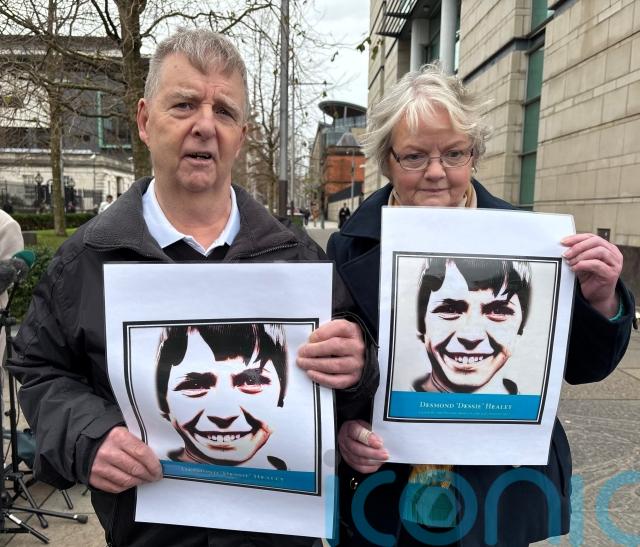
The findings come the day before Desmond and Ted’s birthday on Friday.
An inquest in 1971 had returned an open verdict.
Delivering her findings, Coroner Dougan described a “complex and challenging inquest” battling the impact of delay on the availability of witnesses and evidence, which was heard over 20 non-consecutive days from 2022 to 2024.
On August 9 1971, the scene of Desmond’s death, Lenadoon Avenue close to its junction with Creeslough Park had been blocked by a hijacked Ulster Bus.
Soldiers from D Company of the Parachute Regiment cleared the makeshift barricade at around noon, which led to what the inquest heard had been a “volatile and chaotic” riot.
Earlier in the day, live rounds had been fired at soldiers from a car on Creeslough Park and petrol bombs were recorded as being used in the area.
Missiles, found to be mainly stones and bottles, were thrown at the soldiers, who responded with CS gas and rubber bullets before firing live rounds.
Desmond was observed among a group of young male rioters.
Coroner Dougan found he had been throwing bottles at soldiers, but not petrol bombs as had been reported by military witnesses at the time.
She also rejected intelligence material that suggested he had been a member of an illegal organisation, Na Fianna Eireann, a youth branch of the IRA.
She found that he had been shot by a paratrooper, referred to as Soldier D, who had been ordered to fire by Soldier A.
Neither of these former soldiers was able to be identified in the inquest.
In terms of the circumstances, Coroner Dougan found it was “reasonable” to conclude the soldiers held an honest and genuine belief that the unit was about to come under increasing attack from petrol bombs.
She said she accepted Soldier A had shouted a warning before live rounds were fired, but not that it had been repeated three times or echoed by other soldiers, and added it was unlikely to have been heard by the rioters who were around 41 metres away.
She found the use of a live round was not reasonable in the circumstances, which she found were the throwing of a glass bottle by a 14-year-old boy from an estimated distance of approximately 41 metres, that had landed some 12-15 feet short.
“Further, even if I was to assume, contrary to my findings, that Soldier D had believed that Desmond Healey was in the act of throwing a petrol bomb from that distance, I would nonetheless conclude that the use of live ammunition would have been unreasonable and therefore excessive in the circumstances,” she added.
“Petrol bombs are capable of causing serious injury, significant damage and potentially death.
“Nevertheless, the use of live ammunition in response would have been excessive even in those circumstances.”
Coroner Dougan also found that Soldier D acted in contravention of the Yellow Card rules.
She paid tribute to the “tenacity” and the “dignity” of Mr Healey’s family.
Speaking outside court, solicitor Padraig O Muirigh, who acts for the family, said it was “another shameful day in the history of the British Army”.
“We are very happy with the findings of Coroner Dougan today,” he said.
“It’s another shameful day in the history of the British Army in this part of Ireland.
“In a democratic society when a child has been killed in controversial circumstances, it should be investigated immediately, and it shouldn’t take 54 years, that this family have had to wait on these very important findings.
“It’s a relief for the family to finally have a proper legal verdict.”
Mr O Muirigh said he had stood outside Belfast Coroner’s Court with the families of Stephen Geddis, 10 and Francis Rowntree, 12, who also died in incidents involving soldiers in west Belfast in the 1970s, following “similar findings that the force used was excessive”.
“That’s shameful that it has taken many decades for families to get findings like this,” he said.
“It is difficult for Ted, who celebrates his birthday tomorrow. He has had many birthdays without his twin, 54 without him. It has lived with him, and it has taken a lot of bravery and courage for him to bring this case forward.
“It won’t bring his brother back, but it can be a measure of healing for him that he finally has a legal verdict.”
He added: “I’m sick and tired of hearing about the poor soldiers being harassed and harangued. I have told you about three cases where children were killed, excessive force was used, it as unjustified. And those conclusions were reached after an evidence-based process.”

Subscribe or register today to discover more from DonegalLive.ie
Buy the e-paper of the Donegal Democrat, Donegal People's Press, Donegal Post and Inish Times here for instant access to Donegal's premier news titles.
Keep up with the latest news from Donegal with our daily newsletter featuring the most important stories of the day delivered to your inbox every evening at 5pm.

This publication supports the work of the Press Council of Ireland and Office of the Press Ombudsman, and our staff operate within the Code of Practice of the Press Council. You can obtain a copy of the Code, or contact the Council, at www.presscouncil.ie, Lo-call 1800 208 080 or email: info@presscouncil.ie.