
The road was closed while emergency services dealt with the incident but is now understood to be reopen
Search


12 Mar 2026

Please allow ads as they help fund our trusted local news content.
Kindly add us to your ad blocker whitelist.
If you want further access to Ireland's best local journalism, consider contributing and/or subscribing to our free daily Newsletter .
Support our mission and join our community now.
To continue reading this article, you can subscribe for as little as €0.50 per week which will also give you access to all of our premium content and archived articles!
Alternatively, you can pay €0.50 per article, capped at €1 per day.
Thank you for supporting Ireland's best local journalism!


Widespread culling is not planned to be the response to the arrival of bluetongue in Northern Ireland, the Stormont Agriculture Minister has said.
Two cases of the disease have been confirmed at a farm close to Bangor, Co Down, as well as a further 44 suspected cases.
A 20km temporary control zone (TCZ) is in place.
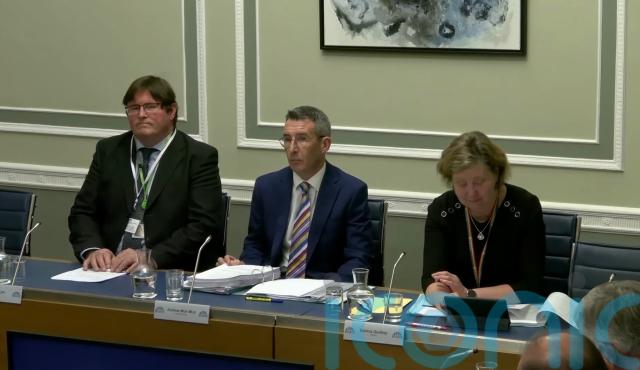
Appearing before the Stormont Agriculture, Environment and Rural Affairs Committee, Andrew Muir emphasised there is no risk to public health or food safety.
The animal disease affects livestock including cattle and sheep, as well as goats, deer and llamas.
It does not affect humans or food safety and is primarily transmitted through midges.
Mr Muir told MLAs on Thursday there are ongoing epidemiological investigations and collaboration with UK and Irish authorities to contain the outbreak.
“Whilst bluetongue poses no risk to public safety or food safety, it is really important to address the need for farmers to abide by the restrictions now in place and to remain extra vigilant … any concerns need to be reported to their vet and Daera (the Department of Agriculture, Environment and Rural Affairs),” he said.
He also described bluetongue as “very different than other diseases such as TB”, adding that widespread culling “is not the response to this”.
Earlier he told BBC Radio Ulster that a Northern Ireland-wide exclusion zone may have to be considered if further cases are found.
Also appearing before the committee, deputy chief veterinary officer David Kyle confirmed there is currently no intention to cull animals.

“We think we need to avoid alarming herd keepers in the area,” he said.
“At the moment, and given the information we have, there would be no intention to cull these animals because we don’t see any veterinary rationale, there is no epidemiological rationale for killing these animals.
“They don’t pose any greater significant risk to other herds.
“This is an extremely well-managed herd, very, very biosecure.
“The issue here is that we are fearing that there are midge infections, and you just can’t control the midge population.
“We’d never say never, we’re undertaking extensive surveillance at pace to try and establish more evidence, and our advice to the minister is to take decisions based on the best science available.”
Asked where they think bluetongue originated from, Mr Muir said that may not be something they will be able to nail, given it is spread by midges.
But he said they can rule out the disease being brought in via an imported animal.
Mr Kyle added they have good midge modelling data which suggested some high density plumes intermittently in September and October.
“Initial indication is that there was an initial incursion, which is then subsequently multiplied quite significantly in the local midge population,” he said.
While temperatures have dropped, Mr Kyle said that midge traps they operate have indicated activity even this week despite colder weather.
Earlier the Ulster Farmers’ Union (UFU) said it is maintaining close contact with senior Daera officials as the situation continues to unfold.
UFU president William Irvine said: “The confirmation of BTV-3 is naturally concerning for farmers, but all the evidence presented to us indicates that this is a highly localised issue driven by unusual midge activity in that specific area.
“It is important to stress that there is no risk to public health, no impact on the food chain, and no intention to cull animals at this time.”
He added: “Movement restrictions within the 20km zone will be incredibly frustrating for the farm businesses caught up in them.
“We are pressing Daera to ensure movement-to-slaughter arrangements operate smoothly and that any further changes to restrictions are communicated quickly and clearly to stakeholders.
“The UFU wants to ensure that any future measures remain proportionate, practical and based firmly on science.
“We will continue to engage constructively with Daera as more surveillance results come through.”

Subscribe or register today to discover more from DonegalLive.ie
Buy the e-paper of the Donegal Democrat, Donegal People's Press, Donegal Post and Inish Times here for instant access to Donegal's premier news titles.
Keep up with the latest news from Donegal with our daily newsletter featuring the most important stories of the day delivered to your inbox every evening at 5pm.

This publication supports the work of the Press Council of Ireland and Office of the Press Ombudsman, and our staff operate within the Code of Practice of the Press Council. You can obtain a copy of the Code, or contact the Council, at www.presscouncil.ie, Lo-call 1800 208 080 or email: info@presscouncil.ie.