Search


12 Mar 2026
Search
12 Mar 2026

Please allow ads as they help fund our trusted local news content.
Kindly add us to your ad blocker whitelist.
If you want further access to Ireland's best local journalism, consider contributing and/or subscribing to our free daily Newsletter .
Support our mission and join our community now.
To continue reading this article, you can subscribe for as little as €0.50 per week which will also give you access to all of our premium content and archived articles!
Alternatively, you can pay €0.50 per article, capped at €1 per day.
Thank you for supporting Ireland's best local journalism!


There is a need for an urgent “paradigm shift” on tackling climate change, the president said, as she opened the Stripe Young Scientist and Technology Exhibition (YSTE).
The YSTE was founded in 1965 and attracts more than 40,000 visitors on average to the RDS in Dublin, making it one of the biggest events of its kind worldwide.
More than 1,000 students presenting 550 projects are competing for more than 200 prizes throughout the week.
The projects were chosen from a pool of almost 2,000 entries.
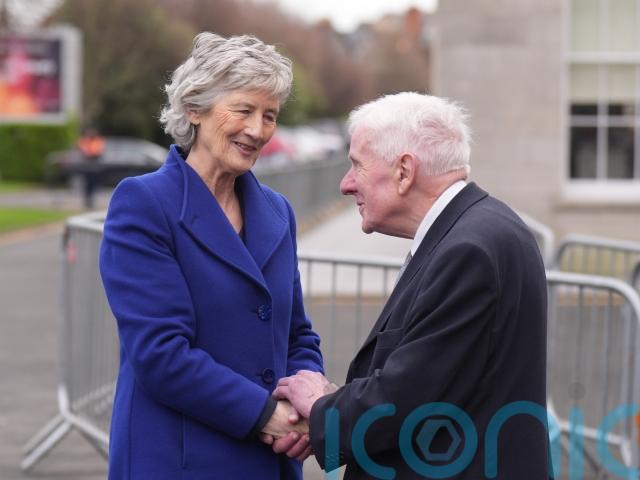
President Catherine Connolly, who opened the event for the first time as head of state, told attendees she gets her “hope for the future” from young people.
In an address in Irish and English, she said it was a “privilege” to be back at the event as president.
She said the YTSE allows students to demonstrate their “creativity, ingenuity and knowledge”, as she described the range of projects submitted as “wonderful” and “very impressive”.
Ms Connolly called for an “open and honest” debate on data collection, as well as “transformative change” for climate justice.
“This annual event serves as an opportunity for science and technology themselves under the microscope – and indeed to pose the question: what conclusions might our society come to following a rigorous application of that same scientific method to science and technology itself as subjects?
“More specifically, what questions are being asked, what data is being collected, the nature of the analysis carried out, the conclusions that are being drawn and will be drawn, for what purpose and for whose benefit?
“Clearly, in my opinion, there needs to be an open and honest debate on these issues so that science and technology can be a part and an essential part of the transformative change required to meet the interconnected challenges of our time – irreversible climate change, biodiversity loss, the normalisation of war, force displacement, global hunger and poverty.”
The president said she was recovering from an illness so had postponed an expected walkabout in the exhibition hall.
The overall winner – to be announced on Friday – receives a prize of 7,500 euros and will represent Ireland at the European Union Contest for Young Scientists.
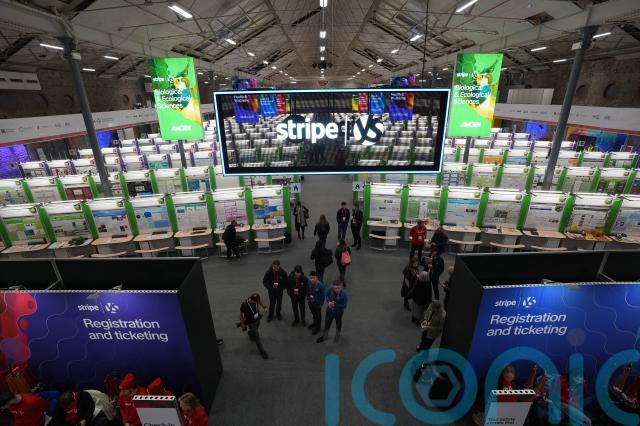
This years main sponsor is Stripe, which has taken over from BT Ireland after 25 years.
Stripe, founded by Irish brothers and former YSTE entrants Patrick and John Collison, will sponsor the exhibition under a five-year agreement.
Patrick Collison won the competition in 2005.
Addressing the opening ceremony remotely after his flight to Dublin was grounded due to snow, he said the event had changed his life, adding: “It is a huge honour to be here.
🎥 Watch the video to see how we manufactured the trophies for the 2026 Stripe Young Scientist & Technology Exhibition.
Leveraging cutting-edge L-PBF #AdditiveManufacturing technology. pic.twitter.com/jIeDwVZrCJ
— Croom Medical (@croom_medical) December 12, 2025
“The Young Scientist was a huge event and huge presence in my life – and in John’s.
“School is great, but it is a prescribed set of train tracks and it is hard to do something wholly unorthodox.
“The Young Scientist was the first time I felt I had the chance to do something of my own volition just for its own sake and for to have other people take it seriously.”
Mr Collison said teenagers can “chart their own direction” and “do real important things”.
The tech firm, which operates a dual headquarters in Dublin and San Francisco, offers programmable financial services for millions of businesses to accept payments.
Nearly a quarter of the projects use or examine artificial intelligence, while environment and climate-related projects also feature heavily this year.
Other entrants looked at behavioural science, health and wellbeing, and mathematics.
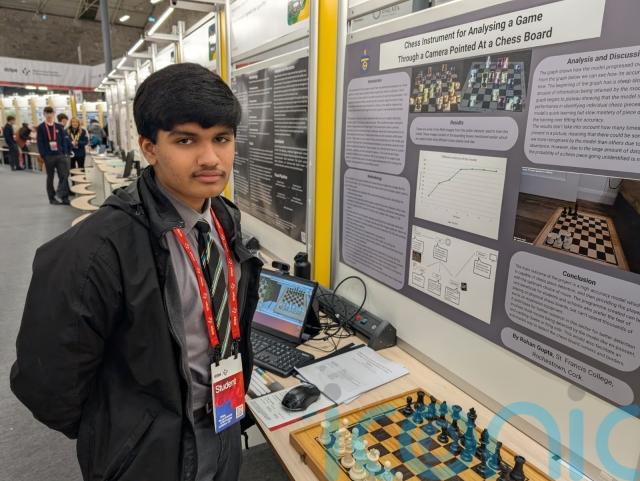
Rohan Gupta, from St Francis College in Rochestown, Co Cork, designed an instrument that can analyse the state of a chess game through a camera.
He says his system, which took six months to design, has benefits for people who prefer the feel of physical chess boards or cannot afford more expensive equipment.
“This improves accessibility for people and tournaments and school clubs who cannot afford to spend thousands of euro.”
Alex O’Connor, from CBS The Green in Co Kerry, designed an AI-powered system that he thinks could help combat the invasive Asian hornet species threatening Ireland’s native bees.

It uses a 3D-printed mount carrying a sensor and lasers which can differentiate between Irish pollinators and the invasive hornets.
It then disrupts the flying of the Asian hornets by firing a laser into its eyes.
Fifteen-year-old disability campaigner Cara Darmody entered with a project examining misconceptions and misinformation about autism diagnoses.
Cara gained national prominence with her campaign on the shortcomings in the assessment of needs system.

Subscribe or register today to discover more from DonegalLive.ie
Buy the e-paper of the Donegal Democrat, Donegal People's Press, Donegal Post and Inish Times here for instant access to Donegal's premier news titles.
Keep up with the latest news from Donegal with our daily newsletter featuring the most important stories of the day delivered to your inbox every evening at 5pm.

This publication supports the work of the Press Council of Ireland and Office of the Press Ombudsman, and our staff operate within the Code of Practice of the Press Council. You can obtain a copy of the Code, or contact the Council, at www.presscouncil.ie, Lo-call 1800 208 080 or email: info@presscouncil.ie.