
Garda Gráinne McLoone and Garda Patrick Kelly accompany Michael Maloney ahead of the court sitting
Search


07 Jan 2026

Please allow ads as they help fund our trusted local news content.
Kindly add us to your ad blocker whitelist.
If you want further access to Ireland's best local journalism, consider contributing and/or subscribing to our free daily Newsletter .
Support our mission and join our community now.
To continue reading this article, you can subscribe for as little as €0.50 per week which will also give you access to all of our premium content and archived articles!
Alternatively, you can pay €0.50 per article, capped at €1 per day.
Thank you for supporting Ireland's best local journalism!

LIMERICK woman Olivia Humphreys has been named the Irish National Winner of the James Dyson Award 2024 with her invention Athena.
A former Crescent College Comprehensive student, Olivia impressed the judging panel with her creation, winning €5,800 from the James Dyson Foundation.
Athena is a portable, thermoelectric, battery-operated scalp cooling device for people undergoing chemotherapy treatment.
The invention aims to offer a cost-effective hospital standard device that gives control to a patient in a time of little control.
The estimated cost for Athena would be around €1000, according to Olivia, compared to current industry scalp cooling machines which come in at around €40,000 or more.
Scalp cooling is intended to help prevent hair loss, known as chemotherapy-induced alopecia.
It works by limiting blood flow to the scalp, and is done by applying cold temperatures to the scalp during chemotherapy treatment, reducing the amount of the treatment that reaches the head, protecting hair follicles from the chemo drugs.
There are currently only 8 machines in Irish hospitals nationwide to cater for this treatment.
READ MORE: Limerick City and County Council shortlisted for Local Authority of the Year
The 24-year-old former Crescent College Comprehensive student witnessed how upsetting it is for patients who face losing their hair during chemotherapy when her mother went through the treatment in 2019.
She noticed the shortage of scalp-cooling machines aimed to minimise hair loss in the hospital her mother was in, as well as how limited the existing solutions were, inspiring her to reimagine the way scalp-cooling can be done.
Current products are heavy duty hospital-only machines which cannot be moved easily, and require the patient to arrive 30 minutes early and stay for 90 minutes after infusion for pre and post scalp cooling.
With Athena, patients can manage this aspect of treatment themselves and seamlessly integrate into an infusion appointment with no extra time or attention required, using this device from the comfort of their own homes.
Athena works by utilising low-cost thermoelectric semiconductors called peltiers to cool a tank of water, which circulates cold water around the head.
Weighing around 3kg, Athena is more portable than the current leading products on the market, which use refrigeration technology requiring constant plugged in power.
Athena consists of a carry case and a cooling helmet and, at full battery power, can run for 3.5 hours, allowing the patient to commute to and from hospital while cooling.
A recent Product Design and Technology graduate of the University of Limerick, Olivia worked on the project during her final year of college.
She explained: “I decided to build a working prototype to test the capabilities of the Peltier semiconductors. Using a Peltier computer cooling fan system, a diaphragm pump, my mum's old suitcase, and my dad's plane battery, I was able to create a strong proof of concept to gather valuable feedback to develop the concept”.
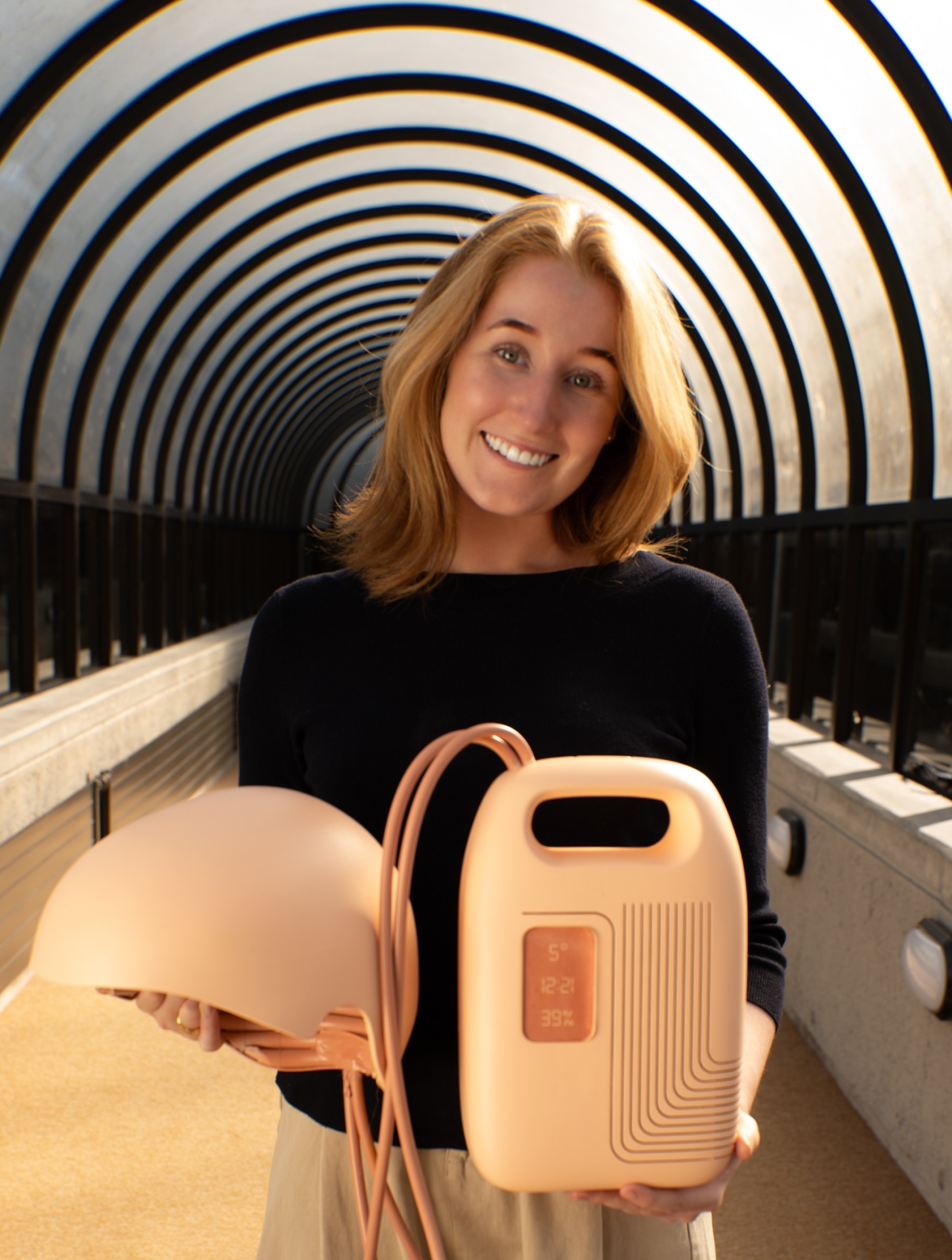
“Following this, I focused on the product's form, creating cardboard and foam models and determining functionality aspects and touchpoints to ensure the best user experience. Ultimately, I arrived at my final model, Athena, which was crafted using SolidWorks 3D CAD modelling,” she continued.
She added: “To elevate Athena to the next level, extensive research and development is required. While working on this project, I have been fortunate to network with Luminate Medical, a company in Galway, Ireland, dedicated to building a better future for cancer care.
“They have extended an internship offer to me as a research and development engineer. I have accepted and am very eager to apply the insights gained from my own research and development to contribute to their mission.”
Lead design engineer at Dyson James Gilchrist who was part of the judging panel, said: “The genius of Athena isn’t just in increasing access; it’s in taking the patient out of the clinic. Instead of spending an extra two hours in the treatment centre, Athena allows patients to precool their scalp on the way there and continue the cooling process post-treatment in the comfort of their own home. That’s not just a win for patients but also for clinics, enabling them to treat more patients each day.”
He explained: “Olivia impressed us with her first prototype, a 'cut and shut' computer cooling fan and diaphragm pump built into her mum’s old suitcase. Once that proved the concept, she went on to develop a high-fidelity prototype, leveraging recent innovations in battery-powered coolers”.
Athena will now progress to the international stage of the James Dyson Award and Olivia will aim to commercialise this product by producing a fully functional, technologically integrated prototype.

Subscribe or register today to discover more from DonegalLive.ie
Buy the e-paper of the Donegal Democrat, Donegal People's Press, Donegal Post and Inish Times here for instant access to Donegal's premier news titles.
Keep up with the latest news from Donegal with our daily newsletter featuring the most important stories of the day delivered to your inbox every evening at 5pm.

This publication supports the work of the Press Council of Ireland and Office of the Press Ombudsman, and our staff operate within the Code of Practice of the Press Council. You can obtain a copy of the Code, or contact the Council, at www.presscouncil.ie, Lo-call 1800 208 080 or email: info@presscouncil.ie.