

‘All about inclusion and integration’: Social farming open day in Limerick

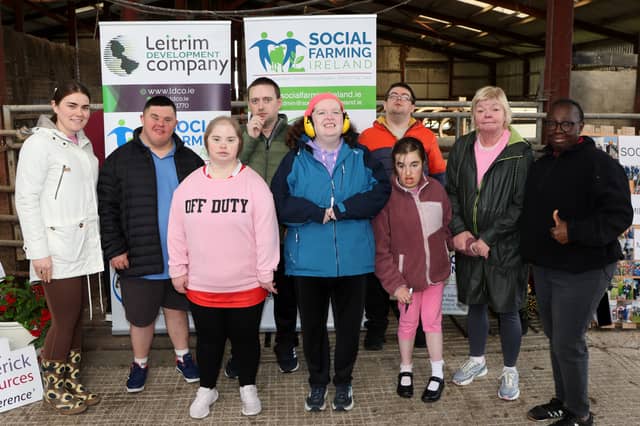

Agricultural event in Effin draws large attendance
VISITORS gathered at Kieran and Liz Fitzgerald's farm in Effin to experience first-hand the transformative impact of social farming.
The event, as part of Social Farming Awareness Week, offered an inspiring glimpse into how a working farm can become a place of inclusion, learning, friendship and personal growth.
The Fitzgeralds have been involved in social farming for a number of years and welcomed guests to share knowledge of social farming.
Their busy dairy farm provides participants with the opportunity to engage in meaningful farm activities throughout the year, from feeding and bedding calves in springtime to caring for hens, preparing calf pens and completing a variety of seasonal farm tasks.
For Liz, social farming is about far more than the work itself.
"It's farming with a social aspect. It's all about inclusion and integration," she explained.
Participants are encouraged to become part of the wider rural community. As well as helping on the farm, they enjoy visits to neighbours for a cup of tea, trips to the local mart and co-op, and creative activities such as arts and crafts. In true Limerick fashion, participants had recently been painting small wooden hurleys, proudly displaying their artistic talents.
One participant has been attending the farm for years and is “like part of the family”. Similar to many others involved in social farming, he has developed confidence, skills and strong connections through regular visits to the farm, taking part in ordinary farming activities.
Participants attend the farm once a week for a period of 12 weeks. Some are supported on a social farm for 12 weeks, and others are recurring participants on social farms for up to 24 or even 48 weeks in some cases, depending on the needs of the person.
Throughout the open day, visitors heard directly from participants about their favourite farm activities. Some spoke enthusiastically about caring for calves, while others proudly shared stories of having a cow of their own in the herd, having watched her develop from a young calf into a fully grown milking cow and taking great pride in caring for it over the years. The sense of achievement and enjoyment was evident.
The Fitzgeralds spoke warmly about what participants bring to the farm.
"The lads are a great addition. Farming can be isolating at times and we're delighted to be doing this. They keep us busy and they get to do things they normally wouldn't have the opportunity to do."
They also noted how social farming changes the way farmers view their own farms, recognising the valuable role farms can play in supporting people and strengthening rural communities.
Also sharing their experiences on the day were local Kildimo farmers Pat and Anne Liston, who highlighted the importance of dedicating time and attention to social farming participants.
Their farm activities include feeding and bedding calves, measuring milk for feeding, moving livestock, fencing, gathering vegetables from the garden and carrying out other practical farm tasks.
The Listons emphasised that even small jobs can have a significant impact.
"It's all about inclusion and helping people access meaningful farming activities."
Participants are encouraged to take ownership of projects. One example involved a picnic bench which participants painted together. The pride they felt in completing the project and seeing the finished result demonstrated the value of meaningful engagement and shared achievement.
A powerful contribution came from Eithne Kennedy, OT Manager Mid-West Adult Mental Health Services, a long-time advocate for social farming within the mental health services. Speaking about the benefits, she explained that social farming creates a partnership between participants, support staff and farmers.
"The person is the expert in their own experience and the farmer shares knowledge and skills. The message people receive is simple but powerful: you are able."
Eithne outlined how social farming supports the development of organisational skills, independence, confidence and hope. She described social farming as a valuable clinical intervention within mental health services and noted that progress is carefully measured through the structured programme and professional support from Social Farming Ireland.
Importantly, she highlighted how involvement in social farming can be a stepping stone to wider opportunities for a person in their own community. Some participants progress into volunteering, hobbies, training and employment after gaining confidence and experience on the farm.
One particularly moving example involved a 14-year-old young girl referred to social farming through Child and Adolescent Mental Health Services (CAMHS). Struggling with severe anxiety, social withdrawal and school attendance, she completed a social farming placement and experienced a remarkable turnaround.
Today, she has returned to school, is completing her Junior Certificate and hopes to pursue a career in social care. The story represents just one of thousands of positive outcomes being achieved through social farming programmes across Ireland.
Social Farming Awareness Week 2026, which ran from 1 to 7 October, saw social farms across Limerick, Mayo, Cavan, Cork, Waterford and Laois open their gates to the public. The initiative aimed to demonstrate how social farming supports wellbeing, confidence building, skills development and social inclusion while also providing farmers with an opportunity to contribute to their communities.
The open day at Fitzgerald's Farm in Effin illustrated these benefits vividly. Whether participants were feeding calves, painting crafts, helping with farm maintenance or simply sharing a cup of tea and chatting, the message was clear: social farming creates opportunities, builds confidence and fosters meaningful connections.
Social Farming Ireland was established in 2016 with core funding from the Department of Agriculture, Food and the Marine (DAFM) by Leitrim Development Company, in collaboration regionally with three other local development companies, South West Mayo Development Company in the West, Waterford LEADER Partnership in the South East and West Limerick Resources in the Mid West. Locally, Leanne Higgins is the Social Farming Ireland Regional Coordinator in the Mid West Region working at West Limerick Resources, and Eilis Cooney is the Social Farming Ireland South Development Manager LDCo.
The network now includes over 200 trained social farmers and engages with service providers, families and advocates across disability, mental health, social care, education, justice, and community development sectors. The network recruits and trains farmers, supports placements, ensures governance and safeguarding, and develops and promotes social farming nationally and internationally.
Social Farming offers people who are socially, physically, mentally or intellectually disadvantaged the opportunity to spend time on a family farm in a healthy, supportive and inclusive environment.
The farm is not a specialised treatment farm; rather it remains a typical working farm where people in need of support can benefit from relationship building through farm activities in a nonclinical environment.
As Social Farming Ireland the National Network continues to grow, advocates believe continued investment and support are essential. With demand increasing and evidence demonstrating positive outcomes across mental health, disability and community services, social farming is becoming an increasingly important part of Ireland's rural and social landscape.
Through simple farm activities, welcoming communities and supportive relationships, social farming is helping people discover new skills, new confidence and new possibilities for the future.
If you are interested in learning more about social farming as a farmer, participant, advocate or service provider, please contact them via our website www.socialfarmingireland.ie or call (071) 964 1772