the Banner Plaza at Junction 12 on the M18 near Ennis
Search


03 Apr 2026

Please allow ads as they help fund our trusted local news content.
Kindly add us to your ad blocker whitelist.
If you want further access to Ireland's best local journalism, consider contributing and/or subscribing to our free daily Newsletter .
Support our mission and join our community now.
To continue reading this article, you can subscribe for as little as €0.50 per week which will also give you access to all of our premium content and archived articles!
Alternatively, you can pay €0.50 per article, capped at €1 per day.
Thank you for supporting Ireland's best local journalism!

As this final video and blog brings our ‘Heroes of Hope’ Jubilee Year series to its close, it did so on a day rich with meaning.
The Jubilee Year of Hope, proclaimed by Pope Francis in May 2024 and formally opened on Christmas Eve that year, concluded with the closing of the Holy Door in St Peter’s Basilica in Rome on January 6 — the Feast of the Epiphany.
In Ireland, this day is also known as Nollaig na mBan, ‘Women’s Christmas’, a gentle, celebratory marker of the end of the Christmas season, when women traditionally gather, rest and rejoice together.
It is entirely fitting, then, that our final exemplar of hope is a woman whose story reveals hope not as spectacle or heroism, but as quiet presence, faithful love and shared humanity.
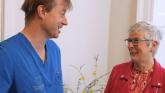
Noirin Lynch, a former member of our Limerick Diocesan team and now director of the FCJ Spirituality House - Teach Spioradálta at Spanish Point, is clear that she does not see herself as a hero at all. But the reason why she committed to telling her story is because of the heroes all around her.
READ MORE: Charity where the stranger is met with an open door in Limerick
Her journey began in May 2024 with the discovery of cancer — a moment that instantly alters the landscape of a person’s life. Surgery, months of chemotherapy and radiation, and the slow, ongoing work of healing followed. Yet when Noirin speaks, the centre of gravity of her story is not illness, nor even recovery. It is people.
Over and over again, she returns to kindness: the attentiveness of medical staff; the quiet faithfulness of those who drove her to every appointment; the family and colleagues who cleaned, cooked and cared; the friends who sat beside her in cafés so she would never feel alone; the friend who sent a poem every week, like a steady candle lit against the dark. These, Noirin insists, are the heroes.
Sometimes we may question where is God? But how appropriate it is that on this day, the feast of the Epiphany, known in the East as ‘Theophany’ – meaning a visible manifestation to humankind of God – that we have this image from Noirin. As she puts it, the people who carried her were “Christ” to her. People who made God tangible and present when words alone would not suffice.
Her faith reflection is striking in its simplicity and depth, “The wound is in the present, the healing is in the present, and God is in the present,” she states.
It is a spirituality of the next ten minutes, not the next ten years. In this, Noirin gives us a profoundly Epiphany-shaped hope. The Feast of the Epiphany celebrates God revealed not in power or certainty, but in vulnerability — a child, a manger, a journey made by strangers who followed a fragile light. Hope, like God, is often revealed obliquely, through people who simply show up.
This final story in what has been a memorable series that gave great witness to the Jubilee Year of Hope invites us also to look back over the year-long Jubilee journey.
The late Pope Francis called this Jubilee at a time when clouds already hung heavy over the world — clouds that have not lifted. In some respects, they hover even more. War and violence scar whole regions; social injustice persists; many people carry private griefs, anxieties and loneliness unseen by others.
And yet, as this series has shown again and again, hope is not extinguished by darkness. It is discovered within it.
We saw that from the very first video, with Limerick Suicide Watch — volunteers who walk the banks of the Shannon at night, attentive to those standing at the edge of despair, willing to offer the most powerful message of all: you are not alone. Their hope is not loud, but it saves lives.
We heard it in the story of Fr Tim Collins, who spoke honestly of a time when he turned his back on God and faith, drifting into a hollow existence shaped by a life that was flat and disconnection. His story is one of rescue and calling — of a God who waited patiently and who still waits, he believes, for others simply to ask for him.
Hope took another form in the life and work of Sr Helen Culhane, founder of the Children’s Grief Centre, which was our third episode in this series. Responding to a quiet but insistent call from God, she created a place where children, whose lives have been upended by death or separation, can grieve safely, honestly and with support. Today, the centre serves 80 children each week. Hope here is gentle, structured and deeply compassionate.
And in the penultimate video, John Lannon of Doras reminded us that hope must also be social and systemic. Doras, the Irish word for ‘door’, is offers an open door, a true Irish welcome to people fleeing trauma, war and persecution. Its hope lies in the daily acts of assistance and access to services. It is hope that insists that a welcome is always there.
Noirin Lynch’s story brings all of this home. Her experience gently but firmly challenges a narrative we sometimes repeat — even in Church circles — that the world, as she says, has “gone to pot.” Her lived experience says otherwise. She encountered generosity, presence, faithfulness and love in abundance. Not abstractly, but concretely. Not in theory, but in flesh and blood.
As this Jubilee Year of Hope draws to a close on Epiphany — on Women’s Christmas — we do not close the door on hope.
If anything, our series reminds us that we just need to seek ‘hope’ and it will be found. With this series, hope was to be found in many places: on riverbanks, in a faith journey, in grief work, in welcome centres, on cold nights, in cups of tea, in tents, in waiting rooms and in people’s generosity.
And, indeed, in the willingness of the Limerick Leader to carry these stories of hope, online and in print. For this we are truly grateful. Spreading hope is, indeed, a great public service.
Thankfully, as this series illustrates, hope is not rare. It is so present. It is revealed when people choose to show up for one another.
That is the Epiphany we are left with. And it is more than enough to carry us forward because hope is always there.

Subscribe or register today to discover more from DonegalLive.ie
Buy the e-paper of the Donegal Democrat, Donegal People's Press, Donegal Post and Inish Times here for instant access to Donegal's premier news titles.
Keep up with the latest news from Donegal with our daily newsletter featuring the most important stories of the day delivered to your inbox every evening at 5pm.

This publication supports the work of the Press Council of Ireland and Office of the Press Ombudsman, and our staff operate within the Code of Practice of the Press Council. You can obtain a copy of the Code, or contact the Council, at www.presscouncil.ie, Lo-call 1800 208 080 or email: info@presscouncil.ie.