

Sexual violence bill is for 'the next little girl, the next survivor' - Limerick woman says

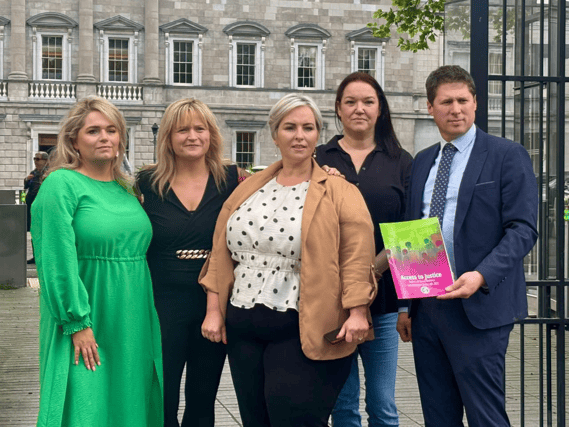

The sexual violence civil protection order will protect abuse survivors in the future, Limerick survivor Leona O’Callaghan says
A BILL which would allow a court to impose a restraining order on a person convicted of a sexual violence crime, will now move onto the next stage.
The bill will now move onto the report stage before being presented to the Seanad.
This afternoon, Tuesday, November 3, survivors of sexual violence were at a Dáil committee meeting in favour of the bill, which would stop perpetrators from approaching their victim.
They included Limerick survivors Leona O’Callaghan of The Haven Hub Trauma Support Group who had a successful prosecution against Patrick ‘Whacker’ O’Dea in 2018, Shaneda Daly who brought a prosecution against her father Harry Daly for sexual abuse as a child and Sonya Stokes who had a prosecution against her uncle Joseph Hogan.
Sinn Féin TD Matt Carthy said that only a small fraction of people who are abused get justice, but that for those who go through the traumatic process, "they need to be heard."
Advocate Leona O’Callaghan said that procedures currently in place for survivors after a perpetrator is released are “broken and inadequate.”
“They place the burden right back onto the victim. They demand that we wait for the perpetrator to terrify us all over again before the law will lift a finger.
“They force us to drag them back to court ourselves, instead of letting the trial be the end of it.
“The time frame given is often limited to a small number of years, this does not take the individual’s fear and experience into account or reflect the lifelong reality of trauma.
“You cannot understand the need for protection until you understand the fear that drives it,” she said.
She explained that when she was raped in a dark graveyard as a child, she would try to look away and try to “survive by looking anywhere else.”
“I read the names carved into headstones to distract from the agony. I stared at the clouds, wishing I was one of the birds flying overhead - praying to be anywhere on earth except trapped under him.
“But if he caught me looking away, he would force my face back. He ordered me to look straight into his eyes.
“He wanted to see the pain he was inflicting. He wanted an audience to his cruelty. He wanted me fully conscious for all of it.
“I was forced to look into those eyes over fifty times as a child. Afterwards, I would go home and sit in a basin of ice, terrified of the bleeding and swelling, praying my parents wouldn’t notice, pretending I was fine.
“Those eyes didn’t stay in the graveyard. They followed me everywhere.
“I faced them when I went to the gardaí and had to describe every single detail out loud. I faced them when the legal process pushed me past breaking point.
“I seen them when I closed my eyes to sleep even when they weren’t there. I faced them in the bedroom during two marriages, because even in moments of love, his face and his eyes were burned into my memory to ruin any hope I had of intimacy.”
She said that the only time she felt safe was when he was sentenced to 17 years in prison.
“For the first time in my life, I felt safe. Because he was locked in a concrete cell, far away from me, and far away from other kids, kids that are your children, your nieces, and your nephews. That break gave me the room to heal.
“For twelve years, I was able to return to work, I started and now run a mental health charity, I graduated with a degree, I could be the mother to my kids that they deserved. Most importantly I could finally close my own eyes and sleep without scanning every corner for his evil presence and memory.”
Ms O’Callaghan added: “Now the clock has run down. In three years, he walks free.
“And I am telling you plainly: my nervous system cannot endure seeing those eyes again. I cannot walk the same streets as him. I will break, not out of weakness, but out of justified, rational terror.
“I don’t want to know where he is, but I need to know where he isn’t. I need to know he’s not beside me, behind me, in the queue next to me in my local shop, behind me on a dark road, on a bench in the same park as my grandchild. After what he put me through, is that not a fair thing to ask?”
She said that unless the law changes, she will be forced to leave Ireland for her own safety.
“I will have to pack a bag, leave the job and charity I love, leave my children, my grandchildren, and my elderly parents, and go abroad without telling anyone where I am. I put myself in the firing line to take a predator off the streets, and my reward from the justice system is exile.
“It may already be too late for me. But it is not too late for the next survivor.
“The next little girl making up her mind whether she can survive reporting her abuser is watching this room today. She needs to know that if she faces him in court, the judge can order an automatic, permanent exclusion zone that keeps him away from her life forever. “She needs to know she won’t spend the rest of her life turning corners, terrified of catching his eye.
“Put party politics aside. Do the right thing for me, for Shaneda, for Sonya, and for every survivor who has carried this weight alone. Support this bill. Make common sense common law.”