

Jury begins deliberations in trial of Limerick man accused of laneway murder
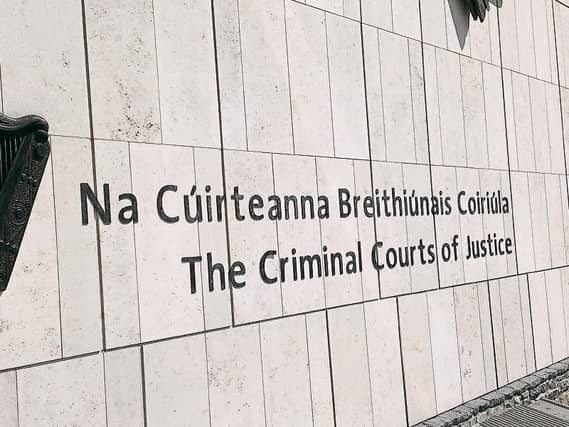

The jury in the trial of a Limerick man, who took a knife to an ‘annoying’ Romanian man’s house and stabbed him to death, has been told that it can acquit him of murder if satisfied that the Limerick man acted in self defence.
It can also reach a verdict of manslaughter if convinced that the force used was excessive or the death was an accident.
Mr Justice Michael White was explaining the law to the jury yesterday this Tuesday in the 60-year-old’s murder trial at the Central Criminal Court.
Desmond Coyle, who is originally from Garryowen but who has an address at Davis Street, Limerick is charged with murdering Calo Carpaci on May 24, 2017. He has pleaded not guilty to the 58-year-old’s murder at Roche’s Row, where Mr Carpaci had lived.
The accused explained to gardai that he had gone to the Romanian man’s house with a knife to ‘stop him demanding money’ off him. He said that, if the deceased had ‘stopped f***ing annoying me, it wouldn’t have happened’.
Anthony Sammon SC, prosecuting, last week urged the jury to convict Mr Coyle, who had ‘trespassed’ into Mr Carpaci’s house with the knife that killed him, before confessing: “I stabbed him in the chest.”
Mark Nicholas SC argued that his client had gone there to confront him and did not have the intention for murder when he grappled with the deceased.
In his charge to the jurors, Mr Justice White told them that there were three possible verdicts open to them: guilty, not guilty, or not guilty of murder but guilty of manslaughter.
He explained that there were various types of manslaughter. “Manslaughter is a very wide type of offence. It can move from gross negligence at the lower end to very close to murder,” he said.
He said that one type of involuntary manslaughter was an unlawful and dangerous act that led to death, but where the accused did not intend to kill or cause serious injury.
“The act must have been both unlawful and dangerous and the accused must have intended it,” he explained.
“A more unlikely scenario is gross negligence manslaughter,” he said.
He explained that this was where an accused carried out a lawful act, but with gross negligence, and a high degree of risk of substantial injury.
“In this particular trial, on the account given by Mr Coyle, he has made the case that his actions were not deliberate, it was possibly an accident,” he said.
The judge also said that self defence had been raised as a possible defence in the case. He explained that this could be a complete defence, resulting in an acquittal. It could also be a partial defence, resulting in a verdict of manslaughter if excessive force was used.
He told the jurors that their verdict must be unanimous before sending them away to begin deliberations.
They spent less than an hour considering their verdict before retiring for the night and will resume deliberations on Wednesday morning.