

New history book remembers Con Colbert and Ireland’s other forgotten young warriors

Boyhood’s Fire is a new history of Na Fianna Éireann by award-winning history author James Durney
On August 16, 1909 the Irish National Boy Scouts (Na Fianna Éireann) was formed by two nationalist activists, Bulmer Hobson and Countess Constance Markievicz, as an alternative to directly counteract the influence of Sir Robert Baden-Powell’s Boy Scout movement in Ireland. Na Fianna Éireann membership was open to male children from eight years old to 18, regardless of class, creed or political party.
While the Fianna was initially for boys, some girls did join, although, by 1922, membership had been limited to boys aged between 12 and 18. Each member was given the title Fian (warrior) and the boys were offered a combination of military training, outdoor pursuits and Irish cultural activities. The aim of the semi-military movement was to train the youth of Ireland for armed conflict against British rule.
Within weeks, a growing number of boys were meeting at Camden Street Hall every Tuesday and Thursday evening for military drill. Limerick born Con Colbert, who had enrolled at the inaugural meeting, was the first instructor in elementary drill formations for the first troop, or branch. The boys also received drill instruction from Seán Kavanagh, an ex-member of the British Army. Regular activities included weekly meetings, route marches, camping trips and céilí dances. Within a year there were five sluaighte (troops) in Dublin and branches in Waterford, Belfast and Clonmel; the first Ard-Fheis (high assembly) had also been held. Subsequently, Na Fianna Éireann developed branches in 19 counties in Ireland as well as branches in Glasgow and Liverpool.
The Irish Volunteers were formed in Dublin in November 1913. Young men who were in the Fianna and had gained experience in the organisation were subsequently appointed as Volunteer officers. The expertise of the Fianna in military training was much sought after by the Volunteers, as many had several years’ training in military drill, signalling and weapons handling.
Through an arms committee, the Irish Volunteers succeeded in purchasing 1,500 Mauser rifles with 49,000 rounds of ammunition from a German arms dealer. One of those involved in the committee, Erskine Childers, agreed to transport most of the cargo onboard his yacht, the Asgard, to Howth harbour, where Volunteers would be on hand on July 26 to accept a shipment of 900 rifles and 29,000 rounds of ammunition. Na Fianna played a significant role in unloading and transporting the arms and ammunition to safety and worked well in conjunction with the Volunteers at the Howth gun-running. Now armed, the Republican movement was ready for rebellion.
On April 24, 1916, 1,600 men, women and children assembled in Dublin and proclaimed an Irish Republic. They occupied a series of locations around the city that had been chosen for their strategic importance. Dozens of the rebels were youthful members of Na Fianna Éireann. During Easter Week the Fianna took part in all the major fighting in the city and four of them were killed in action – including 14-year-old Seán Healy, the youngest rebel to die in the Easter Rising.
Throughout the Irish revolution of 1916-23, Na Fianna Éireann recruited, trained and nurtured a core of young republican activists who made an essential contribution to the Irish Republican Army’s (IRA’s) armed struggle. The Fianna embraced the Irish revolution, the fight for freedom that had eluded previous generations. Many of the leading members of the IRA in the War of Independence had been experienced members of the Fianna, including Paddy O’Daly, Liam Mellows and Roger McCorley.
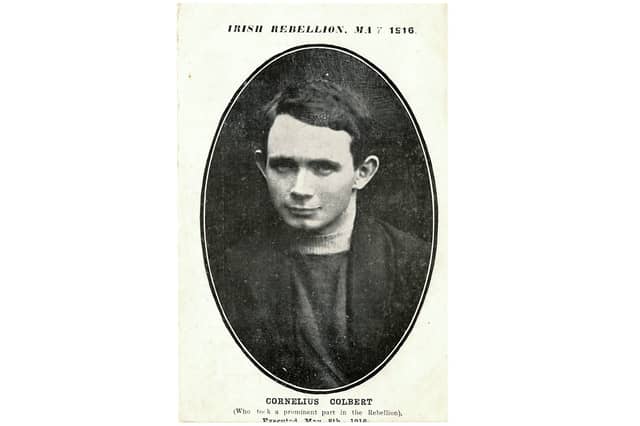
Six members of Na Fianna Éireann from Limerick lost their lives from 1913-23 including the first Fian to die William Davern, a 13-year-old who drowned in an incident, on July 2, 1913. One of the leading Fianna of the 1916 Rising, captain Con Colbert (27), Limerick, was executed by firing squad, in the yard of Kilmainham Gaol, on May 8, 1916. Con Colbert, born in Newcastle West, had enrolled at the inaugural meeting of Na Fianna at Dublin’s Camden Street in 1909, and was the first instructor in elementary drill formations for the first troop, or branch, of the organisation. A month later Colbert was elected joint treasurer of the organisation. The following year after Colbert had given the students at the Irish-speaking St Enda’s School for Boys in Rathfarnham their first lesson in military drill, the school’s founder, Patrick Pearse formed a branch of Na Fianna with Pearse as commander-in-chief. Colbert served at Jacob’s biscuit factory during the Rising and was, along with Seán Heuston, both twenty-five, the two youngest rebels to be executed. Their killings caused widespread anger and revulsion throughout the country.
Weapons handling for boys so young was dangerous and two youthful revolutionaries Thomas Slattery (17), James Street, Limerick, and captain Patrick Tubridy (19), died in accidental shootings during the pre-Civil War period in April and May 1922. Within two weeks of the outbreak of the Civil War another young Fianna member Michael Minihan (19), Limerick, lost his life. He was mortally wounded, on July 15, 1922, as National Army forces began their attempt to take the city from anti-Treaty republicans. The Ordnance Barracks in Upper William Street, was one of the many positions in the city held by republicans, which included Strand Barracks, New Barracks and Castle Barracks, all former British Army installations. Michael Minihan from Sandmall, Limerick, was a member of Fianna Éireann acting as a messenger for the IRA in the Ordnance Barracks, and he was shot and mortally wounded at the Telephone Exchange Building in nearby Cecil Street. He subsequently died in St Joseph’s Hospital from gunshot wounds to the abdomen.
Conditions in the jails and internment camps run by the Provisional Government were not even on par with those of the British during the War of Independence and were responsible for the deaths of far more republicans than those of the ‘ould enemy’. Illness after incarceration was a common reason for a premature death. Fianna lieutenant Martin Considine, of Castle Street, Limerick, died from pneumonia and tuberculosis on December 6, 1923, in the City Home Hospital. He had been released from captivity due to his ill health just months earlier, on September 26.
Considine served with the mid-Limerick Brigade Fianna from 1918 onwards, carrying out scout and dispatch duties, and also took part in the fighting in Limerick during the early weeks of the Civil War. He was arrested on October 25, 1922 and subsequently interned in Limerick Gaol and Hare Park Camp, where he possibly contracted tuberculosis.
He spent four weeks in hospital prior to his death.