

Blind Ukrainian couple seek peace in Limerick after fleeing war at home

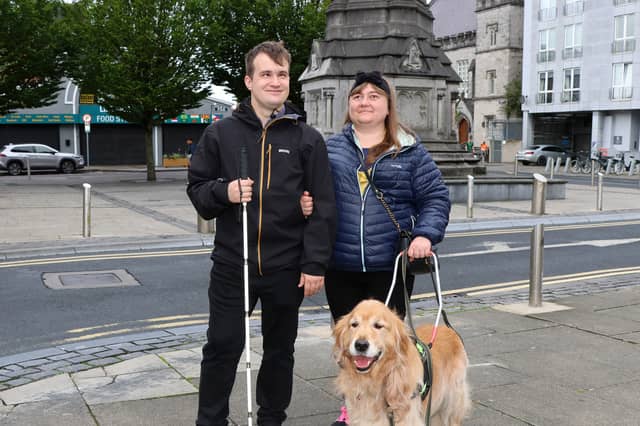

While they are safe from the bombs and bullets of their homeland, Pavlo Romaniuk and Yuliia Nahaiets have faced fresh challenges in Limerick
“I CAN evict you in three hours.”
The words Yuliia Nahaiets says she was told by her landlady in Limerick, after she and her partner Pavlo Rumaniuk had finally found somewhere they hoped they could call home.
"My legs completely gave out. The bed was right behind me, so I just sank onto it, tears silently streaming down my face. I gripped my mattress with all my strength, trying to force a smile, but I couldn't."
Pavlo, 31, and Yuliia, 30, both from Odessa in Ukraine's south-west, are almost completely blind.
They came to Ireland with their guide dog, Amigo, one of only two guide dogs in Ukraine — but getting to that Limerick doorstep took years, a scam, a wartime apartment they called a "stone tomb," and a year in a refugee centre where work was scarce.
Attacks from Russia left things Ukrainians take for granted — electricity, energy, water — cut off. A lack of water, and the need to ration every drop, led to myriad hygiene issues, with Pavlo describing his apartment in Odessa as "something resembling a stone tomb."
"Interestingly, we discovered through trial and error that two litres of water is more than enough to wash oneself from head to toe," he added.
For the blind community, power outages are even more horrendous, with noisy generators kicking in to provide backup. Yuliia explained that they cannot see car drivers — with the generators in full flow meaning they cannot hear them either.
It was against this backdrop that they took the decision to leave their home and family, and come to Ireland, with Amigo.
Yuliia had already tried to leave her homeland once, but she fell victim to a scam from people she described as "devoid of any principles." Then red tape surrounding Amigo's transfer led to a significant further delay before they could finally get out.
When they did reach Dublin, they were moved to Lisdoonvarna in Clare — one of the few places able to take them, due to having a guide dog in tow. Work was scarce there, so after about a year they looked to larger settlements, hoping to find employment. Pavlo used to work as a telemarketer in Ukraine, while Yuliia worked at a school for the blind.
They found very few landlords willing to accept them, even with the bonus of an €800 subsidy from the State, a measure put in place to encourage the housing of Ukrainian refugees.
By September 2024, "fortune finally smiled upon us," Pavlo wrote, when they came across a letting in Limerick, a city in which they felt confident of finding work.
"The owners seemed like a very pleasant couple, and a bus route ran right through the area. They took a liking to Amigo, since they had dogs of their own, and the presence of children and other tenants didn't bother us," he added.
The reality soon soured. At the accommodation, they claimed heating was rationed to just one hour a day — 30 minutes in the morning and evening.
"The absolute worst part was the realisation that we have no control over our own life. We could regulate neither the heating nor the water," said Yuliia.
Worse was to come, the couple said, as their landlords demanded money above and beyond the monthly Government support provided to persuade people to house Ukrainian refugees. Yuliia said they were asked for a deposit of €800, and warned that if they did not hand over the money, they would be evicted.
It was then, she said, that her landlady told her: "I can evict you in three hours" — the moment that put Yuliia on the edge of her bed, gripping the mattress, unable to force the smile she was reaching for.
Rescued by friends from that situation, the couple were later placed in an accommodation centre for refugees in Limerick. It was here, they said, that they faced the most hostility — not from Irish landlords this time, but from other Ukrainian refugees. Some were jealous of their English language skills, while others took exception to their companion Amigo.
Since then, life has settled into something more like survival than stability. Pavlo and Yuliia have engaged with job coaches but hit brick walls, which they believe is down to their disability.
In fact, it is their ageing guide dog — who has a heart condition — that has become their biggest financial burden. Amigo's most basic needs cost €120 a month: €80 for his food, €20 for Simparica medication, and another €20 for his blood pressure medication.
"It was vital to us that Amigo wouldn't feel the impact of this crisis, living on just €38 a week per person. Pavlo and I knew we would cut back, but Amigo would have everything he needed."
Their legal footing in Ireland remains uncertain year to year.
That’s because the right of Ukrainian people to stay here is renewed from year to year. There is a provision for people not dependent on the State — those who have jobs — that they will not be evicted from Ireland.
People who are (dependent), are only protected until 2027, and on a yearly basis thereafter.
The couple are being supported by Limerick Volunteer Centre, who have been trying for a number of months to get them placed in a setting.
Paul Moriarty of the centre said they are hoping to match them to a company which might be able to give them a volunteering opportunity - or even better a job.
There is very little left for them at home, either. Pavlo says friends have disowned them, deeming them "traitors" to Ukraine for leaving during the war. But Yuliia's dream was never an extraordinary one.
"Seven or eight years ago, while studying romance and Germanic philology, I dreamed of living in an English-speaking country to practise the language in a native environment. My dream came true, but in a twisted form and at a devastating price."
Now, she says, she wants nothing more than a quiet life.
"I simply have no strength left to worry. I just want a peaceful life; the most boring life on earth, as long as it's quiet. Each year, it becomes harder to dream. And I am only 30 years old."
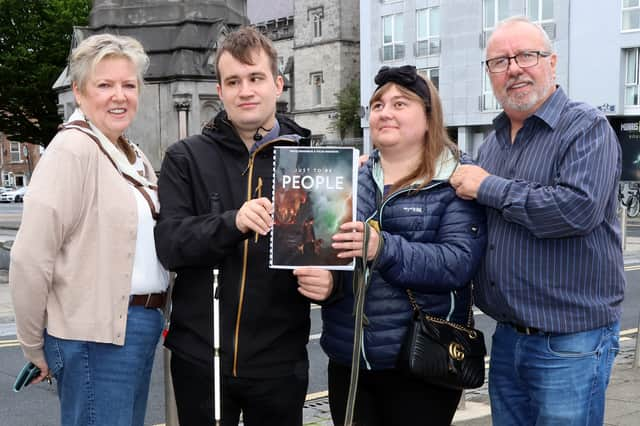
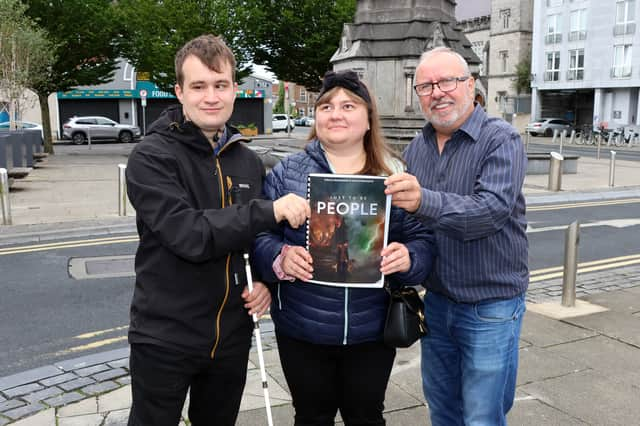
Pavlo and Yuliia have shared their full story alongside Amigo in their book, 'Just to Be People,' with each chapter written by either of them, offering an insight into what war means for people with severe disabilities — and showing that while they are safe from the bombs and bullets of their homeland, life for refugees in Ireland is far from straightforward.
If you can help, call Limerick Volunteer Centre at 087-7387481.
Read the book for free online: https://sites.google.com/view/just-to-be-people