

Limerick woman at heart of bid to reform ‘secret’ family courts

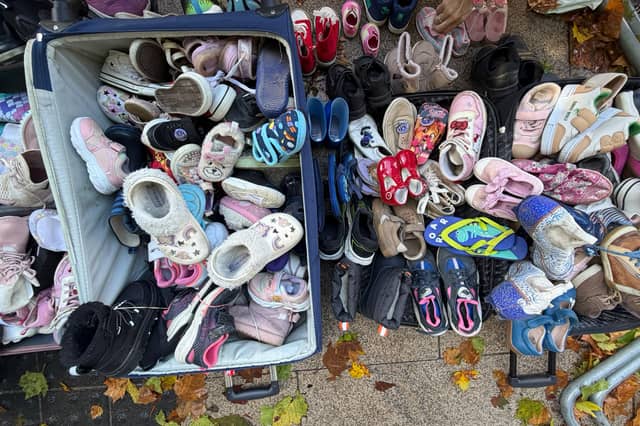

Trish Horrigan-Lehane joined people across Ireland last month symbolically placing tiny children’s shoes at courthouses nationwide to represent the childhoods that campaigners believe are being lost or damaged as a result of decisions made in Ireland’s Family Courts
FOR many people in Limerick and nationwide, the workings of the family court system remain shrouded in mystery.
Cases are almost always held in camera – behind closed doors – with strict restrictions on media reporting to protect the families involved. Details of individual cases are rarely publicised.
Now, a Limerick woman is part of ‘Walk in Our Shoes’, a national campaign urging reform of a system which rules on disputes involving parents and children. Trish Horrigan-Lehane, of Ennis Road, joined people across Ireland last month in organising one-mile walks, during which participants symbolically placed tiny children’s shoes at courthouses nationwide.
In Limerick, the walk ended at Merchant’s Quay. The shoes represent what the childhood campaigners believe are being lost or damaged as a result of family court decisions.
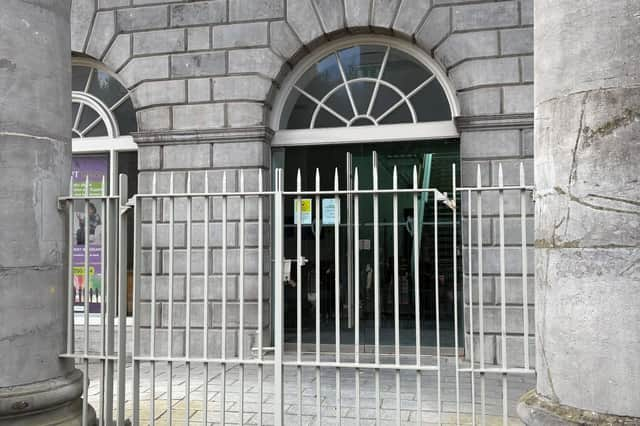
Family courts deal with matters including divorce, separation, child custody and access, maintenance, guardianship and domestic violence orders. Many cases are heard in the District Court, while divorce and judicial separation generally fall under the Circuit Court. Some matters are dealt with by the High Court.
Ms Horrigan-Lehane, the Limerick co-ordinator of the campaign, wants children’s voices to be heard and taken seriously in decisions affecting their families.
Weeks after the walk, which began on Bedford Row, she still gets emotional thinking about it.
“I’m still tearing up thinking about it, I’m sorry,” she admits. “It was a very special moment. It represented the fight that every parent had because there are little people behind every story. To see all of those shoes, you think of your own children [...] But you forget there are thousands of them. If 20,000 people on average are getting married in this country every year, and 3,500 on average are getting divorced, how many children are behind that?”
The campaign continued with representatives from around the country gathering at Dáil Éireann days later.
Meath woman Anna Kavanagh, the campaign’s founder and convenor, was inspired by 91-year-old Lelia Doolan, a former RTÉ producer and veteran activist who walked approximately 220km from Shannon Airport to Leinster House earlier this year to protest against the use of Shannon by US military aircraft and defend Irish neutrality.
“The people going through the family courts, and some close members of their families know how dysfunctional the system is. But Middle Ireland, as I call it, hasn’t got a clue,” she said.#
A social media appeal prompted a huge response, with Ms Horrigan-Lehane becoming one of 26 co-ordinators, representing each county.
A mother with a background in psychology, she believes reform in Limerick must extend to the physical layout of Merchant’s Quay courthouse, where the majority of local family law cases are heard.
“The corridor is a narrow space, because they’ve put these pods in. The pods are supposed to be there for meetings with clients. They are immediately taken up with solicitors. There’s nowhere private for clients to speak with their solicitors. Often, in cases where there is abuse, you have to walk past the person you’re up against and their legal team. It’s a very tense area to be in,” explains Ms Horrigan-Lehane.
“It’s intimidating, and just one strand of the stress caused – and that’s just outside the door.”
Private solicitors can be “unbelievably expensive”, she says, while consultations for those relying on legal aid can be “very short”.
The District and Circuit Courts hear dozens of cases daily, leaving Ms Horrigan-Lehane concerned about whether complex hearings receive sufficient attention.
“Is there case law being referred to, and are those judgements being published? Do we have a transparent and trauma informed system,” she asks.
A report has recommended that at least 10% to 15% of family law judgments be published in anonymised form, prioritising cases of “major legal significance”.
She questions whether this is happening and who decides what constitutes “major legal significance”.
Convenor Anna Kavanagh’s appeal inspired Ms Horrigan-Lehane to join the campaign.
“When the call went out, it was something which really aligned with me. I cannot speak for other women because everybody’s experiences are different. If I see something wrong, you don’t just sit back and say nothing, because the next generation will be affected.
“You have children at different ages, and their voices depending on their age and maturity must be taken into consideration. As they get older, their voice must carry weight.
“At the end of the day, we don’t want to have another generation of children who are simply not listened to, simply not believed. Their experiences be it abuse, or witnessing domestic violence – we don’t want another generation of children coming out, and saying nobody listened to them.”
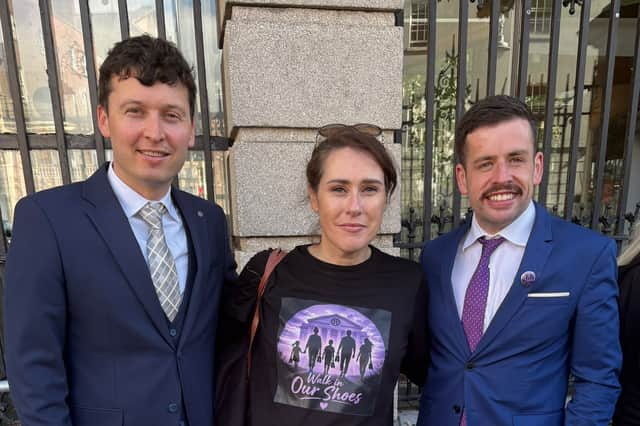
Ms Horrigan-Lehane says the campaign has received limited support from Limerick’s political community, singling out Labour TD Conor Sheehan and Social Democrats councillor Elisa O’Donovan for highlighting its concerns.
Mr Sheehan said: “We need to shine a light on this. It’s in bad need of reform. I’ve met a lot of women impacted by this. There doesn’t seem to be a lot of consistency in how judgements are made.” He said the in camera rule, rather than protecting children, has “created a culture of blanket secrecy, which prevents public scrutiny”.