

Then & Now: Exploring the Kennedy connections to Limerick
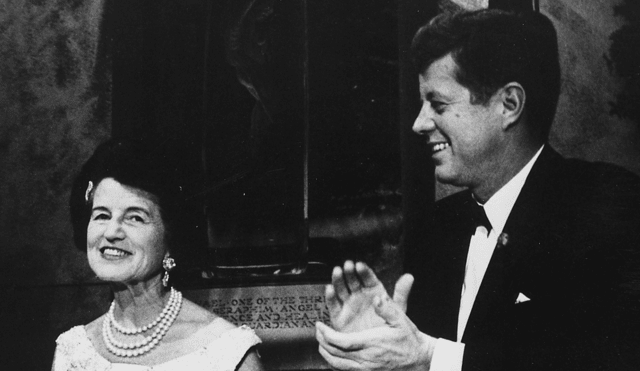

THE ROSE Fitzgerald Kennedy Autumn School takes place in Bruff from Friday, October 28 to Sunday 30. A very interesting programme has been put in place with talks, walks and other events to suit all ages and tastes and it will be a celebration of Irish culture and its Diaspora. All the local groups have come together for the inaugural school which may be the first of its kind to be held in Limerick. It will honour Rose Fitzgerald Kennedy, the mother of President John F. Her grandparents Mary Anne Fitzgerald and Thomas Fitzgerald from the Palatine Road, Bruff and Michael Hannon from Lough Gur.
Kerry Kennedy, the daughter of Bobby, and Thomas Fitzgerald, a maternal first cousin of JFK will speak about the Fitzgerald legacy and the family's journey from Bruff to Boston and the significance of the F in JFK. For more information on the weekend, the number to call is 087 8301574. In times past the Kennedy family knew more about their Irish connection to Wexford and Limerick, than the people of Bruff and Limerick knew of their connection to them. In recent years, research has yielded lots of information. The Thomas Fitzgerald Centre, formerly the old courthouse, houses a photographic exhibition of the president's visit to Ireland in 1963, the visit of Caroline Kennedy (his daughter) to Bruff in 2013, as well as photographs of various members of the Fitzgerald Kennedy Family.
As well as the Kennedy connection, Bruff boasts some fascinating historical buildings and features. The historical aspects of Bruff can be discovered on the self guided audio walking tour that leads you around the town, informing you in its history. The Lough Gur area is a rich archaeological and historical site where you will find ancient burial mounds, megalithic tombs, forts and standing stones scattered around its mysterious landscape. Lough Gur Heritage Centre interactive multimedia exhibition brings to life over 6,000 years of archaeology and history starting during the Mesolithic (Middle Stone Age) Era and progressing until the 19th century (1800s).
Sean Wall is one of several local men who died during the War of Independence, and they are commemorated with a monument in the town. He was born in Ardykeohane, Bruff in 1888 and educated in St Munchin's College Limerick. He left school in 1904 after the early death of his parents and went into business.
His contracting firm Wall and Forde erected many new creameries throughout the county. With Nicholas O'Dwyer he invented new cheese making machinery, manufactured milk powder, and advocated the use of the newly designed milking apparatus, which he demonstrated and introduced to the county.
He was appointed to the East Limerick Brigade when it was formed in 1918 and organised five self sufficient battalions. He also formed an active service guerrilla unit which operated effectively independent of his local commanders and was known as the Circus. Sean participated in the attack on Kilmallock Barracks on May 28, 1920. On June 25, he was elected Chairman of Limerick's first Republican County Council. He was killed in action at Annacarty, Co Tipperary on May 6, 1921, when the RIC attacked his crew. He was interred in the Republican plot, Mount St Lawrence Cemetery Limerick. Around 1944, a committee of former IRA members set about erecting the memorial, which was finally unveiled in October 1952 by President Sean T. O'Kelly. The model for the statue was Joe Shanahan, Bruff/New York.
The F.C.J. (Faithful Companions of Jesus) Sisters came to Bruff in 1856, following an invitation from Dean Cussen. The six F.C.J. sisters set up a girls’ primary and secondary school (Ard Scoil Mhuire). Up until its closure in June 2012, over 200 Sisters had worked in the secondary school. The first two premises they occupied in Bruff were, Dawns, Crawford Lane and the Medical Hall, Main Street. The current convent is a very impressive building, adjacent to the primary and secondary schools.
Bruff appears to have been an important place in early times. During the reign of Henry 111 ( 1216-1272) the Lacy family built a castle here and another one a short distance from it.
They subsequently became tributaries of the Fitzgeralds and held the castle under the Prince of Desmond, in all whose misfortunes they largely participated, especially during the reign of Elizabeth. On April 4, 1600, Piers Lacy, Governor of Bruff Castle, was defeated in battle by troops of the Kilmallock garrison, under the command of Captain Slingsby, and lost 300 of his men. On April 18, 1600, the Lord President seized Bruff Castle and installed a garrison of 140 men. Piers Lacy was later killed during a minor skirmish on the banks of the northern Black Water on July 28, 1641. During his lifetime he had been a noted horseman, an ally of the northern princes, O'Neill and O'Donnell and had been dubbed the 'arch rebel of Munster' by his enemies. In 1641 Bruff was the scene of a bloody battle between the English forces and the insurgents, in which the latter were victorious, and committed acts of great cruelty.
Bruff Castle was located on the north bank of the river, west of the bridge. In 1790 Sir Henry Hartstonge owned most of Bruff while Lord Carbury (Evans) owned the land on the other side of a stream called Cavouri or Morning Star. Bruff then contained two excellent inns, a Catholic church and a Protestant one. Sir Henry Hartstonge once lived in the castle, but by 1840 it was badly ruined, and the ground floor of the remaining structure was inhabited by a poor family from the town. Another old building known as the Court was hard to identify in 1840, because it was thatched with straw and its features were closed up with stonework. This had been situated north -east of the castle.
Bruff and the surrounding areas are full of history which we will return to at a future date. Old Irish Ways Museum, Courthouse, Fairgreens, RIC Barracks, Old village pump, Flax Mill, The Carbery Mausoleum, De Lacy Towerhouse and the Thomas Fitzgerald story linking the Kennedy family. It is well served with lots of active sports clubs, historical and community groups. This Autumn School could be the start of something major which will further the towns aims and ambitions. Enjoy the weekend.