

IF WALLS COULD TALK: A forgotten merchant dynasty of Limerick
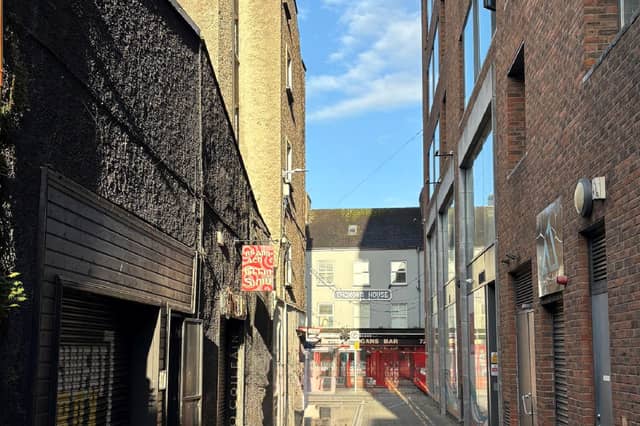

Corner of Limerick city was once home to well-known merchants
Tucked away between Catherine Street and Anne Street, Erson’s Lane preserves the memory of a once-prominent Limerick merchant family whose name has all but disappeared from the city. While the lane itself is a modest roadway today, nineteenth-century trade directories and newspapers reveal that the Ersons were involved in a wide range of commercial activities and occupied a comfortable position within Limerick society. Members of the Erson family were admitted as Freemen of Limerick in 1821, demonstrating their standing within the city.
The family’s earliest known business endeavours date to the opening years of the nineteenth century. In 1811, Edward Erson operated a wholesale and retail grocery warehouse on Mary Street. By the mid-1820s, William Erson had emerged as one of the family’s leading figures. Pigot’s Directory of 1824 listed him as a China, glass and earthenware dealer at 25 George Street (now O’Connell Street), while contemporary trade directories also placed him among the city’s respectable merchant class. Such businesses supplied everything from everyday household crockery to imported decorative wares, making them an essential part of commercial life.
The Ersons were also active in charitable affairs. In 1826, Paul Erson contributed 10s to a subscription for the Limerick Hibernian School Society, one of several charitable educational bodies operating in the city before the introduction of the National School system. Supported mainly by Protestant clergy, merchants, and local gentry, it provided elementary education for poor children while promoting Bible reading and evangelical religious instruction. The following year, in 1827, Paul Erson married Anna, daughter of Thomas Ledger Esq. of Glenview House, a large mansion in Cahernarry, Co. Limerick.
The family’s commercial activities continued to expand. Paul Erson was listed as a baker and miller on Catherine Street and held milling concerns in Askeaton, Co. Limerick during the 1830s. At this stage, the Erson family briefly resided at Rock View House, Askeaton. In the city, they lived on William Street. By October 1839, however, Paul Erson was listed as an insolvent debtor in the Limerick Chronicle, suggesting that commercial fortunes could rise and fall rapidly during this period. However, other members of the family enjoyed the rewards of success, including William Erson, who lived at Landscape House, Clonlara, Co. Clare, a substantial residence overlooking the Shannon Estuary. The marriages of William’s daughters further demonstrate the family’s rising social standing. Julia Erson married Westropp Smith of Newgrove House, Co. Tipperary, in 1837, while Anna Maria Erson married John Richard Ashton of Rose Cottage, Co. Offaly, in 1838.
Although Erson’s Lane appears unnamed on the first edition six-inch Ordnance Survey map surveyed in the late 1830s, it subsequently became known as Erson’s Lane, almost certainly reflecting William Erson’s business interests in the area. However, he was not to remain in Limerick and in the early 1840s, William Erson moved to Upper Mountpleasant Avenue, Ranelagh, Dublin. Burial records reveal where members of the family spent their later years. Anna Ledger Erson of Albany Road, Camberwell, London, died 15 February 1862 and was recorded as the widow of the late Paul Erson. Other family members listed in the burial records include Edward Henry Erson, aged 21, of Lower Gardiner Street, Dublin, who died in September 1852 and was described as the son of Paul Erson of Rockview, Askeaton; Paul Dunne Erson of Rockview, Askeaton, who died in April 1850; and George Erson of Dublin, who died in May 1852. Also recorded is Julia Anna Erson of Upper Rathmines, who died in August 1854 and was described as the daughter of Paul Erson of Rock Mills, Askeaton, Co. Limerick. John Frewen Erson of Rathmines, Dublin, who died in 1859, was identified as the son of William Erson, merchant, formerly of Limerick.
The Erson family’s connection with the civic life of Limerick continued in the mid-nineteenth century. William Ledger Erson was admitted to the ‘freedom and franchise of the City of Limerick’ in November 1849, while members of the family were again recorded as Freemen of Limerick in the same year. Despite their departure to Dublin, the family’s name remained attached to the locality. By 1856, Erson’s Lane was home to significant commercial premises, including a corn store capable of holding 6,000 barrels of grain and equipped with a kiln. Advertised in the Limerick Chronicle during a local court case, the property illustrates the lane’s importance within Limerick’s nineteenth-century grain and provisioning trade. The reference also confirms Erson’s Lane as a named roadway by 1856. The Erson name continued to appear in Limerick records during the later nineteenth century.
References to Erson’s Lane continued well into the twentieth century. A 1907 auction notice described investment properties situated at the corner of Catherine Street and Erson’s Lane, producing an annual rental income of £61 10s. A 1965 advertisement for Patrick O’Malley, hardware merchant, listed his business address as ‘5 Catherine Street, Erson’s Lane and Augustinian Lane, Limerick’. In April 1996, Howard Erson of Auckland, New Zealand returned to Limerick to visit places associated with his ancestors. The same year, Michael J. O’Malley, proprietor of O.M. Hire Centre on Catherine Street, commissioned and erected a name plaque for Erson’s Lane.
Today, little remains to connect Erson’s Lane with the family that gave it its name. No grand buildings survive to tell their story and the businesses they operated have long since vanished. Yet the lane itself acts as a small monument to a merchant dynasty that once traded in everything from groceries and coal to China and glassware. The lane is still home to businesses including noted sign writer, Tom Collins. Like so many of Limerick’s streets and lanes, it serves as a reminder that behind obscure place names lie generations of forgotten people whose enterprises helped shape the economic and social life of the city.