

New exhibition celebrates links between Limerick and Germany

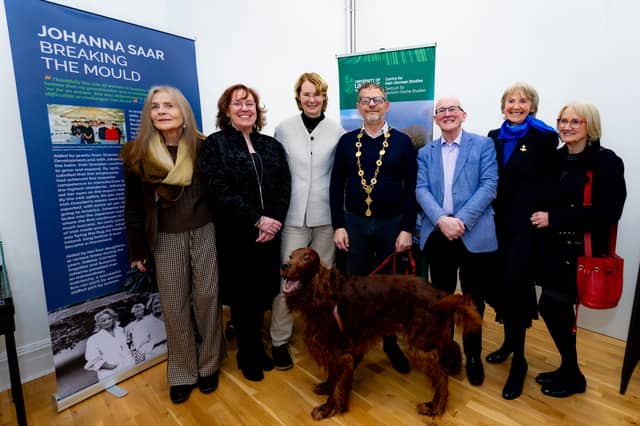

Links between Limerick and Germany forged over 300 years ago are being celebrated in a new exhibition at Limerick Musuem
MORE than 300 years of shared history between Limerick and Germany are being celebrated in a new exhibition at Limerick Museum as part of Ireland’s Presidency of the Council of the European Union.
The exhibition traces the people, industries and partnerships that have shaped relations from the arrival of the Palatines in West Limerick to major industrial links including Ardnacrusha, Irish Dresden and Krups.
The story begins with the Palatines, Lutheran Protestant refugees who arrived in Ireland in 1709. Around 130 families settled on the lands of Sir Thomas Southwell near Rathkeale, in Ballingrane, Killeheen and Courtmatrix. Their farming traditions, surnames and cultural heritage remain an important part of West Limerick today.
The exhibition also explores three major Irish German connections of the 20th century.
In the 1920s, German company Siemens-Schuckert played a central role in constructing the Shannon Hydroelectric Scheme at Ardnacrusha, one of the most ambitious infrastructure projects undertaken by the new Irish State. At its peak, construction employed more than 5,000 Irish and German workers.
In 1962, the Saar family established what became Irish Dresden in Dromcollogher.
The company developed an international reputation for its distinctive porcelain and became a successful, predominantly female-run business whose pieces have been presented to presidents, international dignitaries and cultural figures.
In 1964, German appliance manufacturer Krups opened its Roxboro factory in Limerick City. Employment eventually peaked at almost 1,400 people, making the factory a major part of Limerick’s industrial and social life until its closure in 1999.
The exhibition launch also marked the presentation of ‘Voices of Krups’, an audio-visual oral history project developed by the centre for Irish German studies at the University of Limerick. Through recordings with former employees, the project captures personal memories of working at the landmark Roxboro factory and preserves an important chapter of Limerick’s industrial heritage.
Mayor of Limerick John Moran said: “From the Palatine families who made their home in West Limerick to the workers who built Ardnacrusha and staffed Krups, Limerick and Germany have been closely linked for more than 300 years.
“Our pairing with Germany during Ireland’s EU Presidency is a fitting way to honour that history. It shows that Europe is not a distant idea for Limerick; it lives in our surnames, our workplaces and our memories. This is a story we have written gemeinsam - together.”
Priomh Chomhairleoir, Councillor Tom Ruddle added: “The story of Limerick’s connection with Germany is ultimately a story about people and the communities they built. The Palatine legacy remains very much alive in West Limerick today, while generations of families across the city and county also have strong memories of places such as Krups and Irish Dresden. “This exhibition brings those stories together and ensures an important part of Limerick’s heritage is celebrated.”
Director General of Limerick City and County Council, Dr Pat Daly on the importance of the link between Limerick and Germany: “German connections have played an important role in Limerick’s economic and industrial development, from the landmark Shannon Hydroelectric Scheme at Ardnacrusha to companies such as Krups and Irish Dresden.
“These partnerships brought employment, expertise and opportunity to the region and helped shape Limerick’s development over many decades.”
Dr Matthew Potter, curator of Limerick Museum, said that this is the 133rd exhibition in the old Franciscan Friary since Limerick Museum moved there in 2017.
“We are also delighted to launch Voices of Krups, which brings the history of one of Limerick’s most important employers to life through the memories and experiences of the people who worked there.
“I am particularly grateful to our museum colleagues and to the Irish Palatine Association, Irish Dresden and the centre for Irish German studies for their invaluable contributions to this exhibition.”
The exhibition highlights how generations of migration, industry, innovation and cultural exchange have created enduring ties between Limerick and Germany, making the country's selection as Limerick's partner nation during Ireland's EU Presidency a particularly fitting one.
Limerick and Germany 1709-2026 is on display at Limerick Museum until December 31 2026.
Limerick Museum is located in the Old Franciscan Friary on Henry Street. It is open Monday to Friday, 10am-5pm, and Saturday, 10am-1pm and 2pm-5pm and admission is free.