

Limerick Astronomy Club: The Sun
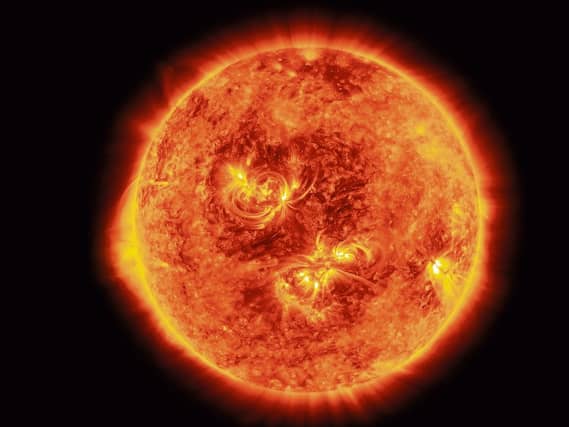

I am going to start with a warning, never look directly at the sun with the naked eye through binoculars/telescopes or you will instantly and permanently damage your eyes. Please ensure that you use a solar filter on your equipment. The sun can be very interesting to look at safely; especially when something really cool is happening such as an eclipse or the Mercury Transit.
Our position at 52 degrees North provides a constant reminder of the Sun’s importance to life on earth: its seasonal coming and going determines the cycle of life. Its energy, mostly as heat, drives the global weather systems, constantly witnessed in our own changeable weather. The Sun determines the time of day, the time of the year, when to plant and harvest. Religious festivals were based on its seasonal coming and going. It was frequently worshipped as a god. It so dazzled us in every way, that serious scientific study of the Sun only began relatively recently. The source of the Sun’s massive energy output was a complete mystery until Einstein formulated his Theory of Relativity a century ago. Only recently has the 11-year cycle of its sunspots been carefully studied, because of the associated risks to astronauts and satellite communications.
It is a boiling, seething sphere of gases, mostly hydrogen, about 1.6 million km in diameter and like any boiling fluid, it occasionally belches and splutters hot fluid from its surface, some falling back, more escaping into space. The stuff that escapes is extremely energetic plasma and if it comes our way, within a few days of leaving the Sun, it can cause magnificent auroral displays at night. It is these Coronal Mass Ejections (CMEs) that can cause much damage to satellites and astronauts exposed to them above the Earth’s protective magnetic field. Even electronic equipment on the ground isn’t immune to damage from these energetic visitors from the Sun.
The source of the Sun’s energy is in its core. Here, hydrogen experiences enormous gravitational compression and is heated to over 15 million degrees Kelvin.
These extreme conditions are needed to initiate and sustain the thermonuclear fusion reactions in the Sun’s core. In this process, hydrogen is changed into helium, and the by-product is a massive output of energy across the electro-magnetic spectrum: the best known to us are light, heat and ultraviolet rays.
Limerick Astronomy Club
email limerickastronomyclub @gmail.com