

Man jailed over €21m cocaine seizure in Limerick withdraws appeal
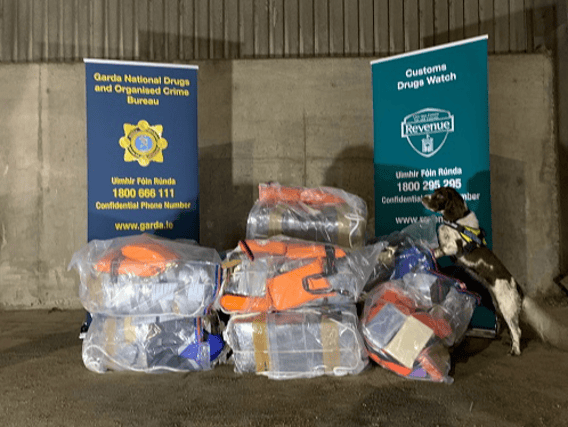

Nikola Penchev had admitted his part in a Brazilian drug cartel's operation to smuggle €21 million of cocaine into Ireland
A MAN who was jailed for ten years in relation to a multimillion drugs seizure in west Limerick has withdrawn his appeal against the severity of the sentence.
Nikola Penchev, who had admitted his part in a Brazilian drug cartel's operation to smuggle €21 million of cocaine into Ireland, confirmed his decision after a judge warned him that the Court of Appeal has the power to set its own headline sentence.
Barristers representing the 35-year-old argued that as the appellant was not involved in any of the preplanning in the operation, the sentencing judge in his case erred in principle by not considering imposing a sentence below the minimum mandatory sentence of ten years.
However, the Court of Appeal ruled that it was very hard to see how anything less than ten years would be justified, adding that if it found there had been an error in sentencing, the court would set its own headline sentence.
Penchev, of Veliki, Preslav, Bulgaria, pleaded guilty at Limerick Circuit Criminal Court to possessing cocaine worth over €21.6 million, for sale or supply, at Foynes Port, County Limerick, on December 19, 2023.
Penchev, a maritime engineer, was arrested after Revenue officials and gardaí, acting on a tip off that the drugs were onboard the MV Verila, searched the vessel and found the cocaine haul tied together in several bales attached to a transmitter.
The ship initially set sail from Hamilton in Canada to Santos in Brazil, before reverting to Hamilton and eventually onto Foynes. Penchev had initially been unaware it was carrying cocaine.
While on route to Foynes Port, Penchev was recruited by another of the ship’s crew, his friend and fellow Bulgarian national, Kamen Petkov (37), to help him dump the cocaine in parcels at Glin, a few kilometres out from Foynes.
Petkov, who was jailed for ten years after he also pleaded guilty to having the cocaine haul for sale or supply, was responsible for loading the drugs on board, tying the drug parcels together with life jackets and attaching a transmitter. He kept in regular contact with the cartel via a satellite phone and a navigation app “OsmAnd”.
Petkov and Penchev ended up not dumping the drugs overboard at Glin as nobody appeared to be there to collect the packages when the ship arrived at the drop-off point.
Penchev told gardaí Petkov told him he would pay him €10,000 for helping him, but he did not receive any of the money.
In launching an appeal against sentence on Monday, counsel for Penchev, Giollaíosa Ó Lideadha SC, argued that the trial judge did not consider the power to go below the minimum mandatory sentence.
He pointed out that the trial judge had fixed a headline sentence of 15 years for the co-accused, before fixing a headline sentence of 13 years for Penchev, but the judge ruled that he could not go below a final sentence of ten years.
Mr Ó Lideadha said that the State had accepted a plea to section 15A on the basis that Penchev was not involved in any of the preplanning in the operation, as he was only recruited while at sea.
Mr Justice John Edwards said that he could see nothing that suggested Penchev deserved to get very much more than the three-year reduction he got with the mitigation available.
Mr Ó Lideadha said that Penchev had identified his co-accused as the leader of the operation, which was a very significant step to take, as he was assisting the investigation by directing the gardaí in the right direction. He said the appellant was just one of a large number of people on board the ship, adding that Penchev also offered the gardaí the PIN to his phone.
Counsel said this was exceptional assistance to the prosecution, which was not properly considered by the trial judge. He also said that Penchev was told by his co-accused that "the value of the drugs was greater than his own life".
Ms Justice Kennedy pointed out that Penchev became aware of the cocaine before the ship docked in Canada, so he could have left the ship and said there was something going on that he was not happy with.
Mr Justice Edwards said that, given the value of the drugs, another judge might have set a headline sentence of more than 13 years. He said that if they ruled there had been an error in sentencing, the Court of Appeal would set its own headline sentence.
"I question whether 13 years as the headline was correct in this case," he said.
Mr Justice Patrick McCarthy said that, as Penchev was involved in bringing in €21 million of cocaine as part of an international operation, it was very hard to see how anything less than ten years would be justified.
After consulting with his client, Mr Ó Lideadha asked the court for leave to withdraw the appeal.
Mr Justice Edwards, on behalf of the three-judge court, granted leave for the appeal to be withdrawn.