

If walls could talk: Ice skating fun through the years in Loughmore

RECENTLY rediscovered 8mm home cine film footage recorded in the winter of 1961 has brought back fond memories of ice-skating at Limerick’s Loughmore Common.
Located about three miles west of the city, Loughmore often froze over and became an outdoor ice rink for locals to enjoy.
The footage, recorded by Aubrey Hodkinson, shows his wife Juliet and their children and friends spinning, skating, spiralling and twirling across a vast sheet of ice.
The grainy footage is punctuated by flashes of vibrant reds and browns as eager skaters resplendent in fur coats and winter suits dash across the screen, all the while dodging whizzing snowballs.
For generations, the frozen lake played host to countless locals who braved the ice and grappled with balance, perfected their style and gracefully glided across the glassy surface.
For most it was a pleasant way to wile away a few hours; for others, perhaps more youthful participants, it was a competitive sport.
Apart from a venue for ice-skating, Loughmore was associated with military field days and manoeuvres, for instance in June 1788, the Prince of Wales’s regiment met there to prepare for a review.
Loughmore was also the site of a racecourse in the early years of the nineteenth century, the Limerick Chronicle reporting in May 1838 that ‘five horses started at Loughmore races yesterday, and the prize was contested by Mr Sheehy’s Cossack and Mr Scott’s Irishman.
The race course is clearly visible on the First Edition OS map (1840). It is not known when the races ceased at Loughmore although the course was suggested for the Limerick Cattle Show in 1846.
As early as 1847, Lord Clarina called for the lands to be drained; this feat did not come to pass until the late 1990s.
During a cold snap in 1841, accounts in local newspapers described ‘hundreds of people out skating and enjoying the amusements at Loughmore, and above the canal.’
On February 22, 1843, the Chronicle described the atmosphere at the lake as brilliant, noting that ‘the frost continues with little interruption.
On the night of Wednesday, the mercury fell in a north east aspect to 11 degrees below freezing; on Thursday night it went below 8 degrees; and last night 6 degrees below zero. There are several skaters on the ice at Loughmore, and the canal fields.’
In winter 1849, a hard frost again afforded opportunities to the ‘lovers of skating.’ According to the Limerick Reporter ‘parties of ladies and gentlemen indulged in that healthy recreation at Corbally, Loughmore, and the canal. Some of our fair townswomen evinced a great deal of skill and grace, in their torturous moments over the slippery surface of the ice.’
The paper also reported that ‘the good people of Limerick were astonished to behold a Russian sleigh sweeping through its snow-sheeted streets.
The Siberian sleigh belonged to Captain De Blaquier of the 1st Dragoons, who kindly volunteered to amuse the natives by this unusual exhibition.’
The next big freeze occurred in late December 1860 when reports of snowfalls up to nine inches in depth were widely reported. Loughmore once again was filled with hundreds of citizens who rushed to take advantage of the icy conditions.
The Chronicle described how they ‘committed themselves to the sliding element with all imaginable courage, and not a few with great temerity: falls were numerous; and some performed somersaults equal to any professional acrobat, others suffered injury, but no limbs broken; and all enjoyed heartily the sport which was thus provided.
One or two suffered dangerous falls and a policeman was knocked unconscious by a severe fall.’ In 1864, several skaters ‘got a good dipping in the cold water’ as mischief makers had cut away the ice from the bank!
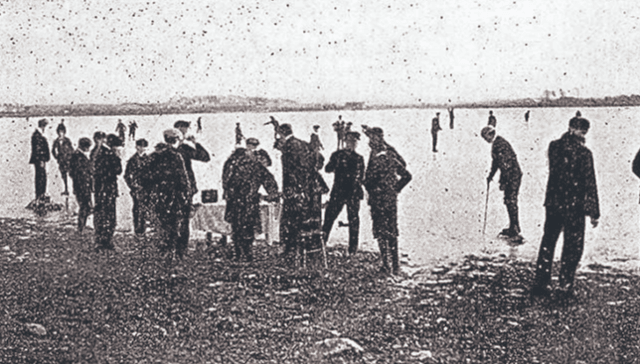
The students from the nearby Mungret College also used the lake to swim in the summer and skate in the winter.
Over the years, the college’s annual journal featured several accounts, photographs and anecdotes about Loughmore including the following lines ‘on every side stretched away the never-ending crowd of merry skaters, dashing in and out, up and down, with all the recklessness of youth.’
Images from the annuals show groups of teachers huddled together drinking coffee and watching on as students from the college played hockey on the frozen lake.
Tragically, James Campbell (17), a student at Mungret was drowned at the lake on Saturday May 5, 1928. He was a native of Swinford, Co Mayo.
Skates had to be procured in order to take part in the activity, and many sets were sold by well-known Limerick shops such as Nestor’s (Est. 1817) of O’Connell Street.
A pair of skates cost approximately 12/6, and were usually made from polished steel. Recalling fond memories of his time on the lake, Frank Larkin stated ‘I used ice skates belonging to my mother strapped to rugby boots with studs removed. The big freeze of winter 1961 lasted for over a month.
I still have the skates, but last used them about 20 years ago on Lough Gur.’
As the short winter days turned to evening, the issue of illumination was overcome by tractors and cars leaving their engines running and beaming their lights across the surface of the lake as it glistened in the night sky.
Thus, this much-loved winter theatre entered a new act and the crunch of ice, joyous laughter, occasional shriek, chatter and murmur continued until the last skater hung up their skates for the night, only to return to Loughmore the following morning at first light.