

Home of hurling: Has the oldest ever hurley been unearthed in Limerick?

Prof Aidan O’Sullivan, UCD School of Archaeology, and Cathy Moore, MA and Archaeological Wood Expert, describe a carved wooden object from Skehacreggaun, Mungret, dating to the early medieval period and wonder, is this an early Irish cammán?
THE people of early medieval Ireland, AD 400-1100, played a range of sports and recreational games (e.g. jumping, swimming, wrestling, horse-riding, javelin throwing etc), and especially stick-and-ball games.
Early medieval documentary sources describe in particular stick-and-ball games, using terms such as immáin (‘driving’), or áon líathróti (‘ball-driving’), which may be the same game using different words, or actually different games. It’s long been believed that these stick-and-ball games are ancestral to the modern Irish field sports of hurling and camogie, while recognising that these have been codified by the GAA and Camogie Association since the 19th century, and are still evolving today indeed. Modern historians of hurling have tended to meld different medieval sources together and make of them one game that would look to be hurling’s ancestor, and this may well be true. On the other hand, scholars like Dr Angela Gleason have suggested that we are looking at different ball games.
Our sources of knowledge about these early medieval stick-and-ball games include early Irish laws dated to the 7th to 8th centuries AD, sagas or narrative literature dated to between the 10th and the 14th century, and occasionally references in saints’ lives, of varying dates, as well as some intriguing material or archaeological evidence. It is apparent that these stick-and-ball games had teams, equipment, ways of scoring/winning, and that there could be feats of athletic achievement that were to be wondered at and praised.
The challenge for us – we are not an early medieval audience after all - is how to understand them. Firstly, these are fantastic stories so the unlikely feats of players might not be normal practices. Secondly, terms and phrases are used that would be easily understood by people in the 8th century, but are enigmatic to us. Think about how, if you didn’t know hurling/camogie, you’d be puzzled by the sentence; “Tony Kelly scooped up the ball at the edge of the square, and drove it into the roof of the net” (what does ‘square[ mean, or “drove it”? And ‘square’, what is that, and is it not a rectangle anyway? How can a net have a roof?)
But it is clear that early medieval people understood these games as being organised, with playing fields, rules of behaviour and types of equipment. They were played on legally recognised spaces for games such as the faitche (‘green’) or the cluichemag (‘games field’), or it seems on beaches sometimes. The idea that a distinct space was used is clear from the Old Irish law tract Cetharslicht Athgabála (‘Law of Distresses’) required that the “green be maintained in time of games” (cartad oenaigh .I..in aimsir cluthi). The 8th century Irish law tract Bretha Éitgid (‘Judgments of Inadvertence’), a law of accidents, states that anyone who causes injury or damage while striking ball on green is exempt from fines. Interestingly, however, spectators might be compensated for injuries sustained while watching games.
Our best descriptions of early Irish stick-and-ball games are the stories of the heroic boyhood deeds of Setanta/Cu Chulainn in the Táin Bó Cuailgne – preserved in early and late 12th century versions. Thus, O’Rahilly’s translation of the late 12th century version in the Book of Leinster, describes “He went on to the place of assembly in Emain where the youths were. There were thrice fifty youths lead by Follomain mac Conchobuir at their games on the green of Emain. The little boy went on to the playing field in their midst and caught the ball between his two legs when they cast it nor did he let it go higher than the top of his knee no go lower than his ankle, and he pressed it and held it close between his two legs, and not one of the youths managed to get a grasp or a stroke or a blow or a shot at it. And he carried the ball away from them over the goal.”
Annoyed, the boys “all attacked him together”. They cast their thrice fifty hurley-sticks (trí coíctu cammán) at the boy’s head. He lifted up his single play-thing stick (óenluirg n-ánuisa) and warded off the thrice fifty sticks. Then they cast the thrice fifty balls at the little boy. He raised his arms and his wrists and his palms and warded off the thrice fifty balls. They threw at him the thrice fifty top spears with sharpened butt. The boy lifted up his toy wooden shield and warded off the thrice fifty spears. Then he attacked them…”
The words used for the playing sticks then were the lorg áne (‘driving stick’), the cammán (literally, ‘little bent thing’), and a third word – the play-thing stick (óenluirg n-ánuisa). But again, we use the words ‘hurl’ or ‘hurley’ (a controversial issue in itself!) and ‘stick’ to refer to precisely the same thing. Indeed one of us remembers a tough club game in north Tipperary in 1985, when a spectator enthusiastically encouraged a player to “timber” his opponent. In the early medieval sources, the ball is most commonly called the líathroit. Clodagh Doyle and the National Museum of Ireland have radiocarbon dated hair hurling balls from across Ireland and have shown that they date back to the Middle Ages, to at least the 12th to 13th centuries AD.
There are also clues in early Irish texts for how the early medieval lorg áne (‘driving stick’) and cammán (‘little bent thing’) were used, accepting of course that these are often heroic tales describing remarkable feats. In the Táin, the sticks are clearly used to propel ball across field, and to occasionally lift and strike it into air (incidentally, on the lorg áne “driving stick” name you will often hear today at a hurling match a fan, frustrated at the short-passing tactics, shouting “drive it, will ye?!”)
The sticks were made of wood, either broad or narrow. It is apparent that playing sticks were regarded as personal property. In the Old Irish law tract Mell Bretha (‘Judgements of Games’) if a stick is stolen but is then returned to its owner, no penalty is applied. Some law texts provide more detail about the decoration of sticks. A later (11th/12th century AD) commentary on the law text Cáin Iarraith claims that the son of a king should have a cammán ornamented with silver, while the son of a lord should have stick ornamented by bronze. But these are the typical early Irish legal obsessions with status and property, and may not necessarily represent reality. In a Middle Irish tale in the Book of Leinster, Crimthann receives stipend of fifty bronze playing sticks and balls (cammán creduma co lliathroitib credumaib), and again this sounds fantastical.
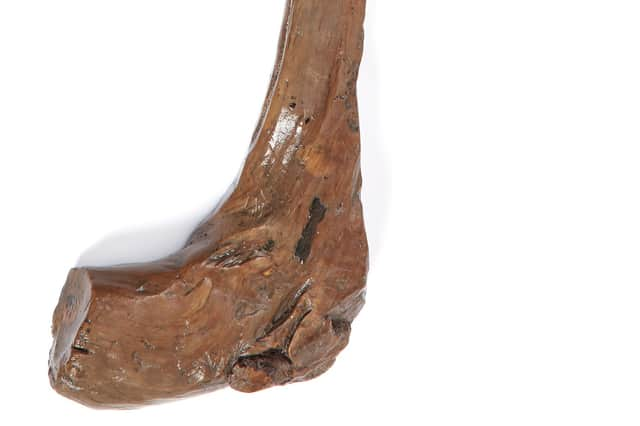
The object we are intrigued by was found in an archaeological excavation by John Kavanagh, Icon Archaeology, at Skehacreggaun, east of Mungret, Co. Limerick, southwest of Limerick city. It was uncovered in Pit 5, itself a deep, waterlogged pit dug into in a late Iron Age/early medieval enclosure ditch, possibly associated with a nearby ecclesiastical site (LI013-009008-) reputedly founded in the mid-6th century AD by St Nessan. It was later the site around which the medieval town of Mungret was centred. The wooden object itself has been radiocarbon dated to cal AD 593–650 (median probability, AD 621; 1441±20 BP; UBA50477). Other organic finds in the pit date to a similar period, and later activity there has been dated to the 11th/12th century. The object can therefore be dated to the 7th century AD.
The object is a long, carved piece of wood, possibly taken from where its trunk curved out to a root, so the natural curve was being exploited to create a wider heel or head. It has been identified as willow (Salix sp.) by Dr Ellen O’Carroll. It measures 1m 35cm in length (53 inches), the shaft approximately 4cm square in cross-section, increasing towards the head which is naturally curved, and crudely worked, with multiple toolmarks from the iron blade used. The heel / head of the artefact is very roughly finished and occasional small patches of bark remain. It is knotty and the trimmed stumps of two small branches or roots occur at the heel. The shaft retains some of its natural curved surface and there are also long strips where wood has been removed with a metal blade.
It seems possible that the Skehacreggaun find is unfinished, but it is nonetheless a very deliberately worked and shaped object. The pit from which it was recovered also produced roughouts for bowls, an unfinished disc and hoops, and a turning core, and it is clear that skilled wood workers were active on the site. The deposition of unfinished wooden items within the pit suggests they were being soaked mid-way through manufacture to help prevent cracks, and so we can assume that had it been finished, the object would be more refined. On the other hand, it could be used as it is.
So, what is it – and could it be a cammán? We have little enough to compare it to in terms of archaeology or material evidence. We have one definite hurley from the Middle Ages. This is an alder-wood stick from Derries, near Edenderry. Co Offaly. It was 95cm in length, 6.5cm in width, and dated to AD 1467-1635. Like the Skehacreggaun stick, this was a narrow bladed stick, but shorter. We also have the iconographic depiction of a hurling (or Scottish shinty) stick from Clonca, Co. Donegal. This is the 15th century graveslab of one Mánas mac Mhoireasdain of Iona; decorated in west Scottish style, it depicts a late medieval sword, a narrow playing stick and ball - both images of masculinity and skill. There are also similar depictions of a hurley-like object on two early medieval high crosses – on the side of the Market Cross at Kells, Co Meath, and on the base of the Tall Cross, Monasterboice, Co. Louth. Both are depictions of the biblical story of David killing the Lion. They show a curved object and a spherical object, and you could imagine how an early medieval audience familiar with Setanta and the fierce hound, would be happy to understand how a cammán and líathróit could defeat a vicious creature. However, you could also argue that what is shown is a sling and sling-stone.
It is entirely appropriate for these to be ancestral hurleys, as several drawings and photographs of hurleys from the 19th and early 20th century variously depict sticks that have gently to sharply curved heads, and that are longer, and narrower than modern hurleys which have evolved in living memory. (Kilkenny’s Henry Shefflin only a decade ago played with a 37-inch hurley (94cm), whereas younger players today can be seen using 34” (86cm) or even 32” (81cm) hurleys, with a very wide bas indeed. The modern game is all about getting it into the hand, and striking it in a tight space, and ground hurling has almost disappeared).
What if it is something else? If it is not a hurley, it could be a walking stick or a herder’s crook (though it seems far too short in the head, and it has no ‘crook’ so would be useless to a herder). The argument could be made that it’s a roughout for a crozier (though it is very crude and knotty, and whereas its length is good, the head is deliberately and needlessly quite short, and lacks any turn that symbolically mimics the shepherd's crook). It could be a fighting stick (incidentally, one of us played Wicklow Junior B hurling as a youth, but we’ll say no more about the difference between a hurley and a fighting stick…). However, even if it was a herder’s stick or weapon, it could also have been used in games as a hurley of course.
In conclusion, we can only say that if we were to find an early medieval cammán, or an unfinished one, we would expect it to look exactly like this, a stick carved from a naturally curved tree, lengthy (an advantage with violent swinging) and narrow, with a weighty head to propel a ball across a green, or drive it into the air as Cu Chulainn did.
We think on balance then that the Skehacreggaun, Mungret, Co Limerick stick, dated to the 7th century AD, is Ireland’s oldest hurley.