

New memorial marks centenary of Limerick disaster



The garden hosts a new piece of commemorative art by Limerick artist Eric O’Neill
A NEW memorial garden has been opened to honour the centenary of the Dromcollogher Cinema fire.
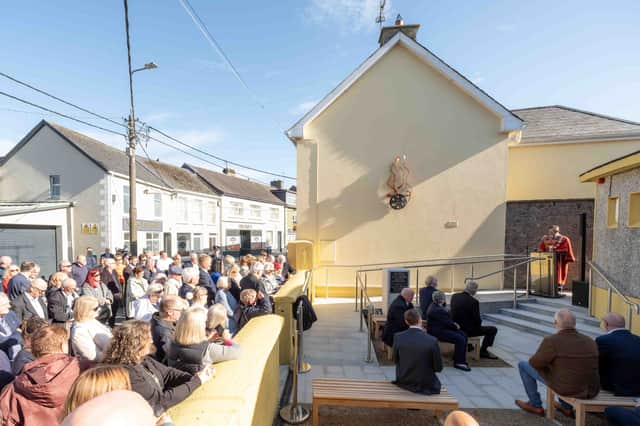
Mayor of Limerick, John Moran and Príomh Chomhairleoir Cllr Tom Ruddle officially opened the newly enhanced Dromcollogher Memorial Library and Memorial Garden, on Saturday, September 5, marking the 100th anniversary of the tragedy.
The opening ceremony took place ahead of the State Commemoration at St Bartholomew's Church Grounds on Saturday and recognised not only the 48 people who lost their lives in the tragedy, but also the “vision and generosity” of the local committee of relatives and community members who, in the years that followed, purchased the former cinema site and gifted it to Limerick County Council for the development of a memorial library.
The library has served the community for more than 70 years and remains a “lasting testament to the resilience and generosity of those who sought to create something positive from profound loss”.
A council spokesperson said: “The project marks a new chapter in that legacy, building on a decision that transformed a place of devastation into a lasting community resource. It includes extensive enhancements to Dromcollogher Memorial Library and the creation of a new Memorial Garden – funded by the Mayoral Fund - ensuring the site continues to serve as both a place of remembrance and a focal point for community life.”
The garden hosts a new piece of commemorative art by Limerick artist Eric O’Neill supervised by Naomi O’Nolan.
Mayor John Moran said: “The Dromcollogher Cinema Fire Disaster remains one of the most tragic events in our county's history. As we mark its centenary, it is fitting that we create a lasting space where people can remember those who lost their lives while also providing a place that brings the community together.
“Ever since I first met the community and heard first hand their passion to mark the centenary, I resolved to support this garden through the Mayoral Fund. I enjoyed the design process and getting regular progress updates. I want to thank all our team, the Dromcollogher ‘26 Committee and all who made this project a reality. I am delighted that the Mayor's Fund could support such a meaningful initiative.”
Príomh Chomhairleoir Cllr Tom Ruddle said: “As we mark the centenary of the Dromcollogher Cinema Fire Disaster, it is important to acknowledge the local committee of relatives and community members who, after the tragedy, purchased this site and gifted it to the Council for the creation of a memorial library.
“Their wisdom and generosity transformed a place of loss into a sanctuary of knowledge, connection and peace that has served Dromcollogher for more than seven decades. Today's improvements honour that remarkable gift to the community, ensuring this special place continues to serve and bring people together for generations to come.”
Director General of Limerick City and County Council, Dr Pat Daly said: “This project has delivered significant improvements to the library and created an important space for remembrance that will serve the community for generations to come. Limerick City and County Council is committed to preserving and celebrating the stories that have shaped our communities while continuing to invest in public facilities that improve quality of life.”
The Dromcollogher Memorial Library and Memorial Garden project brought together investment from Limerick City and County Council, the Department of Rural and Community Development and the Gaeltacht, and the Mayor's Fund.
Works at Dromcollogher Memorial Library included major mechanical and electrical upgrades, improvements to lighting, heating and emergency lighting systems, ducting and trenching of services, internal redecoration, improvements to library shelving, an enhanced reception area and the installation of a new kitchenette.
External works included the opening up of the site through the removal of railings, cleaning and restoration of walls and facades, and enhanced accessibility measures including a new disability access ramp and accessible toilet facilities.
The council spokesperson added: “The Memorial Garden was developed as a dedicated space of remembrance and community gathering. At its heart is an outdoor cinema feature comprising timber seating and a whitewashed screen that reflects the character of the original cinema.
“Brass nameplates installed on the benches commemorate each person who lost their life in the disaster, while a projector pedestal has been incorporated into the design, allowing the space to function as an outdoor cinema and community event venue.”
Funding for the project included €100,000 from Limerick City and County Council Development Levies for library improvements, €47,700 from the Department of Rural and Community Development and the Gaeltacht's 2026 Targeted Small Scale Capital Investments Programme for external and accessibility works, and €100,000 from the Mayor's Fund towards the Memorial Garden, landscape works, sculpture piece and a contribution to the Grove of Remembrance.
Speaking at the Centenary Mass in Dromcollogher on Saturday evening, Bishop John Fleming said that the effects of the disaster extended far beyond the 48 lives lost.
“An entire parish community was traumatised in the horror of that dreadful night,” the retired Bishop of Killala, a native of Co Limerick, said.
“The one hundred years which have followed the tragedy have also seen the lives of many individuals and families, in varying degrees, deeply impacted by the events of that night.”
He said the absence of the counselling and trauma supports that are available today made the suffering even more difficult to process, contributing to a silence that descended on the community.
Bishop Fleming said the scale of the effort undertaken locally to commemorate the victims was itself evidence that the spirit of community which emerged from the tragedy remains strong a century later.
“The fire affected every family in this community. While views always differ, community togetherness as well as resilience predominated in the years that followed,” he said.
“This has endured down to the tremendous efforts of so many people in so many ways in bringing this Centenary about.”
Concluding his homily, Bishop Fleming reflected on the Christian message of resurrection - that darkness and death do not have the final word.
“We gather this evening, therefore, as a gentle breeze soothes our remembrance of this devastating fire and tragedy,” he concluded.
“We gather to remember the past, to pray for the dead and look to the future with hope.”