

How do we want Limerick city centre to develop?

Architect and director at the firm Healy Partners Architects Richard Rice considers the question of how do we want Limerick city centre to develop?
There has been considerable discussion in recent weeks about Limerick city centre, the Summer in the City programme, temporary street closures and, inevitably, our directly elected mayor, John Moran. City-centre traders are entitled to be concerned about their businesses, councillors to question decisions, and the Mayor and Limerick City and County Council should be expected to listen and learn. But the increasingly personalised debate risks obscuring a more important question: what kind of city do we want Limerick to become?
Maintaining the status quo is not an option. Shops have closed, retail patterns have changed, online shopping has transformed how we buy things and suburban shopping centres offer convenience with which traditional city centres struggle to compete. These are not uniquely Limerick problems. We should therefore be careful about attributing the difficulties of city-centre retail to temporary street closures, summer events or any one individual. If the city centre is struggling, defending how it currently operates cannot itself be our strategy for recovery.
Limerick has a complicated relationship with the car. There remains an assumption that the economic health of the city centre is directly related to how easily we can drive through it and how close we can park. Access to the city is important; access by private car to every street and every front door is something different.
Our Georgian grid gives us considerable flexibility. It can redistribute movement when streets are temporarily used differently. The question is how we allocate the finite public space between our buildings: to cars, buses, bicycles and pedestrians, or to trees, seating, cafés, children’s activities, markets and events. This is not anti-car. Cars remain important to accessing Limerick, particularly from rural areas. It is about balance.
Parking illustrates the contradiction. On-street parking costs €1 per hour, while there is no comparable standard hourly rate in our city-centre multi-storeys. Some of our most convenient spaces, immediately outside businesses, are therefore also among the cheapest places to leave a car. From our offices on Glentworth Street, I regularly see cars arrive early and remain on-street for much of the working day. This is not a traffic survey, but if these limited spaces are particularly valuable to customers, should we not manage them to encourage turnover rather than long-stay commuter parking?
We have already experimented with alternatives. During Covid, short-term click-and-collect spaces proved useful to businesses. Parklets converted a small number of parking spaces into places where people could sit, meet, eat or drink, bringing activity and colour to streets. Most have since disappeared. Whatever shortcomings existed in their construction or durability, it is unfortunate that a successful idea was removed rather than improved. Experimentation should allow us to refine good ideas rather than simply abandon them.
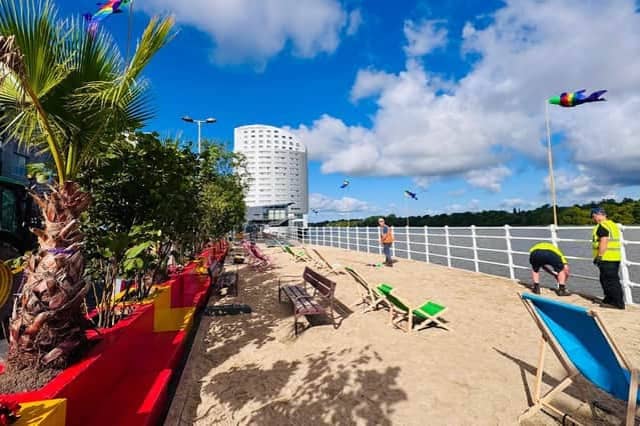
That is why I welcome the principle behind Summer in the City, even if every intervention does not succeed. Close a street temporarily and see what happens. Introduce seating, an urban beach or a sporting event. Then measure the results. Count pedestrians, monitor traffic and parking, and talk to businesses and residents. Keep what works, change what nearly works and abandon what does not.
There is nothing reckless about this. Temporary interventions are reversible. The intelligent city does not take risks blindly; it experiments, measures and learns. Barcelona’s transformation from the 1980s provides a useful precedent, where interventions in streets and public spaces became instruments of regeneration. Cities do not always transform through grand gestures; sometimes they change because enough intelligent things are tried in enough places.
Nor should traders’ concerns be dismissed. Running a city-centre business is difficult. But claims that temporary street closures damage trade should be capable of objective examination. When Summer in the City concludes, let us examine footfall, traffic, parking and meaningful comparative information. If something has damaged trade, understand why; if it has increased activity, understand that too. Evidence is more useful than competing assertions on social media.
Limerick has taken risks before. In the mid-1980s, Jim Barrett effectively performed the role of City Architect and helped advance an idea which seems obvious today: Limerick needed to turn around and face the River Shannon. Arthur’s Quay Park and the emerging strategy for the quays helped recognise the river as our greatest piece of public realm.
Following Jim’s death, The Irish Times described him as an unconventional public servant who was always prepared to take risks. He subsequently became Dublin City Architect, influencing projects including the Liffey Boardwalk and O’Connell Street. He understood that changing a city requires more than plans: somebody has to advocate for ideas and bring others with them.
I am not suggesting John Moran is another Jim Barrett. Their roles are very different. The comparison is more fundamental. Cities benefit from people prepared to question established thinking and imagine alternatives. Successful city-making, however, is never achieved by one person. It requires political leadership, professional expertise, effective administration, businesses and communities working together.
Limerick City and County Council deserves considerable credit. The Three Bridges route and riverside boardwalk, O’Connell Street public realm, active-travel investment and work around Arthur’s Quay and the Market Quarter all contribute to a city continuing to rethink its centre. Through Healy Partners Architects, I have been fortunate to contribute, most notably through the redevelopment of the Milk Market.
Another change is increasingly visible building by building. Vacant upper floors in the Georgian city are returning to residential occupation. As more people live and work in the centre, its streets become their neighbourhood. Creating an attractive city in which people want to live, work and spend time is not opposed to commercial activity; it is fundamental to it.
Against this background, we should consider John Moran’s contribution with some perspective. I do not agree with everything John Moran does or how he sometimes does it, but Limerick would be making a serious mistake if political or sectional opposition extinguished the ambition he has brought to the office. Some ideas will work, some will change and some may fail. Challenging established assumptions should be part of what we expect from an elected mayor.
We are also establishing something new: how Ireland’s first directly elected executive mayor works alongside an established local authority structure. There will inevitably be teething problems to iron out as the system matures. LC&CC and the mayor’s office share the same responsibility to the city, and Ireland will learn from our experience.
A mayor should be scrutinised. Councillors should challenge proposals, journalists ask difficult questions and traders and residents make their views known. But there is a difference between scrutiny and a culture in which every new idea becomes a disaster and every disagreement becomes personal.
John Moran will not be mayor forever. We should want talented people from many backgrounds to seek this office in future. If the lesson from Ireland’s first directly elected mayoralty is that proposing anything unconventional results in relentless personal hostility, capable people may decide public office is not worth the effort.
People argue about Limerick because they care about it. That is our common ground. But caring about a city cannot mean preserving it exactly as it is. Let us experiment with our streets and public spaces, measure the results, listen to businesses and residents, acknowledge what fails and build upon what succeeds.
John Moran’s term as mayor will eventually end. The more important question is what kind of Limerick we will have helped to create by then: a city frightened of changing what does not work, or a city sufficiently confident in itself to try things, measure them, learn from them and keep moving forward.