

Munster Rugby memories still driving Paul O’Connell forward
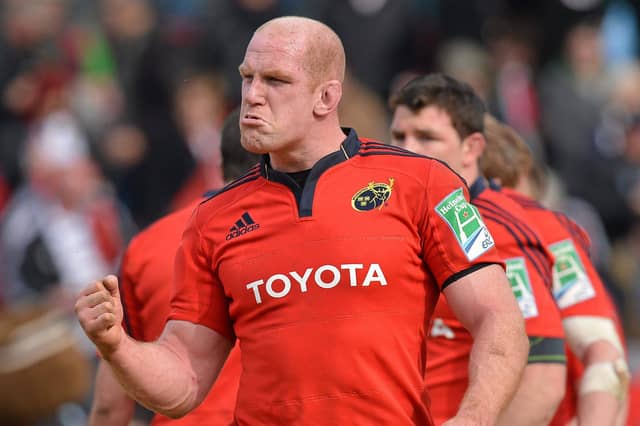

THE former Munster captain, and current Irish forwards coach, sat down with the Limerick Leader before heading off to Australia for Ireland’s summer tour fixtures.
The 2002 Heineken Cup final was the second heartbreaking loss for Munster in the space of three years.
Declan Kidney’s side had lost out to Northampton Saints in the decider two years previously and it was another English outfit, the Leicester Tigers, that downed Munster in Cardiff.
At that stage, it looked like the top honour of European rugby would never be making its way back to Thomond Park.
However, green shoots, well in this case red shoots, were emerging. A gang of young guns were ready to take over from the old guard.
Paul O’Connell was a 23-year-old lock that had forged a big reputation after a stellar debut season as a professional player.
Twenty three years on, that first year as a pro is something that O’Connell still holds very close to his heart as he explained before he and the Irish squad jetted off to Australia.
"Yeah, it was incredible,” remembered O’Connell “It was the years before the iPhone and before social media, which made it a lot more enjoyable.
"I still look back on my first year as a professional rugby player with Munster as the most enjoyable year of my life.
“That Munster team was probably backboned by that Shannon team that won all those All-Ireland Leagues (AIL’s).
"They were such big characters as well, and when you go in, it's like you feel like you're going into a new school and you're going to have to keep your head down for a while and climb the pecking order or something, but it wasn't like that at all.
"All the lads were unbelievably welcoming, great fun. As long as you were serious about your rugby, tough about your rugby, and wanted to enjoy it and were committed, you just became one of the gang straight away.
"I would have known some of the Limerick guys to salute, but Ronan O’Gara, Peter Stringer, Anthony Horgan or John Kelly, they are some of the nicest guys you could ever meet.
"Ireland head coach Andy Farrell has a saying, ‘leadership is about how you make people feel’, and those players, for me anyway, made me feel like this was the best place in the world to be and this was the most important team in the world to play for.
"That first year is just, the older I've gotten, the more I've been able to look back on it and reflect on why it was so good, and the reason it was so good was just the players.
“The old guys who were 15 years older than you, like Mick Galwey or Peter Clohessy. They looked after you so well and made you feel so good about yourself.
Munster eventually got to the very summit in 2006 and in 2008 but it was still that introduction to the professional game, with all its simplicities and intricacies that the current Ireland forwards coach looks back on with great fondness.
Those successes, both in Cardiff, were backboned by Munster talent but a bit of New Zealand flair had a major impact, certainly in 2008 in the form of Rua Tipoki, Doug Howlett and Lifemi Mafi.
All three become honorary Munster men after time in the province.
Another memory of the era that O’Connell recalled came from Anthony Foley’s father, Brendan. When a player reached 100 games for Munster, Brendan would get a cap made to honour the achievement but the tradition fell away when more and more players reached the milestone.
However, in recent times a situation has arisen where players had the option to get their first, 50th and 100th cap but they would have to pay for it themselves. The Kiwi trio were the first guys in on the WhatsApp.
"I think of all the caps I had at Munster, it's probably the most important, because it's part of that first year, and it just, obviously I ended up having a career in rugby on the back of it, but it changed my life, because of how good it was, so that was a great year, it was just such a special time.”
O’Connell also spoke, briefly, on Munster's indifferent season, both on and off the field and admitted that he doesn’t know what is happening at Munster in the current era, but that for the province to be successful, he believes that traditions that made Munster great shouldn’t be forgotten.
"I think Munster need to understand what's important, what makes us different and what makes us special, and don't be afraid to try the other stuff, but make sure we're sticking to the things that made it work.
"I don't know what's happening. It's a very different competitive environment to what it used to be, so I don't know, I can't comment on what's happening, because you can just look at results and say, it's never that simple, so it's only if you're really in the thick of it that you can say things are right here or things are wrong here."
That first Heineken Cup win in Cardiff had its 20-year anniversary back in May.
Munster beat French side Biarritz, who at the time, were one of the best teams in the TOP 14, and one of the best in Europe.
Biarritz contained the likes of Serge Betsen, Dimitri Yachvilli and Thomas Lievremont in their starting lineup but it was Munster that came out with a 23-19 win thanks to Trevor Halsted and Peter Stringer tries, as well as 13 points off the boot of Ronan O’Gara.
Even now, two decades on, memories are as fresh for the man who played a pivotal role in the triumph, as they are for those that were lucky enough to be in the Welsh capital on the day itself.
“I think of the Millennium Stadium,” O’Connell recalled of that great day in Cardiff. “I think of the bus journey to the ground, I think of the few days out, I don’t think of the game.
“I think of the connection and the fun with the supporters, you know, it was easier to have fun then, no one had a camera phone.
"It was a team that played on solid foundations and we really had great players big players like David Wallace. Even though it was great to win two cups, I think we should have won more.”
Despite his own teams’ success, O’Connell was keen to point out that without the work put in by the Munster sides in the early days of the Heineken Cup, his group would not have had the achievements they have today.
The former Munster, Ireland and Lions captain says that the teams he played on were not the best that Munster produced.
"I think the best Munster team ever is the team that won nothing, that team from 1999-2000.
“They started it all, like lost 60-19, to Toulouse in 1997, but yet beat them in Bordeaux in 2000, the most amazing display of rugby you've ever seen.
"So, they're the guys that actually changed the whole culture and they're the guys that people identified with all of a sudden.”
O’Connell set off with Ireland on their southern hemisphere tour in on Monday and is looking forward to the tour where they will play Australia, New Zealand and Japan.
The Irish forwards coach doesn’t have the greatest memories of the southern hemisphere from his playing days, especially in World Cups, but as a coach, beating New Zealand in their own back yard in a three-test series is highlight he picked out with great pride.
There is a perception that Ireland’s golden era that participated in World Cups in 2007 and 2011 didn’t deliver but O’Connell has a different perspective.
"I wish we had a better record at World Cups but I grew up in the 1990s watching the Irish rugby team. In some ways, I’m a paranoid coach because I grew up in the 90s.
"We just couldn’t compete. I remember watching Ireland play England one time and I think the score was something like 50-17 and I was thinking that wasn’t too bad. That’s where we were.
"My sense of perspective is whenever anyone gives out about the Irish rugby team, that’s where I go back to.
"To be part of the journey of the early 00s to where we are now, with all the ups and downs, it hasn’t been a bad return.
"There has been a few crashes along the way but it’s mainly been on an upward curve and I have enjoyed being a part of that.
"I have enjoyed being at fault for some of it, and I have enjoyed helping some of it along the way.”
O’Connell has enjoyed an upward curve as a player throughout his career and that trend has continued into a successful coaching career.
Even now, however, he isn’t sure that it is something that will be his career forever.
“I love it but I don’t know if rugby coach is my career for the rest of my life. I may have another retirement sooner rather than later.
"I really enjoy it, I get to live at home in Limerick. When I am away, it’s for long periods. When I’m home, you’re still working hard but I can still bring the kids to school and collect them from school.
"International coaching takes you away from home for three months of the year. The other nine months, people think you are off, but you are working. There are opportunities for downtime within that.
"This era of Irish players have been incredible to work with. I played New Zealand nine times in my career and never beat them.
“To be down there in 2022 and walking down from the coaches box with five minutes to go because we were so far ahead and you know that you are not going to get beaten was a pretty amazing feeling.”
Family is a strong theme throughout the interview with Paul O’Connell at the opening of the new Aldi store in Dooradoyle where the Irish forwards coach is an ambassador for their Aldi Play Rugby initiative with the IRFU.
It was his family background that gave O’Connell the opportunity to flourish in what he described as a sports mad house.
"I found myself thinking about that recently. “My dad would watch any sport that was on TV and support it passionately, particularly if any of the players were from Cork because he's from Cork.
"So that's what we have in our house now, it's non-stop sports and it's great fun. Myself and Emily (Paul’s wife) are in the car all the time driving to all the different parts of county Limerick and it's great fun and it's good for the kids, it's really good for them.
Another family that O’Connell still holds dear is the one he has been a part of since he started his sporting career. Young Munster.
Although swimming became the main sporting focus in his early teens, the Greenfields club had a major impact on his life when he returned to rugby at the age of 16.
"When I went back, I was behind really,” O’Connell admitted. “I would have been behind a lot of guys.
"But when I went to the Young Munster, or even I suppose going to the Young Munster games with my dad or whatever, the physical side of the game was the big thing in the Young Munster.
"They had that amazing pack of forwards from 1993 (AIL winning team and that was the philosophy.
"At that time in professional rugby, if you were going to give a young second row a chance, you needed to know that he could handle himself and that he was able to be physical in how he handled himself. So I would have gotten that from Young Munster.”
"At 18, down training, my brother Justin would have been there, Declan Edwards, Ger Earls. Peter Clohessy was probably more with Munster at the time, but he did play with us. Mick O’Halloran, Denis O’Meara.
"My first year I was on a Junior Cup team with Ian Ryan, Eddie Fraher and David Moriarty. We had a great set up and I really learned the skills of being a second row forward.”
What O’Connell learned with his club team soon transferred onto the pitch and soon caught the eye of then Munster forwards coach Niall O’Donovan. A call up to the provincial side was inevitable.
"When Mick Galway and John Langford were getting older, I suppose Niall O’Donovan was looking around for another second row. He would have probably had a good bit of respect being a Shannon man for Young Munster people.
"When he was looking for a young second row, he said that guy is starting for Young Munster, I'm sure he's going to be able to handle himself, and I was lucky to get a chance, and was lucky enough that I was smart enough to figure out how to be able to take my chance.”
“And then once you get in, you can get better at the other stuff. And I was probably very light. I would have played Munster U20s with Donncha O'Callaghan, would have trained a little bit with Mick O'Driscoll, a very good line-out forward.
"Brian Hickey was coaching in Young Munster at the time, had come down from UCC, was a very good line-up coach. And then I started with Munster and John Langford was there. So I kind of figured out a bit of the line-up stuff early.
"And it's funny, and I do it myself, when young players come out of the 20s or whatever, sometimes you're looking for them to be a complete player. But very often they just need one or two things to get them into the team.
"A lot of them are just good sports people. They're probably good soccer players, good GAA players, and they ended up picking rugby. Most of them will get better as long as there's something that can help them swim while they get picked.
"So it's probably something for us as coaches to probably be a little bit more open-minded about as well."
Luck is a theme that O’Connell mentions several times throughout the half hour sit down at Aldi’s new store in Dooradoyle. Getting into the Munster side at the time wasn’t easy, but O’Connell never left once he got his chance.
O’Connell also has a link to the Limerick hurlers through their performance coach Caroline Currid, who worked with him up until his retirement in 2016.
He has revelled in their success from a fans point of view like so many of his fellow Limerick people have. O’Connell added that he will miss the 2027 Ryder Cup in Adare Manor due to the Rugby World Cup in Australia.
The mention of a possible ‘second’ retirement suggests that the World Cup might be the end of his stint with Ireland but it’s unlikely that the Irish rugby legend will ever be too far from the action.