

Dick Smyth - a decorated sportsman who led by example
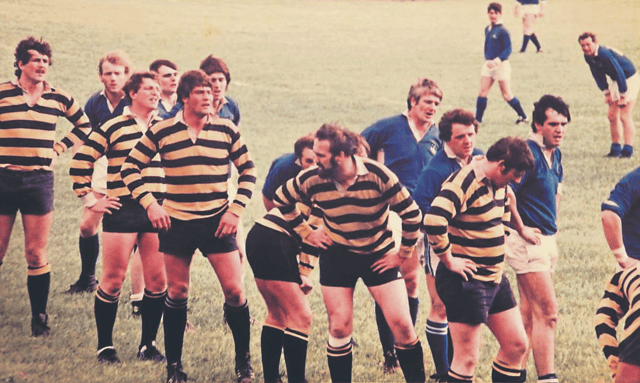

Dick Smyth was a sporting all-rounder who impressed at soccer and hurling before excelling as a rugby player
1929: Presentation RFC Win Munster Junior Cup
WHO would have believed it? Perennial losers Presentation defied all the odds in beating Cup holders Waterford City 9 – 0 in the final.
Presentation players were mostly living in the market area of the city. Limerick’s rugby fraternity, to a man, celebrated. Presentation’s team included exceptional players in English, Flannery, Bromell, Creamer - names still familiar to this day.
Special mention must be made for two members of the Presentation winning team:
• Ned Grimes, teak tough prop forward who dominated every opponent he came up against.
• Richard Smyth was a flying wing forward that press notes of that era suggest that he was a Munster player in the making.
Young Richard loved to hear his father talk on the 1929 Junior Cup Victory which led him to emulate his father by winning a Munster Junior Cup medal – total four winners medals in all!
A very prominent hurler in his early days in St. Munchin’s School, run by the Christian Brothers, like all players his age, Dick Smyth would, for safety reasons, have to wait until his 16th birthday to play competitive rugby.
Dick filled the gap by embracing soccer and hurling as sports he enjoyed. In soccer, the tall, gangly Smyth became one of Limerick’s best young soccer prospects highlighted by the fact that the Ballynanty Rovers youth was selected as centre half and Captain of the possibles team who were due to meet Wales.
Looking back at the issue from a distance, Dick says, “I never had a chance of being selected though I played a blinder against Blondie Carroll in the trial.” Just before the trial game started, the Limerick delegation were advised by John Farrell, Chairman of the FAI Selectors that the team to play Wales would contain one Limerick man at most.
Think of it, a team announcement before a trial game was held! The more things change . . . .
Back to hurling and soccer after that, “I enjoyed playing in Shelbourne Park, but I was surprised to be called to a meeting of the local GAA Committee who told me that I was being suspended for Breach of Rule 27 for six months. Nine months later, another letter arrived and guess what? Another six-month suspension!
“At my age, just under 16, it was frustrating to see virtually all my colleagues breaking Rule 27 without being penalised.”
Thomond Days
In the mid-1960’s right through to the mid-1970’s, Garryowen had what seemed to be a production line of sprinters - including Paul McDonogh, Tommy O’Carroll, Gerry Joyce and Eddie O’Sullivan - which made them a very hard team to play against.
To his surprise, Dick was selected by Thomond on the left wing for the City Cup final in 1965 even though his knowledge of the position was very limited.
“I recall an incident where Gerry Joyce attempted to use his pace to get around me on the outside. Luckily for me, I read Gerry’s intentions correctly and was there to meet him with a tackle, which may not have been in the Dennison teaching manual but it stopped Gerry in his tracks.”
In the late 1960’s, Thomond acquired a magnificent coach in Sean McNamara, who brought the art of forward play to a new level. Incredible to think that “Mac” should make only one appearance with Munster against the Royal Air Force, “Mac” deserved far more caps but the presence of Props like Tom Clifford and Gordon Wood were regulars on the Irish team; no easy task to dislodge that duo!
“I enjoyed some great days with Thomond. I was delighted to win four Munster Junior Cup medals, only losing one final against a superb Young Munster team.”
Coaching
The foot rush is one of the great qualities of the game, but rarely given its due.
Brian Spillane once said, “I spent all my life playing rugby, and was coached by the very best that an Irish international team could provide and yet the person who taught me the most about the foot rush was Thomond's Dick Smyth”.
Best foot rush exponents were: 1. Dick Smyth; 2. Colm Tucker; 3. Brian Spillane and 4. Pa Whelan.
“If the foot rush tactic could dismantle a team like the All Blacks, it's good enough for me.”
Place-kicking
A noble art and a match winner requiring nerves of steel under extreme pressure.
Let me give you an example in this regard: in the 1971 semi-final, Thomond were still chasing their first Munster Junior Cup title. Thomond were three points behind against Highfield with seconds to go and a penalty was awarded to Thomond.
“I'm close to the touchline, Thomond's full back, Brian Flanagan, bisected the Highfield post with a magnificent kick.”
Flanagan was a superb place kicker throughout his career – very few players ever reached his level of kicking under pressure.
Sport is all about opinion. Through the ages, the debate as to the greatest score under pressure – across all fields of sport – continues to divide. Dick Smyth is unshakable in his view – his colleague Brian Flanagan’s successful penalty in his No. 1 pick just ahead of Richie Bennis’ 1971 score for Limerick against Tipperary.
Career Highlights
Amongst his reflections on his career, Smyth takes pride in the fact that he was Captain of every team he played for.
For the Munster Junior team, Smyth set a record number of appearances - although he is hazy about the exact tally - “I stopped counting at 25.”
Over the years, Thomond/Dick Smyth won many important games. The highlight, as far as Smyth is concerned, being the Munster Junior cup final win in 1981 against a rampant U.C.C. side. The college team contained four players and two substitutes from the previous day's Senior Cup final against Shannon.
Thomond won easily in the end with the Captain being Brian Flanagan who had been a vital part in Thomond’s first Junior Cup victory in 1971.
Smyth suggests that the 1981 win was team play at its best - “I was so privileged to be part of that great side.”
Popularity
Dick Smyth remains happy with the decisions made during his rugby career.
Given his high profile, Smyth has acquired a huge amount of plaudits and is acknowledged widely for the tremendous spirit he brought to the game.
For instance, when the IRFU, for the first time in 1981, bestowed the title of “Mister Boots”, it was awarded to Smyth - the honour being a just reflection of his contribution to the game.
During his career, Smyth acknowledges the support he received from his playing partners in Thomond - “We always played as a team and the rugby trophies received as Team of the Month and Team of the Year reflect on the camaraderie we shared.”
To this day, Dick Smyth is a loyal Thomond supporter and is delighted to see so many players in his image following through in his footsteps.