

Then & Now: The problem with going cashless
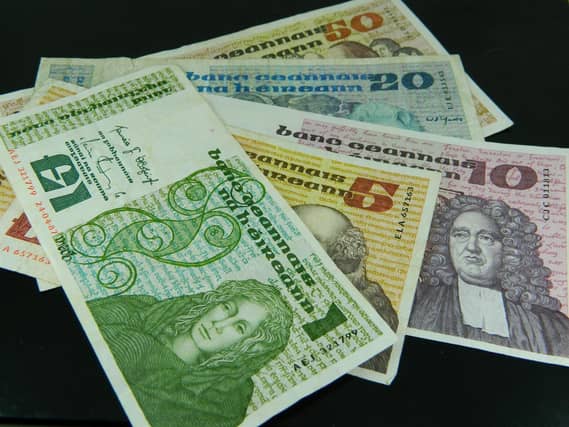

A CASHLESS society is something I hope will never happen during my lifetime but the powers-that-be are doing their best to bin the cash and encourage the flash and tap. The arrival of Covid was a bonus for them, describing the notes and coins as dirty money and not to be touched.
It may not be that hygienic to handle but you know the amount you have and have more control on how you spend it.
The Government has enough control over us and they now need to step up and address the issue and confront those who are denying people the option to pay with cash. No citizen should be denied access to a public or a community-based service, if they are prepared to pay with legal tender. The Dail motion last week calling for its protection is a start and the quicker it is made law, the better.
The paper notes and coins are vital for vulnerable groups to manage their money as those who are poorer, living in rural areas, elderly or in receipt of a low income having less access to the various digital payments in use.
Cash allows inclusion and keeps targeted groups on board and does not allow them to fall behind. Groups who depend on church gate and bucket collections will lose out.
Children will lose out on getting treat money from grandparents, at birthdays, Communions, Confirmations, Christmas etc. Those in favour of cashless will argue otherwise, but seeing the joy on a child's face after receiving cash will never be the same again with the flash of a card or the tap of a phone.
The GAA are one organisation that has come in for criticism for refusing cash-paying patrons entry into their grounds. This directive has come directly from Croke Park and not from the County Boards. Having to pre book a ticket for entry to a match can pose problems for many people without smartphones. A person living in a rural area with poor internet coverage has no access to print out tickets and depends on others to do so.
This has left a lot of anger and some have stopped attending the matches in protest. It may suit Croke Park and all the levels beneath it to go cashless, but it is the people in small local communities that keep their clubs afloat by supporting the various fundraisers they run. Are the association trying to follow AIB, who wanted to introduce a cashless society in some of their branches? They got their answer and surely it is time the association got rid of this booking system and let people pay at the gate, as they always did if they cannot access the tickets.
There is always a risk with credit and debit card payments if the system breaks down or having all financial requirements on a phone which may be stolen or lost. Cash was always king and long may it continue to do so.
The Saxon shilling
I GREW up in an era when the older generation spoke about farthings, half -sovereigns, guineas and the Saxon shilling. In the old Irish patriotic ballads, one sometimes hears reference to the “Saxon Shilling” which was given by a recruiting sergeant to the new recruit who had just enlisted in the British army. Nationalist Ireland equated the taking of the Saxon Shilling with treason, joining with the forces who held Ireland in subjection.
The first coins minted in Ireland were produced in about 995 AD in Dublin for King Sitric, the Hiberno -Norse King of Dublin.
These penny coins bore the head and the name of the king and the word Dyflin for Dublin. John of England was among the first Anglo-Norman monarchs to mint coins in Ireland; these were farthings, half-pennies and pennies. bore the harp, and later in Henry's reign. It was not until the reign of Henry VIII that Irish coins bore the harp and, later in Henry's reign, the year.
Coins issued in the 18th and 19th centuries often included the word Hibernia on the harp side.
The Irish Free State coinage was introduced on December 12, 1928, and not many people may remember what the coins looked like up to Decimal Day which was Monday February 15, 1971.
The harp was on one side of all the eight coins that reflected nature, air, land and river.
Each coin had its own distinctive name or nickname when I was going to school. A half-penny was a mag and a penny was a wing. A three penny piece was a kids eye and a sixpenny piece was a tanner. A shilling was a bob, and we called a two shilling piece a florin. The two-and-six pence was a half crown and four of these coins was the equivalent of the “half sovereign”.
Coins were often used in everyday conversation, to describe people, places and events. A person who was not that bright, or lacking was referred to as being not the full shilling. A person tight with money was called a penny pincher.
Penny wise and pound foolish, and the penny dropped were other coin expressions.
When a deal was completed during the old fair days, it was customary to give a “luck penny” after getting paid for an animal.
The pair would shake hands on the deal and would sometimes spit on the luck penny. To coin a phrase, he could turn on a sixpence was used to describe a sportsman who was nimble of foot. One of the earlier types of transport was referred to as a penny farthing bicycle.
A lot of people were annoyed when the ten shilling note was taken out of circulation to be replaced by the fifty pence decimal coin. The note was light in the pocket and had real value back in the days. It was red/orange in colour and Lady Lavery's photo was on one corner. When we first went dancing it paid for our night out. It covered the entrance fee, mineral and a snack bar for a girl if you were lucky and a bag of chips afterwards.
When the decimal currency was introduced the value of our money dropped and we had only 100 pence in the pound compared to 240 and prices rose as a result. On January 1, 2002 we bid goodbye to the punt and welcomed the euro , as the biggest currency changeover in history got underway. The rounding of cash transactions was introduced on Wednesday October 28, 2015, and in time the one and two cent coins bit the dust.
Our selection of coins have served us well over the years and rare ones are worth money if you are lucky to obtain one.