

Then & Now: Limerick snowdrops in spring symbolise a new hope

FEBRUARY COMES from the Latin word februa, which means “to cleanse.” The month was named after the Roman Februalia, which was a month-long festival of purification and atonement. It’s the only month to have a length of less than 30 days!
Though it’s usually 28 days, February is 29 days in leap years (the next being 2024). This means it’s also the only month that can pass without a full Moon. Not this year as we will have one on this Sunday night - February 5.
A Moon orbit is 29 ½ days, and since February only has 28 days, there are some years when February will not have a full Moon. When this happens, both January and March will have two full Moons each.
This last happened in 1999 and will happen again in 2037. The second full Moon in a month is popularly called a Blue Moon.
Traditionally, the Moon we see in February (whatever the phase) is called the Snow Moon because usually the heaviest snows fall in February. This name dates back to the Native Americans during Colonial times when the Moons were a way of tracking the seasons.
And the Native Americans were right. On average, February is the USA’s snowiest month, according to data from the National Weather Service.
January and February were the last two months to be added to the Roman calendar (c. 713 BC); originally, winter was considered a month-less period. Originally, February was made the last month of the calendar year! Eventually (c. 450 BC), February was moved to its place as the second month.
Even though so many roses are sold during February due to Valentine’s Day, the Violet and the Primrose are the symbolic flowers. The violet signifies watchfulness, loyalty, and faithfulness. Give a violet to someone to let them know that you’ll always be there for them. The primrose lets someone know that you can’t live without them.
Like the violet, February’s birthstone is a purple colour, the beautiful amethyst.
This gem is a form of quartz; it can range from a pale lilac colour to a deep, rich purple. The name is based on a Greek myth that speaks of a nymph named Amethyst who was inadvertently turned into white stone; in remorse, the Greek god Bacchus poured wine over her to turn her a beautiful purple.
The amethyst was thought to prevent intoxication and keep its wearer thinking sharply. It was worn by English royalty in the Middle Ages.
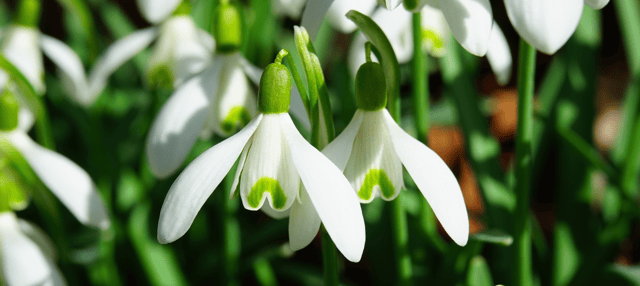
The flower called snowdrop appears in February and is a symbol of hope. According to legend, the snowdrop became the symbol of hope, when Adam and Eve were expelled from the Garden of Eden. When Eve was about to give up hope that the cold winters would never end, an angel appeared. She transformed some of the snowflakes into snowdrop flowers, proving that the winters, do eventually give way to the spring. There is an old rhyme which says:
The Snowdrop, in purest white array,
First rears her head on Candlemas day.
The name snowdrop does not mean drop of snow; it means drop as in eardrop - the old word for earring.
The Latin name for the snow drop is Galanthus, which means milk flower, and they are also known as Candlemas bells. The following are some verses about February:
When the cat lies in the sun in February
She will creep behind the stove in March.
Of all the months of the year
Curse a fair February.
If it thunders in February, it will frost in April.
If February give much snow,
A fine summer it doth foreshow.
Stamp of approval
POSTAGE STAMPS have been universally popular since the introduction of the Penny Black, the World’s first adhesive stamp used in a public postal system.
It was issued in Britain and Ireland on May 1, 1840 for official use from May 6, of that year and it featured a profile of the Queen Victoria.
Sir Rowland Hill’s idea of the adhesive stamp was to indicate pre-payment of postage and it was part of the proposals to reform the British postal system as it was normal at the time for the recipient to pay postage on delivery and it was charged by the sheet and on the distance travelled. His companion idea was to have a separate sheet that folded to form an enclosure or envelope for carrying letters.
When Ireland became an Independent State in 1922, British Stamps were overprinted and remained in use up to 1937.
Following a design competition organised by the Provisional Government the first Irish stamp, the 2p Map of Ireland, went on sale on December 6, 1922. The stamp, which was printed by the Irish Government Printers Dublin Castle, was designed by J.Ingram.
Stamp collecting was a very popular pastime and hobby in my youth and the postman was awaited with interest to see what delights he had for us. The stamps from abroad were especially interesting and we had a fine collection of used stamps after a while.
I still collect the used stamps which are much sought after at present for worthy causes. Magazines carry regular appeals for them as they can be sold to collectors in exchange for money. Stamp collecting can of course be a very rewarding business for the real professionals and large sums of money exchange hands for the rare one inch square pieces of paper.
Special and commemorative stamps are introduced regularly and they contain a range of subjects covering history sport, arts, science, and nature. Back in 2014, in one of my early columns I did a piece about postage stamps. That year, stamps were issued to commemorate Brendan Behan’s 50th anniversary. The Centenary of the founding of Cumann na mBan and the Centenary of the founding of the Irish Citizen Army. And stamps to honour Ireland’s Viking Heritage, Bloom, and the World Flower Show which Ireland hosted that year. The Centenary of the passing of the Home Rule Act 1914 was also remembered as was the recruiting of Irish Soldiers for World War 1 (1914 -1918) and An Post marked the contribution of the men and women of the Irish Prison Service.
The price of sending our letters and mail had increased since Monday July 21, 2014, and that was the second increase in over a year. The cost of a standard stamp for a letter increased from 55 cents to 60 cents and then it went up to 68 cents, which was a major increase.
This February 2023, a year after the last increase the same stamp, will cost €1.35. I hope this will not turn people against using the postal system.