

IF WALLS COULD TALK: The Limerick man of Chicago
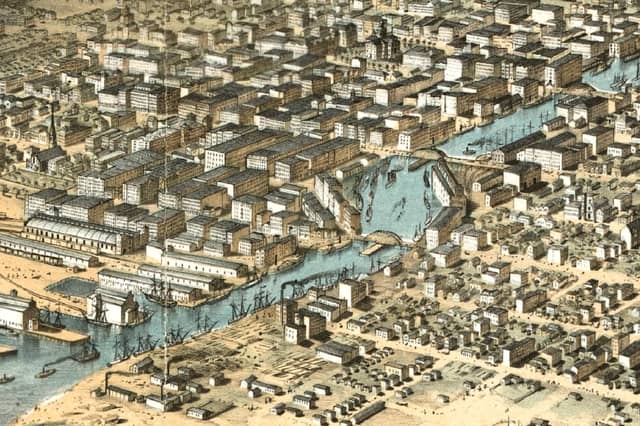

Dr Paul O’Brien explores the life of Broadford-born James O’Sullivan who became one of Chicago’s most respected journalists
When James O’Sullivan left Limerick for America in 1869, he was a newly qualified teacher. Within a generation, he had become one of the most respected newspaper editors in Chicago.
Born at Cooleygorman, Broadford, Co. Limerick, James O’Sullivan was baptised on February10, 1850. He was the son of Timothy Sullivan and Maria Barry. James had seven brothers (Dermot, Patrick, John, Timothy, Eugene, Michael and William) and two sisters (Helen and Mary). Six of his brothers also settled in Chicago. An article in the Munster News of May 1884 described James as ‘an educated scholar who passed his examination as a first-class teacher for the Examination Board in Limerick.’ It continued ‘some fifteen years ago, he emigrated to the great City of the West, and soon afterwards he was appointed teacher in one of the public schools.’ It appears that O’Sullivan was predisposed to writing and in his spare time researched and wrote articles for various newspapers and journals in Chicago. During his brief teaching career in the southside of the city, he produced an educational journal known as the Teacher’s Journal.
His accounts of events in Chicago were received with great applause and within a few months his talents were noticed by the editor of the Citizen. Resigning from his teaching post, O’Sullivan established himself as one of the most promising, up-and-coming journalists in the Windy City. In 1882, the editor of the Citizen, the Hon. John F. Finerty (1846–1908), offered O’Sullivan a position as sub-editor. Finerty, a fellow emigrant, was born in Galway, the son of M. J. Finerty, nationalist and editor of the Galway Vindicator. In 1883, Finerty was elected to congress as an independent Democrat for Chicago’s South Side.
READ MORE: ‘I see hope’: Limerick mother shares daughter’s story ahead of Down Syndrome Ireland Jumper Day
From the Citizen, O’Sullivan moved to the Chicago Tribune in about 1884. His journalistic output centred on the political affairs of the city, while he kept a close eye on Irish affairs. He never lost touch with his native Limerick, and his articles often featured stories from home. During the land league agitation of the late-1880s, O’Sullivan wrote about the league’s activities with a particular focus on the actions of Limerick landlords in the west of the county. Universally known as ‘Jim Sullivan’, he cultivated relationships with both political parties in the American arena and his influence in municipal affairs was strong. It was said of him that there was ‘no writer better informed in the twin spheres of local politics and city finances.’ By the late 1880s, O’Sullivan had established himself as a prominent figure in Chicago’s political and journalistic circles. His contemporaries regarded him as one of the best-informed writers on public affairs in the city. Yet despite his success in America, he never lost touch with Ireland. His journalism frequently dealt with Irish issues, particularly the Land League agitation, while his support for the Irish Parliamentary Party was practical as well as ideological. Universally known as ‘Jim Sullivan’, he was respected on both sides of the Atlantic. As his career progressed, O’Sullivan became known for his articulate approach to journalism coupled with astute skills as a political editor. O’Sullivan’s reporting was described as ‘brilliant pieces that upheld the grand old cause of Irish nationality.’ He was particularly respected by the Irish community in Chicago who recognised his ‘invaluable services rendered to the cause of Ireland.’
O’Sullivan was also part of a remarkable Limerick family story. Of the eight O’Sullivan brothers raised in Broadford, six settled in Chicago, establishing themselves in professions ranging from the courts and railways to the postal service, retail management and agricultural machinery. Together they formed a successful family network that reflected the opportunities and ambitions of Irish emigrants.
In 1878, James O’Sullivan had married Rose McCarthy, a principal of one of the west side public schools. Their marriage produced three children, the oldest of which was Daniel (b.1880). O’Sullivan visited Ireland in 1893 when he represented the City Council of Chicago at the inauguration banquet of Lord Mayor of Dublin, John Shanks (1893-94). His trip home was very well-received, and he induced Mayor Shanks to visit the Chicago Exposition in October of 1893. It is unknown if O’Sullivan visited his native county.
James O’Sullivan died suddenly on July 4, 1894 in what was described as a ‘great loss not only in newspaper circles but across the great city of Chicago, especially among the Irish community.’ His lengthy obituary described him thus ‘peerless as a news gatherer, strong and forceful as a writer of facts, not soon shall we look upon his like again.’ As his obituary observed: ‘while the mellow notes of his native Limerick yet lingered on his tongue, there burned in his heart a deep and tender love of the green old land that gave him birth, though many long years have sped since he bade goodbye to the Shannon’s banks and the classic vales of his native Munster. O’Sullivan’s love of his native land was of the practical kind… many who have entered the USA in the intervening years have felt the influence of James O’Sullivan in the great metropolis of the West. In the molding of public affairs of the country, James O’Sullivan was more of a factor than is generally known.’
Born in the closing years of the Great Famine, James O’Sullivan rose from modest beginnings in rural Limerick to become one of Chicago’s most respected journalists. Like six of his brothers, he crossed the Atlantic in search of opportunity and, through talent, ambition and hard work, made a lasting mark on his adopted city. The esteem in which he was held was evident even after his death. In 1895, a colleague in the Newspaper Club commissioned a life-size bronze bust of O’Sullivan by sculptor Robert Henry Parker. More than a century later, it still occupies a place of honour in the library of the International Press Club of Chicago, a fitting tribute to a man who rose to serve as its president during his short but remarkable life.
Dr Paul O’Brien is a lecturer at Mary Immaculate College