

Opinion: 'The missing women of Limerick' - Samira Kaissi
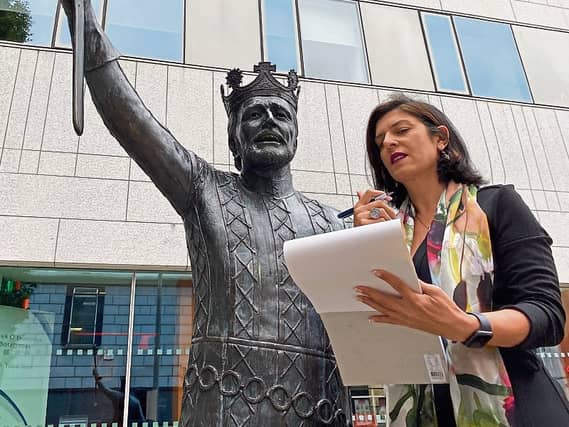

Samira Kaissi is a Lebanese American scientist who was recruited to Limerick to lead a biotech multinational site three years ago. She had spent her life between Beirut and Southern California “so Limerick weather was hard to make friends with at first, but the warmth of the Irish people made it worthwhile”. She has been living in Limerick with her daughter for the past two years and has slowly fallen in love with the river and the streets, “and a lovely Irishman”. She believes Limerick unfolds her wonders slowly to the seeker, and is trying to learn more about Limerick history through its architecture and public art.
Dia Dhuit young woman. Do you know my name?” she asked. “I have to be someone.”
It was unbelievable, but the statue of the woman in the 1916 monument just talked to me! It happened when I was crossing the Sarsfield bridge. I stopped suddenly and turned to face the kneeling ample bosomed damsel, representing no less than all of Ireland, being saved from her chains by three men.
It took seconds to learn the men’s names. Carved in the limestone were Con Colbert, Ned Daly and Tom Clarke. Actually, I immediately found numerous articles about the monument that proudly mention where they come from and what they did for Ireland. From that I learned so much about Irish history. Yet none of the articles mentioned her name. Or the name of any woman from that time. I tell her that and she says: “Féach, there is a list of names on the side. Maybe it is there.”
On the side of the limestone pedestal, facing town, there is a list carved in bronze displaying no less than 82 names of Irish patriots executed or killed in action during the Irish War of Independence. Her name was not on it either.
I looked up to her on that rainy summer day and said: “I’m sorry Mother Eire. You are nameless. Representing everyone yet at the same time no one.” From the sky fell a tear that rolled slowly down her cheek and fell onto Thomas Clark’s feet.
As I continued my way into town I wondered: how many iron and brass women of Limerick can I talk to during this lockdown? I am sure there are some with real names, specific faces and good stories to tell of why they have been chosen to be commemorated by the city. So I went on to meet these good folks, and ended up getting more than I bargained for.
Richard Harris on Bedford Row is very upset that Netflix won’t carry any of his movies. Sir Terry Wogan on Harvey’s Quay talked my ear off about the Eurovision. And don’t get me started on the Bard of Thomond Michael Hogan.
Although he is facing the castle he can only look into his book of poetry. After the fifth poem recital I had to pretend to be checking his plaque across the street so I can sneak away to dinner.
On and on it went. Thomas Spring Rice in People’s Park could hardly be heard all the way up from his high pedestal.
And of course I spoke to the venerable Daniel O’Connell in the middle of the Crescent. He had so much to tell, not the least of which that his heart was lost in Italy. And I confided in him that for a few years in my 20s I thought mine was lost there as well.
The days passed. I met other pieces of what they call modern art. They’re not much for talking these. Some are made by women. But none represented real women. I started to wonder if any woman from Limerick has done anything worth commemorating. Until one day as I turned the corner from O’Connell to Cruises street, I saw her. A tall drink of water with a tambourine in hand. I ran over to her excited. I tried to hug her lanky figure but could only reach her thighs. I looked up to her and said triumphantly:
“Dear lady, please tell me your good name?”
“Quoi?” she replied with a blank stare.
I looked down and in horror I read on the base on which she stands: “The Singer from Quimper”. Another nameless metaphor. And she is not even Irish. Quimper is in Brittany, France.
I wondered would Mother Eire be comforted or furious at this discovery? The only two statues of women in Limerick are stand-ins for an idea of a person. One is singing in French, and the other is frozen eternally in an act of kneeling defiance. I better not tell her I thought. She has just been liberated of her shackles after all.
It’s not about feminism this, or equality, or public art even. It is about the voice of our city, what it tells its children and visitors as they stroll down her streets.
Statues are not just backdrops for selfies. Each one is there for a very specific reason. People of this city have proposed them and argued over their locations and fought over their funding until they finally happened. Each statue and monument is the start of a thread. The beginning or middle or end of a story. A story that the city at one time or another thought worthy to tell everyone living at that time and for generations to come.
Visitors walking our streets will look up, see the beginning of that thread, and follow it to a story that makes their visit more meaningful. Locals will one day notice a monument that they have walked by a thousand times before. When they follow that thread it might be the beginning of a beautiful friendship. An origin story that roots them in where they come from, and shows them how far they can go.
Some of these spectators are our children, conspicuous avid consumers of our public art even if they don’t show it. I wonder what is stamped on their everyday consciousness when all they see is that the story is about the men. Men on pedestals. Men with books and pistols and rugby balls. Each one with a specific and proud story to tell. Each one with a name.
And yes there are murals. Beautiful large colourful murals. I have met at least two murals of women with names. I have put my ears to the walls but their voice was a mere whisper. They told me that although they were happy to be there, they felt slighted. Because in contrast to statues, murals are cheaper to commission and easier to erase. Murals are relevant but more temporary. Ephemeral. Is their name not as worthy of posterity?
We cannot rewrite history, but we can write more of it. I am sure that there is a woman in the history of Limerick with a name and a story worth sharing with the world.
Actually, I am sure that there is a queue of inspiring Limerick women in our collective memory worthy of being revived on our streets. Let us write these names and stories down. Start a wish list. Start a waiting list. Let us pay attention to the next time the city council calls for proposals for public art in town. And then Limerick, let us propose her name. Let us proudly release her voice to the world so our children can hear her story, and our visitors can know us more, all of us.
Let us make mother Eire on the Sarsfield Bridge finally stand up, straighten her dress, and wrap her hands around her sons proudly, when she hears her name.
For more on Limerick public art visit Wikipedia link:
Call for Public Art Submission for O’Connell Street in Limerick, 2019: