

Money printed during Limerick Soviet up for auction in England


A NOTEWORTHY part of Limerick's collective history will go under the hammer this Wednesday.
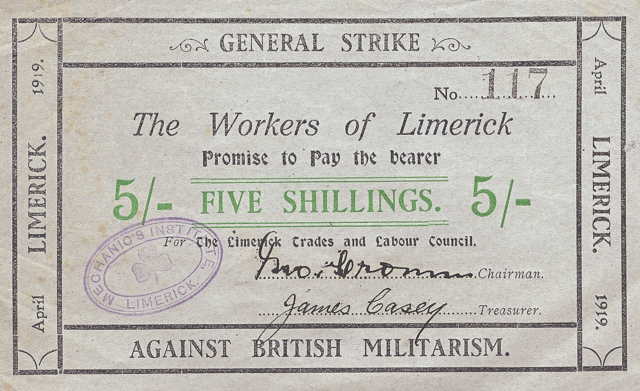
Money printed by The Workers of Limerick in 1919 is part of an online auction by Noonans of Mayfair in London. It was during the Limerick Soviet or general strike against British militarism.
The three lots made up of one shilling, five shilling and 10 shillings are all guided at between £2,000 and £2,600.
Andrew Pattison, head of the bank note department at Noonans, said the notes are being sold by a collector of Irish notes.
“While there may be interest close to Limerick, the major bidders for such materials are often international.
“The notes themselves really are exceptionally rare. We know that although thousands were printed, only around 200-400 of each denomination were issued, so there weren’t very many to begin with.
“The vast majority of these were redeemed (paid in), leaving only around 30 examples in private hands today. With most of these firmly in collections, this is a highly unusual opportunity to acquire a complete set,” said Mr Pattison.
Dr Paul O’Brien, Mary Immaculate lecturer, historian and Limerick Leader columnist, said it showed the workers’ determination in their cause that they issued their own bank notes.
“It suggests that the Soviet had links with local businesses who would accept the notes as valid currency.
“The issuing of the notes also helped fund their cause and avoided the need to tax the workers who they represented. The issuing of their own promissory notes helped to alleviate some of the strikers’ financial pressure.
“The notes themselves could be viewed as another means in which to get their message out as they had the following inscription ‘General Strike against British Militarism 1919’ and on the face it had ‘The Workers of Limerick Promise to Pay the bearer the sum of __ shillings’,” said Dr O’Brien.
He said the notes that are now for sale at auction are “important historical artefacts and provide a direct link to the Limerick Soviet which emerged during the fight for Irish independence”.
“It would be great if they were acquired for the city,” said Dr O’Brien of the rare pieces.
The background to the Limerick Soviet was the beginning of the Irish War of Independence.
A general strike was organised by the Limerick Trades and Labour Council, as a protest against the British Army's declaration of a Special Military Area under the Defence of the Realm Act, which covered most of Limerick city and a part of the county.
The Limerick Soviet existed for a two-week period from April 14 to 27, 1919
The Soviet ran the city for the period, printed its own money and organised the supply of food.