

If Walls Could Talk: Divine decorator was based right here in Limerick
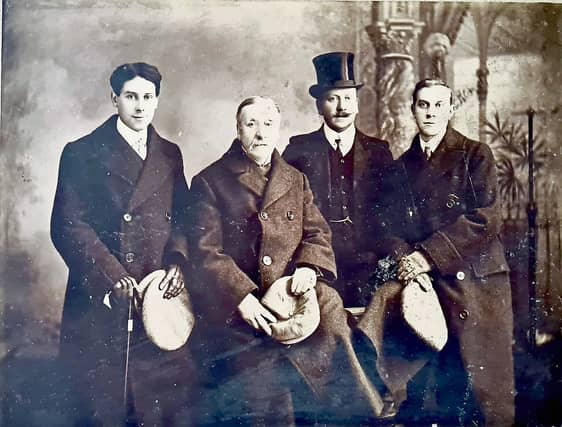

Dr Paul O’Brien paints a picture of the family who took advantage of the 19th Century church building boom
For over 170 years, the well-known family business, J. Hodkinson and Sons has undertaken ecclesiastical decoration in Limerick and across the country.
It was founded in 1852 by James Hodkinson, a Manchester native who first moved to Cork and then to Limerick. Although James had set up his business in Manchester, he took the decision to move it to Ireland owing to the growing number of Irish commissions.
James studied ecclesiastical decoration under the renowned architect and designer, Augustus Welby Pugin, noted for this Gothic style. Pugin’s most famous commission was the Palace of Westminster, London. When James moved to Limerick, he married Delia Kennedy, daughter of a merchant tailor of O’Connell Street and later Sarsfield Street (now Billy Higgins). James and Delia had three daughters and three sons.
In the years after Catholic emancipation (1829), the church building business boomed, and it was in this scenario that J. Hodkinson and Sons was established. At its height, the firm had offices in Limerick, Cork, Dublin, and London and employed over 100 people.
Approximately 3,000 churches, chapels, and cathedrals have been built in Ireland since about 1830, and J. Hodkinson and Sons has worked on most of these buildings including Longford Cathedral, the Pro-Cathedral, Dublin, Waterford Cathedral and St. Mary’s, Cork. In addition to their work in churches and convents, the firm also engages in the painting of private houses and business premises. Recent projects have included the interior of South’s Bar, Quinlan Street, and Lismore Castle in Co. Waterford.
Along with a handful of other enterprises in Limerick, J. Hodkinson and Sons is one of the oldest family businesses in the city. Indeed, the 11th of January 2023 will mark the 150th anniversary of the Hodkinsons living at 53-54 Henry Street, possibly making it the longest lived-in family home in the city.
The house also serves as the offices and workshop of the firm. James Hodkinson died in 1916, leaving the business to his sons Alfred, Louis, and Harry, with Louis continuing to operate from the Henry Street premises. Harry branched out on his own and his grandson, Kenneth runs this branch of the business today.
Louis studied at the Royal College of Art in Kensington, London, and in doing so added new layers of expertise to the enterprise. The business continued to flourish under Louis until the Second World War when it began to slow down. Louis died in 1955 and his son, Aubrey took over the running of the firm. He was known for his skill and meticulous approach to work.
The business is now under the stewardship of Randel Hodkinson and his two sons, James and Gerard, the fourth and fifth generations, respectively.
Perhaps the greatest challenge faced by the firm, came in the wake of Vatican II. In 1965, Rome decreed that elaborate church interiors were to be simplified, resulting in hundreds of carefully crafted interiors, designed by J. Hodkinson and Sons, being painted over by the master craftsmen who had created and maintained them.
Fortunately, Aubrey Hodkinson had the foresight to make a record of the interiors that were to be lost, and he set about taking photographs, drawings, and paint samples in a bid to chronicle the work carried out by his father, Louis.
From the late 1980s, it was gradually recognised that church interiors should be decorated in their original style, the firm’s rich archival collection proved invaluable as Aubrey and Randel set about undoing the damage that had been meted out in the previous decades. Aubrey passed away in 2006 aged 78.
Recent projects undertaken by the firm include the breath taking and detailed restoration of Mount Saint Alphonsus and St. Joseph’s Church. These projects included the restoration of stencil work, gold leaf gilding, statues, paintings, frescoes, and stations of the cross.
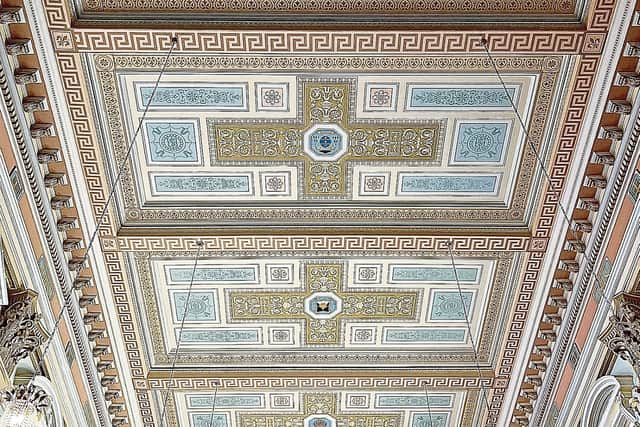
The level of detail in his proposal drawings included sections picked out in real 23 carat gold leaf, thus providing an insight into the skilled approach of the firm. Working from atop lofty scaffolding, Randel, James, and Gerard carry out the painstaking restoration work by following authentic and traditional methods.
Let’s hope that one of Limerick’s oldest family businesses, and only remaining ecclesiastical decorators in Ireland, can continue to thrive for at least another 170 years.
Many thanks to Randel and Lorna Hodkinson for sharing their insights with me.
Dr Paul O’Brien lectures in Mary Immaculate College