

If Walls Could Talk: A snapshot of Limerick retailers
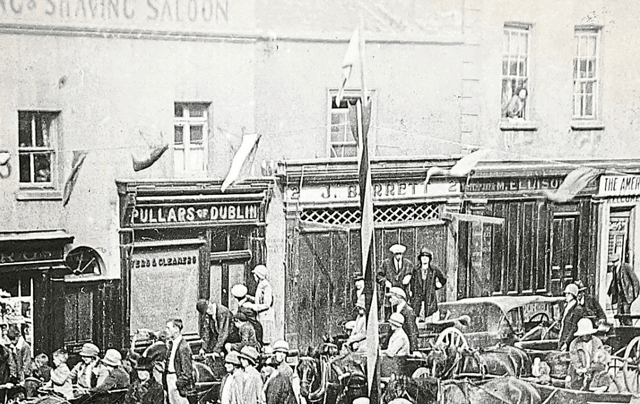

A detail from the background of a photograph taken in July 1928 offers a glimpse into the retail history of Limerick.
While the photographer captured the main event – Cardinal Van Rossum being driven in an open top car by Louis Hodkinson (1882-1955) as crowds of onlookers thronged the streets – he inadvertently took a snapshot of several city centre businesses.
The Cardinal was in the city for the Diamond Jubilee celebrations of the Arch-Confraternity.
The neat row of stores featuring traditional shop fronts with prominent lettering on ornate fascia boards, recall a time when the retail business of the city was firmly conducted within the three towns that comprise the original footprint of Limerick, namely Englishtown, Irishtown, and Newtown Pery.
The five businesses in the 1932 photograph are Nestor Bros, Pullar of Dublin, J Barrett, M Ellison, and the rather curiously named American Shoe Hospital.
From 1814, Nestor Bros of O’Connell Street occupied a prominent location in the heart of the city. They began trading as hardware merchants but expanded into sporting goods. Their offering included fishing tackle, bicycles, rifles, revolvers, footballs, and boxing gloves.
It’s safe to say that Nestors was the first all round sports retailer in the city. The 1901 census informs us that Augustine Nestor, a hardware shop keeper, lived on South Circular Road with his wife, Charlotte and their four daughters and four sons.
The family business originally occupied no. 28 O’Connell Street, but Alex Nestor expanded to include the corner of O’Connell Street and Roche’s Street.
That building is now home to Chicken Hut, a business synonymous with the city just as Nestors was during its time trading. Nestor’s premises in the 1928 photograph is resplendent with large painted lettering on the wall facing Roche’s Street.
On the ground floor it reads ‘High Class Hairdressing Saloon’ while on the first floor can be seen advertising for ‘pipes, tobacco, and cigarettes’, clearly the family knew how to diversify.
One wonders whether the Hodkinson firm had carried out the signage as his firm, better known for its ecclesiastical decoration business, they also designed and painted shopfronts. Nestors eventually traded until 1998, but in the pub business.
Tucked in between Nestor’s building and the Pullars of Dublin premises was a Georgian door with a beautiful fanlight, an indication that a family lived overhead the business, as can be seen by another clue in the image; curtains drawn and neatly tied back on the upper floor.
Trading from no. 1 Roche’s Street, Pullars was a dye works business that had its Irish headquarters at 122, Saint Stephen’s Green, Dublin.
This office was complemented by a network of agents throughout the country. The firm, in fact, was a Scottish outfit with its headquarters in Perth. Even in the 1920s, Limerick attracted international brands to the city. It is unclear when Pullars ceased trading.
Next door at no. 2 Roche’s Street was J Barrett, a ‘game and poultry business’. John Joseph Barrett operated his business from about 1878.
He lived overhead the shop with his wife, Mary Ann, and their four daughters and four sons. In the 1911 census, his daughters are all recorded as having the same profession: accountant in stall, while his sons are described as victuallers.
Barretts was a well-known shop on Roche’s Street and regularly featured all manner of game hanging from hooks along the façade of the shop. The Barretts were very charitable and often contributed to appeals for the poor including a donation of £5 to the Limerick Fuel and Blanket Fund in 1921.
Barretts ceased trading in 1947, the sale notice stating, ‘these premises have not changed hands for over half a century.’
The shop with the most curious name remains the most elusive in terms of giving up its story. The American Shoe Hospital of no. 4 Roche’s Street is clearly visible in the Hodkinson photograph, however no mention of it is recorded in any contemporary newspaper or trade directory, suggesting that it was a short lived enterprise.
William Wallace appears to have been the proprietor, while his neighbour, John Joseph Barrett was the landlord. Wallace had rented no. 4 from Barrett since 1908.
By 1935, Robert Costigan was operating a betting shop from no. 4.
In the present day all these buildings are occupied by a variety of well-known city centre shops.
To borrow a line from the 1947 sale notice of Barrett’s poultry shop ‘the good will that naturally attaches itself to all premises on Roche’s Street is extremely valuable.’
One hopes that these words continue to ring true for all businesses on Roche’s Street, now and in the future.