

Medical board of University Hospital Limerick calls for urgent Government action to keep patients safe

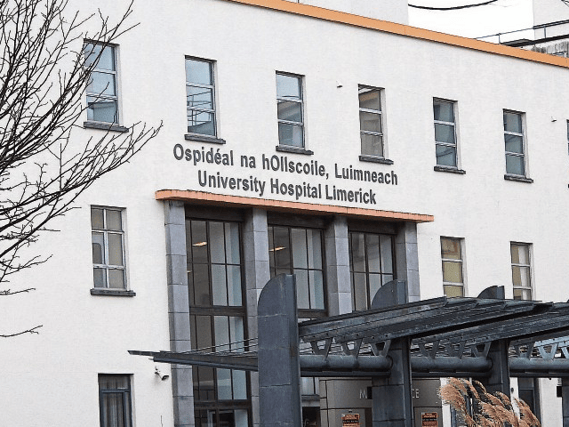

The chair of the University Hospital Limerick (UHL) medical board today said that they need Government funding for a Mid-West development board
THE MEDICAL board of University Hospital Limerick is warning that patients are at risk and that there are “not enough acute beds in the Mid-West.”
Speaking on RTE Radio 1 earlier today, consultant rheumatologist and chair of the UHL medical board, Professor Joe Devlin warned that risks to patients “remain intolerable and unacceptable.”
He said: “The problem has clearly been identified here. We do not have enough acute beds in the Mid-West."
The medical board has stressed that there is persistent severe overcrowding, high trolley numbers, delays with admissions, stretched resources and an emergency department under pressure.
The board is now calling on the Minister for Health, Jennifer Carroll MacNeill to provide emergency funding - they say that this will address urgent patient safety risk, while allowing for recruitment of consultants, non-consultant hospital doctors, as well as nurses and support staff.
The medical board also wants to see a fully empowered HSE Mid-West development board set up, which would have local leadership and the authority to drive the delivery of the new hospital project.
READ ALSO: Not enough evidence of 'feud' involvement for Limerick judge in case where young men had weapons
Professor Devlin said that there needs to be an acute hospital with all services, which has at least 400 beds in Phase 1 and has long-term capacity for expansion to 1,000 beds and would be co-located with the new maternity hospital.
Meanwhile, the National Ambulance Service is operating a work-to-rule today, Monday, with plans for a 24-hour strike starting at 8am tomorrow, Tuesday.
More than half of the paramedics, emergency responders, and supervisors are called for a properly funded workforce plan, along with recognition of their skills and the implementation of recommendations from the 2020 review.
This would address pay and condition concerns, as well as putting in place staffing, regulation, management and governance for a modern ambulance service to meet current demands for the service.
Speaking on RTE Radio 1 today, clinical director of the National Ambulance Service, Cathal O’Donnell said that tomorrow will see around 1,000 people calling 999 or 112, while half of the staff will not be in ambulances - they will be on the picket lines.
He stressed that they will be prioritising time-critical calls, such as those suffering cardiac arrest, stroke or with critical injuries.
However, he said: “I would not underestimate the seriousness of this. The people who need us may experience significant delays. We are doing everything we can to minimise that.”
He added: “If you can get help from another part of the health service or make your own way safely and appropriately to an emergency department, I would strongly encourage that.
He said that he wants this resolved so that their committed and dedicated staff can get back to what “they do best - looking after sick people.”
Sinn Féin TD Maurice Quinlivan has welcomed the comments from Professor Devlin, saying that all three of the HIQA recommendations for emergency healthcare in the region need to be fast-tracked.
Deputy Quinlivan said: “Confirmation by Professor Devlin, chairperson of the board, that ‘there are trolleys in corridors all around the hospital’ echoes what I and the INMO have been saying for years about the trolley crisis at UHL.”
He added: “University Hospital Limerick is not receiving the support that it needs.”
He also echoed the call from the medical board that staffing restrictions across the Mid-West must be lifted.
“All resources must be made available to end this crisis once and for all. The people of the Mid-West deserve better, the staff at the hospital deserve better,” he said.
The Sinn Féin TD added: “For too many years now Limerick and the Mid-West has been left behind. The crisis of people being treated on hospital trolleys is not new, it has been ongoing for years.
“The lack of investment and government indifference had left the people of Limerick, and the Mid-West cruelly exposed as UHL simply hasn’t the capacity to deal with the huge number of people who rely on it.”