

Limerick author reflects on how much hurling has changed since 1973
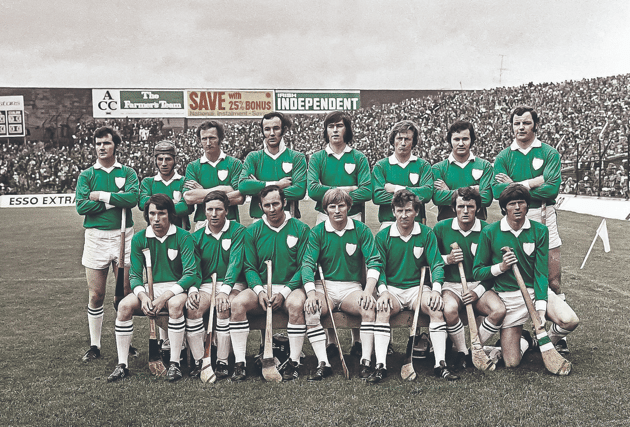

LIMERICK played Kilkenny in the wonderful All-Ireland hurling final of 1973 and they renew rivalries 50 years on, albeit the final is now played in July rather than September as was the tradition for many decades.
How has the championship and its traditions changed in this time? Like Ireland itself, quite a lot.
In 1973, the championship was straight knockout. In Munster, Tipperary beat Waterford and beat Cork. Limerick beat Clare. Limerick then beat Tipperary in one of the most famous and spoken-about Munster finals ever played. In Leinster, Offaly beat Kildare and Laois after a replay.
Dublin beat Westmeath. Kilkenny beat Dublin and Wexford beat Offaly. Kilkenny beat Wexford easily in the Leinster final. The All-Ireland series saw London beat Galway. Limerick then beat London, while Kilkenny got a bye into the final.
The current championship series has two round-robin provincial series that guarantee 11 teams at least four games each. Otherwise, we all know how we got to the final two this year.
A short experiment was conducted between 1970 and 1974 of having 80-minute provincial finals, as well as All-Ireland semi-finals and finals.
The 1973 Munster and All-Ireland finals were both 80 minutes, while Limerick's other two games that year were only 60 minutes, Clare and London. All games are now 70 minutes in duration.
There was no penalty in hurling or Gaelic football in 1973, this rule only being introduced the year after, with the addition of the large parallelogram and specific rules governing the awarding and taking of these special frees.
The original penalty in hurling allowed for three players on the line, with many tweaks being made to the rule over the succeeding years in both codes.
The National Hurling League was a split-year competition, from its introduction in 1925/26, right through to 1995/96. The first official single-year league was played as recently as 1997, which Limerick won.
Limerick played four league group games before Christmas 1972, and another three after Christmas, then three knockout games in late spring 1973, losing to Wexford in the league final in Croke Park in May.
Nowadays, the league is played off in a very short early-spring time window, as is the case with the championship in early summer.
This is the consequence of the split county and club seasons, recently introduced. The county and club seasons no longer overlap like they did in earlier times. Limerick won their 14th league in April 2023 after playing seven games in a little over nine weeks.
There was no GAAGO in 1973 with only a very small number of games televised in any form at the time, usually to black and white televisions.
There was some colour but most people didn't have the expensive equipment required to display it. The Railway Cup final games, Wembley Games contests, and both All-Ireland football semi-finals (minor and senior) were televised live, while the All-Ireland finals had been shown live since the early-1960s – a total of 12 games.
The 1973 All-Ireland final was not Limerick’s first time on live television. Even radio broadcasts were quite limited in nature at the time.
All games being played on Sunday, usually at the same time. Radio broadcasts were very rarely extended if games finished up in extra time, as did happen with the replayed league semi-final played in Birr in March 1973 between Limerick and Tipperary.
How times have changed as we have seen with the recent controversy about the (free) televising of all championship games. Local radios stations and web streaming is pervasive these days too.
Inter-county panels were much smaller in the old days, usually 21 or 22 players. Training was also less intensive, with Limerick usually training twice a week at the Gaelic Grounds.
Better training methods were slowly being instituted as sports science was improving, as was general team preparation. “Collective training” had been banned by the GAA years before.
The job of preparing and selecting the team was shared across between five and fifteen selectors. Yes, in some case as many as 15! Limerick had five selectors, a trainer, and a masseur in 1973. How many are involved with the team nowadays?
The game itself was also quite different in 1973. Players usually stuck rigidly to their playing position and the game was mostly about getting rid of the ball as soon as possible and as far up the field.
Interplay between players was minimal, though judicious use of the hand pass was notable in the 1973 All-Ireland final, all of which is available free to view on YouTube. It is highly recommended viewing.
Ground strokes were common as was pulling in the air, successful or not. Soloing was rare for various reasons. The referee did not have recourse to yellow or red cards, which were introduced in the 1990s. A player's name was rarely taken but was always deserved.
Even rarer was a player being sent to the line, with the commentator not always naming the offender, sometimes for fear of embarrassing him and his family.
Contrast that with the intense coverage in the print and social media that both players and officials, all amateurs, get nowadays for the least infraction.
Limerick played five challenge games in 1973; one before the league re-started in February and three more pre-championship, even playing an 80-minute challenge game after Clare were defeated in the Munster championship.
Eddie Keher was injured in a Walsh Cup game in August 1973, between the Leinster final and All-Ireland final, Kilkenny winning the Leinster final a full eight weeks before appearing in their next championship game. When did Limerick last play a proper challenge game – nine or 10 years ago?
The official programme that day was 10 (new) pence and was also a product of its time. Sunday's will be at least €7. There were also pirate (non-official) programmes produced for many big games of the era. Which do you have? The official is worth €60 to €75 on the open market, while the pirate may make €20 in the right circumstances.
Earlier Limerick championship programmes of 1973 are even more valuable, especially the London game. Programmes produced these days will never acquire any great value.
Hurleys were bigger in the old days, upwards of 37 inches in some players' cases. The average was 34 inches. Sliotars were more variable as specifications were vague and not well enforced.
The rim on these balls is much more pronounced than presently and is the primary reason given for the ball travelling further and more accurately nowadays.
Saying that, Richie Bennis did strike a sliotar over the bar from the half way line while on the run late in the 1973 All-Ireland final, something that would still be noteworthy today but must have been amazing to those watching live at the time.
Jerseys were not yet synthetic, and bulkier than their current incarnations. Old jerseys and sliotars were likely to get even heavier when it rained too.
Croke Park was a totally different place in the old days, a stadium of its time. It was totally rebuilt in the mid-1990s, to what it is today: one of the great sporting amphitheatres of the modern world.
Just over 58,000 attended the final on 2 September 1973, down 7,000 on the year before, mostly due to the heavy showers that morning in Dublin. Let's hope there is not a repeat this Sunday. There will be close to 82,000 attending the renewal, hail, rain or shine.
All this, and much more, is covered in great detail in an upcoming book to celebrate the wonderful year of 1973.
It is entitled, 1973 Keeping The Dream Alive - The Story of Limerick's Historic All-Ireland Success 50 Years On. For more details, check out the 1973 LimerickBook.wordpress.com web site.
It will be available from local book shops and online. It reveals the exact number of handpasses made in the 1973 All-Ireland final. The number may surprise you! It will be more than those who will be wearing authentic green and white crepe hats next Sunday!