

Secrets of Limerick cashel set to be revealed

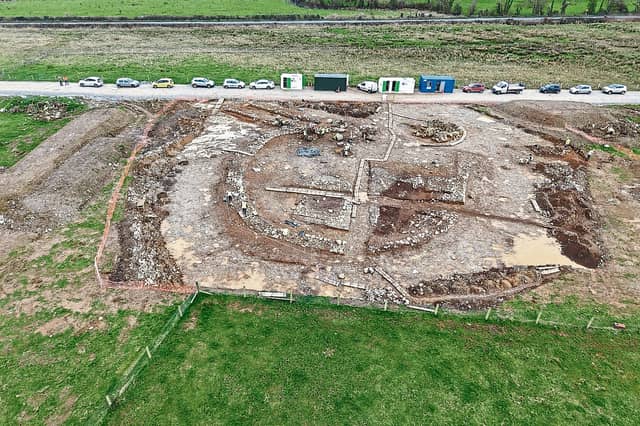

Medieval site was uncovered along route of the Foynes road
THE analysis and research around samples and objects taken from a former cashel on the Limerick to Foynes road will begin in the coming months.
The information was given in response to a query from the Leader to Limerick City and County Council.
As revealed back in May, excavation of land earmarked for the final phase of the Limerick to Foynes road revealed an early Medieval cashel, a type of settlement where people lived between the fifth and 10th centuries.
Detailed archealogical investigations carried out last year uncovered the ancient stone settlement, along with a number of 18th and 19th century military artefacts in the townland of Ballyclogh around 4km from Askeaton.
The ancient cashel now appears to have been removed, with construction of the road, which will feature the Adare bypass, continuing at pace.
Limerick City and County Council did not confirm whether this was the case, in a reply to a query from this newspaper.
Previously, they had said the cashel site will not be able to be preserved in situ. Instead, they said the site would be “preserved by record through archaeological excavation”.
In practical terms, it means the site will not be retained physically, but its contents are fully documented before removal.
This week, a spokesperson for the local authority confirmed the analysis will begin.
“Post-excavation processing, analysis and research on the samples and objects retrieved during the excavation will begin in the coming months. The results of this work will be integrated with the excavation records and presented in a final excavation report for the site,” they said.
It’s expected the report will be completed within 18 months and will be made publicly available thereafter. "The results of the excavation and the other significant excavations undertaken on this project will be described in an illustrated book that will be published as part of the TII Heritage Series,” council added.
In response to a question in Dail Eireann from Deputy Niall Collins, Transport Infrastructure Ireland said the archaeological site was first identified in 2017.
"The cashel excavated at clogh is an interesting addition to this corpus of known monuments and is considered locally significant in terms of its contribution of our understanding of the early Medieval settlement landscape of the area,” the response to Mr Collins’s question reads.
Council added it was “airborne laser scanning” which initially made the discovery of the cashel near Askeaton. Among other discoveries made on site were two kilns – one believed to have been used for drying cereal, another for lime-burning as well as a rectangular building thought to date from the 18th or 19th century.
Artefacts including a saddle quern – a simple, hand-operated stone mill – along with stone axe fragments and items dating from the early Medieval to early-modern period were identified.