

Unique project cuts food waste and boosts circular economy in Limerick

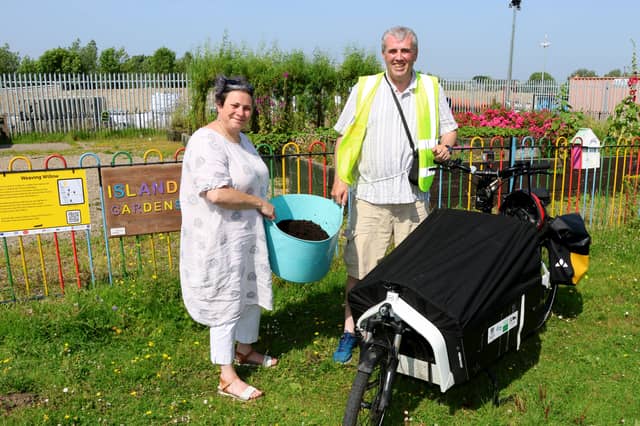

Biodigester in Kileely processes up to 16 tonnes of plate-scrapings each year, saving them from landfill
IN A world where sustainability is all-important and the need to address waste is vital, Limerick is leading the way with a unique new scheme, which sees food waste from community cafés converted into compost for community gardens.
Twice a week, Tim Hourigan, who works for Limerick City Partnership, jumps onto a purpose-built bike and collects leftover food from eight community centres across the city.
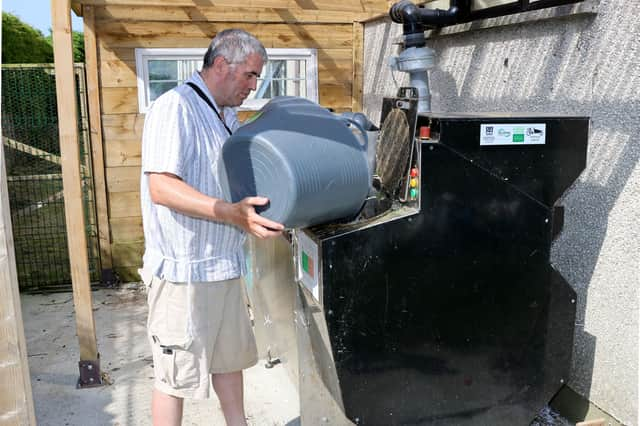
But rather than depositing sausages, potatoes, vegetables and other food waste in landfill, it finds its way into a new state-of-the-art biodigester, located in the grounds of the Learning Hub in Kileely.
Add in some wood shavings, paper and grass, and a process kicks into action which, within a month, sees what is initially quite a sloppy sludge transformed into fresh compost to be reused across Limerick.
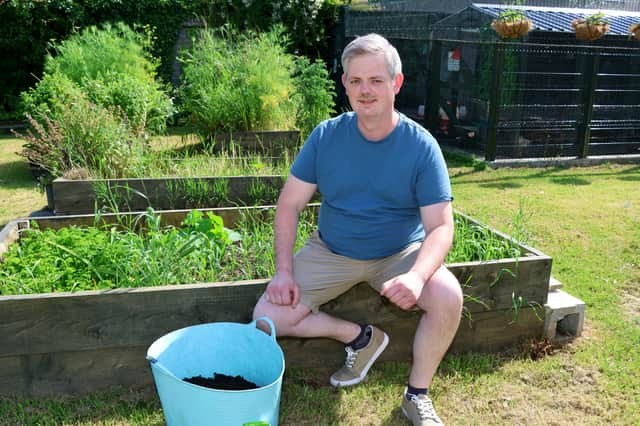
The scheme is called Foodcycle Limerick, and it’s a project run by Limerick City Partnership, involving multiple community groups.
Explaining the process, Tim says: "The machine has two large chambers. The leftover food is fed into a grinder, which breaks it into small pieces before moving it into the first chamber, where it is stirred for two weeks while additional food and material are added as it heats up.
"After two weeks, that batch is moved into a second chamber for curing for another two weeks, and a new batch is started in the first chamber. At the end of the four weeks, there is a stark contrast between the compost ready to leave the machine and the bits of pears, carrots and potatoes still identifiable in the first half of the machine," he added.
Many people do their bit for the environment by composting at home. But this machine operates at extremely high temperatures. And there is a good reason for this, Tim adds.
"The biodigester process is much faster than regular composting because it takes place at high temperatures inside sealed metal chambers, with the machine stirring the mixture every 15 minutes to help break it down and maintain airflow. With the right balance of ingredients and moisture content, the bacteria breaking down the food can heat the mixture to over 65°C, which speeds up the composting process from several months to just a few weeks. It also makes it safe to compost scraps of meat, which can't go into a traditional colder compost heap," said Tim.
Over the course of a year, the biodigester processes 16 tonnes of food waste, coffee grounds and wood shavings, with the used coffee grounds and wood shavings also being collected.
It's a great example of the circular economy in action, with the finished compost returning to community gardens, where some of the food grown eventually finds its way back into the cafés.
READ MORE: Man to appear in Limerick court in connection with prostitution and money laundering operation
Incredibly, Tim says there is actually scope to collect far more.
"There’s already enough stuff out there to run a second machine. I go up to some places like the Northside Family Resource Centre and Tait House. As they have crèche facilities and are feeding kids, they’d have a lot of leftovers. If we had a second machine, I could take twice as much out of there. I am reducing their output from two or three wheelie bins down to just one. But I could take all their waste," he explained.
Getting in the saddle, collecting leftover food and operating the biodigester is something of a dream job for Tim, a keen environmentalist and cyclist.
In the past, he has been part of the environmental, peace and social justice group Gluaiseacht, as well as Limerick Against Pollution.
He even ran for the Green Party in the 2002 General Election in Limerick East.
"I really enjoy working with it. When you see leftovers going in one end, and then later, compost being put into raised beds in a community garden, it's really rewarding," he said.
The impact of Foodcycle Limerick is felt right across the city.
Philip Moloney, who maintains the community garden at Southill Family Resource Centre, visited Kileely during our visit to collect compost.
He said: "I know from using stuff like this from biodigesters that it is really potent, really effective. It’s always better when it is not mass-produced. It’s like black gold!"
Mary Hughes, a development worker at King’s Island Community Centre, is very proud of their garden.
Here, they grow cabbage, onions, potatoes and even artichokes.
A raised bed forms the centrepiece and has 12 roses planted in memory of lives lost in the local community.
"It’s especially dedicated to one special lady who died at the age of 103 last year. So we have one red rose bush in there for her and 11 pink roses for the others we have lost," Mary explains.
She loves the fact that the compost used in the garden originates just metres away, as the crow flies, across the River Shannon.
"The great thing about this is, instead of paying for mulch which would need to be brought to the garden from a different part of the country, we now have a renewable source of recycled compost in the city. It’s great. We are getting it from a biodigester on one side of the river and bringing it to the other," she says.
James Blake, chief executive of Learning Hub Limerick in Kileely, the educational charity which hosts the biodigester, is surprised this measure has not been adopted sooner.
"I think, for waste disposal in general, future generations will look back in bafflement at how we are dumping stuff, ruining the environment, but not seeing the potential value that could arise from it, and the resources we are just frittering away," he said.