

University of Limerick researchers find robot solution for wind farm maintenance

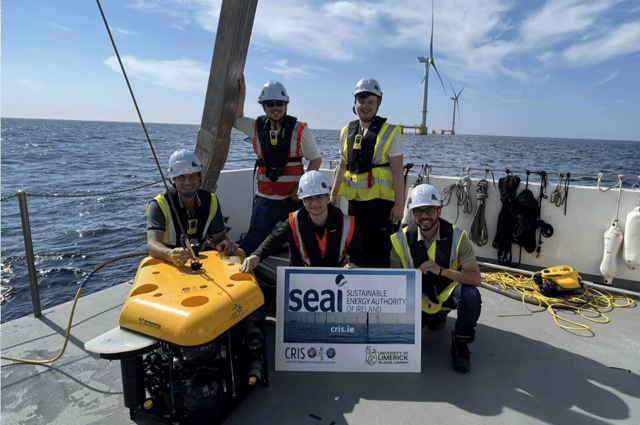

The team used pioneering technology to survey wind farm off the coast of Portugal
Researchers at the University of Limerick (UL) have pioneered a robotic solution for inspecting floating offshore wind farms.
A UL developed remote-operated vehicle was successfully tested at WindFloat Atlantic, the world’s first semi-submersible floating offshore wind farm, and the results will help prepare for the challenges of maintaining these structures.
The intervention, repair and maintenance survey was carried out by a team from the Centre for Robotics and Intelligent Systems (CRIS) at UL.
Regular inspections and maintenance are vital for offshore wind farms, whether bottom-fixed or floating and currently, these tasks rely heavily on human intervention. However, with the industry’s growth and advancements, there is an increased emphasis on enhancing reliability and reducing operational costs.
The team used a fleet of Field Robots, subsea Remotely Operated Vehicles (ROVs) and Unmanned Aerial Vehicles (UAVs) to survey the Ocean Winds’ WindFloat Atlantic off the coast of Portugal.
The survey yielded high-resolution, geo-referenced 3D models of structures above and below the waterline. The datasets and findings will be accessible through gold open-access articles and proceedings, benefiting the public, academia, and government.
Professor Daniel Toal, Co-Director of UL CRIS said: “The significance of our research should be viewed in the context of Ireland's existing offshore wind strategy, which aims to achieve 37 Gigawatts of offshore renewable energy capacity by 2050. This target also includes six Gigawatts of floating offshore wind farms on the West Coast and plans for the Shannon Estuary.
“Achieving this goal requires the development of intervention, repair and maintenance capacities and capabilities to ensure offshore operations are efficient and cost-effective,” Professor Toal added.
One of the challenges in inspecting a floating turbine is the movement of the structure, an effect that the UL team successfully minimised by using an adaptive control system for the remote-operated vehicle, as well as customised machine vision algorithms used in the image post-processing.
Commenting on the success of the trial, Dr Phillipe Santos, Chief CRIS scientist for the trials at WindFloat Atlantic said: “CRIS has been developing exceptional robotic capabilities that can transform the way we approach offshore wind farm inspections. I am really proud of the results we achieved in these trials, and I believe this is just the beginning of a groundbreaking partnership”.
José Pinheiro, Ocean Winds country manager for South Europe and project director for WindFloat Atlantic mentioned: "At Ocean Winds, we are thrilled to support University of Limerick's use of our operating project to test their remote-operated vehicle. These initiatives are essential for advancing the floating offshore wind sector to commercial scale, as well as continually improving operation and maintenance strategies for bottom-fixed installations. This collaboration not only drives innovation but also sets a precedent for implementation in other countries and projects."