

Green Limerick: Groundbreaking discovery to ‘revolutionise carbon fibre industry’

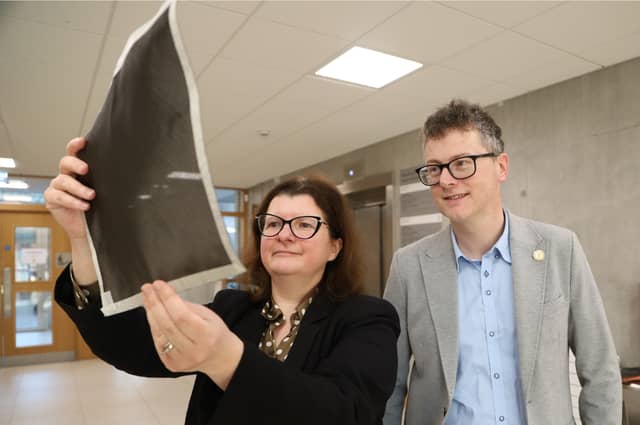

A RESEARCH team at the University of Limerick (UL) has developed a groundbreaking new method of producing carbon fibre while drastically reducing its energy footprint.
The breakthrough is said to be “transformative” as it aims to “revolutionise the carbon fibre industry” by replacing conventional heating processes and significantly reducing energy consumption.
Researchers at UL are leading the project, whereby they developed a new method of producing carbon fibre, a high-cost lightweight material used in sectors such as aerospace, wind energy, construction and transportation.
The CARBOWAVE project uses an innovative plasma and microwave heating method to make carbon fibre, replacing the conventional heating processes and significantly reducing energy consumption by as much as 70% while maintaining the materials performance.
The reduction in the energy required to produce the material will make the process greener and less expensive.
The ambitious new project, coordinated by UL’s Professor Maurice N Collins and Dr Anne Beaucamp McLoughlin, is set to transform the energy-intensive carbon fibre industry by deploying cutting-edge alternative heating technologies.
Professor Collins, principal investigator on the project and professor of materials science in UL’s School of Engineering, said: “Europe’s reliance on energy-intensive processes has long been a barrier to achieving sustainability.
“CARBOWAVE addresses this challenge and is an exciting project which offers the potential to produce more sustainable and cheaper carbon fibre.”
During their research, the UL team discovered that carbon fibre can be produced in an inexpensive domestic microwave and exhibit mechanical performance equivalent to that produced using conventional heating.
The advancements developed by the research team will enable a more efficient conversion of Polyacrylonitrile (PAN), a key component in carbon fibre’s production.