

Core values for a thriving business at Limerick apple farm
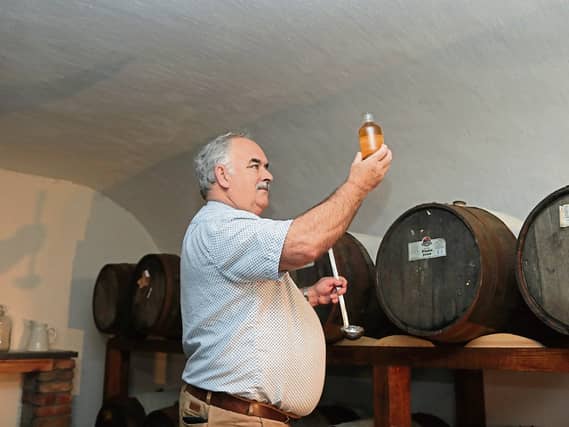

One thing most people seem to have in common is the belief they are in control of their own destiny, even though everybody, at various stages, has seen life get in the way of their plans.
Sometimes it is little things, like a burst tyre or a bad day at work, that blow us off course; other times it can be global events that come crashing into our lives and gather us up in their grand sweep.
Things like the great economic crash of 2008 or the ongoing force of nature that is climate change. So it has proved for Maurice Gilbert, co-owner and public face of Ballyhoura Apple Farm who has steadily been building his food business with Gerry Murphy out of the former Shannon Development site in the town of Kilfinane.
Derelict and overgrown only three years ago - “it cost us €8,000 just to clear the trees and get in the gate” - the site is now abuzz with activity, a huge Centra truck laden with apple juice and apple cider vinegar is inching its way back out as we arrive, workers are packing bottles into crates. Inside the reception area and shop neatly display the wide range of products, the office wall is papered with Blas na hEireann and Great Taste award certificates.
It was all so different at the beginning. It was even in another county. Across the Ballyhoura mountains in Churchtown, Co. Cork, Maurice, a carpenter by trade was in partnership with businessman Gerry, the building boom, the one that would last forever, was in full cry.
“Gerry bought old derelict buildings in the village and I renovated them,” says Maurice looking back to the early noughties, “that's how our relationship started. Following on from that Gerry bought the field across the road and we had planning permission for 70 houses and I built the houses.
“He would sell them the site and I would sell them the house. We were in a lot of different ventures and bits and pieces.”
Looking to add something extra to the village, “to create a nice vista”, as Maurice puts it, and possessing a field without planning permission, the men planted their first orchard in 2005, with the long term view of opening a visitor centre. Over three years, put 5,000 trees in the ground.
Cue life-changing event.
“By the time it came to 2009/10 I had 20-odd fellas working for me in construction, but that all collapsed. We had our trees looking lovely, blossoms and everything but of course the downturn put a dampner on that, money wasn't available, the construction side of things collapsed so I started at Mahon Point market in Cork in September with just a few apples and my plain apple juice, that one there,” he says gesturing to the green bottles on the shelves.
Things were going fine for a while, but come November, Maurice could already see the necessity of innovation.
“People didn't want the apple juice, the weather wasn't right, the time wasn't right, so I had to do something, I had to keep the thing going,” he says.
“I had four kids to look after, I'd been self employed all my life and had no social welfare to get so I came up for an idea for a hot apple juice, a mulled apple juice.”
That little change-up got him to the far side of Christmas and was tweaked again with spices and apple and blackcurrant juice - “red, is a great colour for any product, because people are drawn to it” - and taken to Blas na hEireann, the Irish food awards.
“We got a silver medal for best new product. We also had a chutney and salad dressing and got silver for that . Two awards first time entering and that best new product was a huge category, and so we are starting to get recognised by the trade that we were getting things right.”
By then he'd started doing sauces and syrups, vinegars, diversifying the range.
“Ideas come easy to me and recipes come easy to me. It brings out my creative side. I was the same with the carpentry and the building, things come to me. I’m good for ideas, I even do a little painting, I'm a bit artistic.”
More innovations, particularly in the health side of things led to more awards. In 2013 they took 10 products to the prestigious Great Taste awards in London and got seven golds. Things were still small scale, the bottling and pressing outsourced, but the result instilled in them the belief they could do it.
But more trials were to come and in 2014 with agricultural land sales soaring, the property market poked its nose back into his business.
Someone bought the 80-acre farm around the orchard in Churchtown, and wanted Maurice and Gerry’s field and yard too.
“Gerry said to me, if we sell it your business is destroyed. So I said let me think about it and we'll see what we can do.
“We had a field in Kilfinane where we had planning on five acres of it and we had 10 acres below that didn't have planning and that wouldn't ever be zoned. So we had this land in Kilfinane, we couldn't sell it, we had a customer for the place in Churchtown, so I suppose the economic decision was we'd sell it, because to keep things ticking we had to, basically.”
The decision was made to replant the orchard in Kilfinane from scratch, plough the other one into the ground, sell it and move on, he says but, in the meantime, he got a notion that maybe they should move the orchard.
There is a machine for digging up the root ball, which is fine if you’re moving something 100 yards, but not much good for moving something 20 miles up hill and down dale.
Instead, he got a digger and tried to bare root some of the trees anyway, but the machine was just breaking trees - “It wasn’t working at all”.
“So I said turn the bucket upside down, and now he was coming in under the root and tipping them up, bringing them up intact
“So we had tractors and trailers lined up. One fella described it as the like flight out of Egypt, all the tractors coming across through Effin. A contractor from Churchtown Jimmy O'Brien who did it. We had a couple of lads over who would dig them up, put them into the trailer and the trailer would bring them over - 5,000 trees, 20 to 30 trees at a time, it was a lot of journeys.”
A few trenches had been dug in Kilfinane and with the first few trailer loads gone over the intention was to plant around the perimeter. Which was fine, but the weather was not going to play ball. The heavens opened and stayed open.
With the field being on a slope, they couldn’t drive the tractors down to the bottom or they wouldn’t get back up, so everything had to be dropped at the top and roughly covered.
“It started on the 19th of March and it just rained and it rained and it rained. We could get up the field and get them out and keep the thing rolling, but it meant we had to stop planting trees, and instead put them there with the roots against each other and cover them with soil. So basically we had to replant them twice.
“We had to cover the roots because in March you would have frost and that would affect the roots, I had calculated at the start that if we had a 40% success rate it would have paid us to do what we did. I’d have 10 year old trees instead of one year old trees and it would be financially viable.
“All in, we were up to our neck in sh*t for three months, we just had them in on time and they did blossom and that was the proof of the pudding.
“We had six weeks to get them in, it was crazy. Half way through I said Gerry was right, I'm feckin' mad to try this at all, but it worked and when they started blossoming, lo and behold, we had 95% success rate, way above our expectations. They settled in, they liked Kilfinane.”
There was more to come. Maurice’s partner Helen got cancer in the bladder, and the young boy they had fostered who had spina bifida was going through a lot of operations, which necessitated an extension on his house.
“We had a lot going on,” he says, though thankfully, he knocks on wood, they came through it all.
Come 2015, he saw the chance to move in to the old Shannon Development premises he now occupies. He had done the food academy course with Musgraves which was his introduction to the multiples and mainstream shops.
“The big thing is the margin, they take a lot,” he muses, “but if you can pump up the volume, you can survive and that was a new beginning.”
Having done everything on the spur and out of necessity in the past, the move was key.
“When we got in here, we could see the future, this was the catalyst that changed the whole thing from one man band to going mainstream to making a proper business out of it.”
And in stepped climate change to open the door to that future.
“We had been doing vinegar and I saw the vinegar market was growing. Braggs, who would be our main competitor, are based in the USA and there was a drought in California which put them in short supply so we saw a niche in the market and an opportunity if we could get going with the vinegar.
But going for large scale production requires an acetator, a piece of machinery which converts cider into vinegar. two of which would cost €300,000, not a feasible investment.
So, instead, Maurice designed and built his own with a bulk tank, a hot water cylinder and an ice cream fridge, With some expertise drafted in for the pipework and electronics, ‘V1’ was up and running. The cost was a small fraction of the shop model. Now he has three tanks of 3,000, 4,000 and 5,000 litre capacity.
“Now we could produce, now we could talk serious and at that stage I started looking for markets. The vinegar is not like a pound of butter that you're buying every week, it’s a slow burner, a long lasting product so you need a lot outlets and no one outlet will sell what we can produce.
“Musgraves were selling 10% of what I produce. So we put into the Aldi and Lidl competition programmes, through Bord Bia, and were accepted on to both.
These initiatives invite up to 350 indigenous producers to submit their goods, which after an intensive selection process is whittled down to 70. The next step sees the products put into the shops on a trial basis for two weeks.
“We started the process on August 23 with Aldi and on the first day sold out 33% of the product, within the week we sold 92%. So that was hugely successful, we were hugely excited with this.
“So, on the 17th of September Lidl were doing the same process, but their thing started on the Monday, which is bad day for shopping, but as it happened we sold out 30% on the first day and 87% overall, so the figures were great. It proved the market was there, so we’re now in negotiations with them as well.”
Aldi were first to jump, announcing their five winners at this year’s ploughing championships. The German multiple has committed to taking the Ballyhoura apple cider vinegar for 12 months, with a view to an extension.
For Maurice’s operation, it means that the jobs and livelihoods of his nine employees, full and part time are secured. “This is bigger than ourselves it has an impact on the whole area, being part native (chuckles) there is a great satisfaction in working local. The goodwill that is around for the operation and to get the place up and going and a bit of employment up and going again, there is a great amount of satisfaction in that as well.
“A lot of people remember this place and the Molex factory and their mothers and fathers would have worked here it was derelict there was nothing happening for a long time.”
“Going forward if we can create a few more jobs, we're looking at putting in a bottling and labelling plant if we can get these contracts in place it would make sense to do some of that. We'd still outsource the pressing of the apples and bottling of the juices, but for the vinegar we might do a bottling plant. the big thing is they'll sustain the jobs we have and create a few more it's positive.”
With Lidl there is a chance that things could go further again. Rather than just taking some of the products for their own shelves here, the top three or four would be taken for export, because as Maurice points out, the Irish market won’t sustain their capacity to produce. He is already planning a foray into England, Brexit notwithstanding.
“We got the support of Bord Bia and were at this year’s Great Taste awards dinner where we got the highest honour, a three-star for the cider vinegar, so we now have faces to put on the people in London. I've been invited to the Irish embassy in London in December they're doing a showcase of Irish products and it's paving the way for when we do start going in to England.”
In Ballyhoura’s case it looks like the apple will fall far from the tree.