

Off The Record - 'The bullet never stops travelling': The Kidnapping recalls Tidey's story
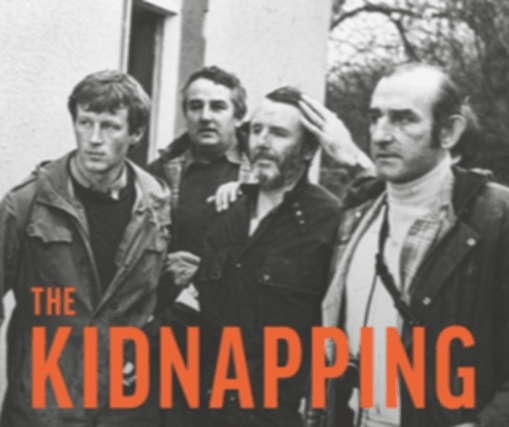


NOVEMBER 1983: The IRA has turned to kidnapping to fund its armed campaign. The organisation has a supermarket boss in its sights - Quinnsworth chief executive, Don Tidey.
As Tidey pulls up at a garda checkpoint, he is dragged from his car, bundled into another and driven away at speed.
The ‘gardaí’ are terrorists in fake uniforms. It is the start of a massive manhunt and a 23-day ordeal for Tidey. At the instant he is found, in an isolated Leitrim wood, his captors kill a trainee garda and a young soldier.
That’s the dramatic story told by journalists Tommy Conlon and Ronan McGreevy in The Kidnapping.
Originally from Co Leitrim, Tommy Conlon has been living in Limerick city centre for the past 15 years.
For many years, he has been working as a sports writer and a ghostwriter.
In 2022, he decided to team up with his friend Ronan to write The Kidnapping.
Speaking of why he wanted to tell this story, Tommy says: “I think most journalists are interested in history and politics, it’s part of maybe why we are journalists, but this one has a personal connection because the events we describe in the book took place in my hometown, and outside my hometown.”
Don Tidey was found in the woods five miles from Tommy’s hometown of Ballinamore.
“I was down there at the time when the bodies of the guard and the soldier were taken out of the forest. They were shot dead, rescuing Mr Tidey. I remember the ambulances taking their bodies through the town and onto the hospital,” he recalls.
The book also references Limerick detectives Jerry McCabe and Seamus Quaid, who were both murdered by the IRA.
“We also mention a detective called Seamus Quaid, who's from County Limerick, he played hurling. He was a very good hurler and won an All-Ireland senior hurling medal with Wexford in 1960,” Tommy points out.
“It's a story I hope to investigate further and find out more about the circumstances of that terrible incident, and maybe talk to his family if that's possible.”
The most challenging part about writing The Kidnapping was to speak to the families of the victims. According to Tommy, the events caused intergenerational trauma.
“We met three of the four Kelly sons last winter when we were researching the book. We spent many hours with them, and they told us of the devastation of their mother and how this violent event that took away their father traumatised them and still does to this day. This for me was a manifestation of intergenerational trauma right in front of my eyes, sitting at their kitchen table in County Westmeath,” Tommy recalls of the death of Patrick Kelly.
Page after page, he tried to represent their grief.
“It was a responsibility I felt to try and represent or express their grief. There is an expression, ‘the bullet never stops travelling’. Their father was killed by many bullets, and in a way, the bullets are still travelling and still damage his children,” he says.
Even though the book is the story of a kidnapping and a manhunt and the plot is constantly moving forward, Tommy hopes the book is compassionate for the families.
Speaking of his friend and co-author, Ronan, he notes: “He brought an enormous amount of knowledge and experience that I couldn't bring, that he could bring to the project. We kind of almost organically and logically divided up the chapters among each other without really having to discuss it much. I knew what his strengths would be, the division of labour was pretty smooth.”
An intimate account of an iconic episode in recent Irish history, The Kidnapping includes a number of interviews with Don Tidey, who spoke in detail about his abduction and its aftermath for the first time.
Equally startling and moving are interviews with the families of Patrick Kelly and Gary Sheehan, who reveal the devastating impact of the two men's violent deaths and the ongoing challenges of coming to terms with their loss.