

Government will face ‘test of sincerity’ over pay deal dispute comments
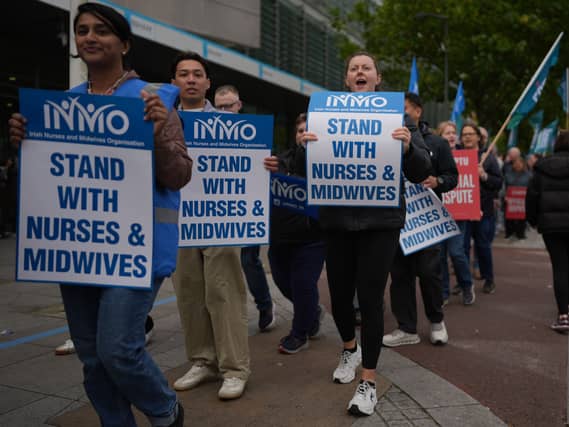

Hundreds of thousands of public sector workers are taking part in a national 24-hour walkout on Wednesday in a dispute over pay.
The Government will now face a “test of sincerity” after the public expenditure minister said that pay can be the starting point for negotiations on a new public sector pay deal, a union leader has said.
It comes as hundreds of thousands of public sector workers take part in a national 24-hour walkout on Wednesday in a dispute over pay.
The public sector workers, including nurses, doctors, teachers, and civil servants, are engaging in the national strike following earlier work-to-rule action.
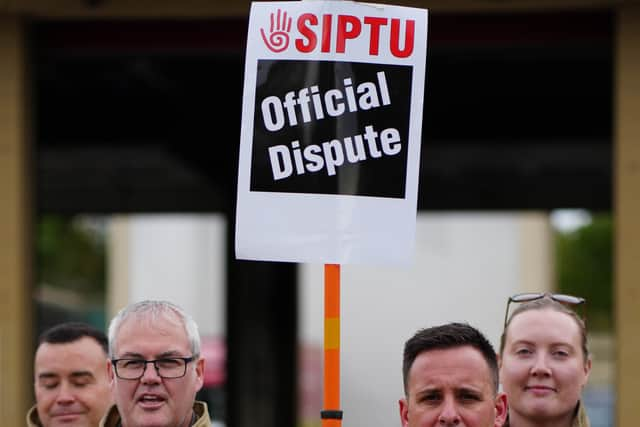
Members of Fórsa, Ireland’s largest public sector union, as well as Siptu had voted in favour of industrial action including strike.
The major teachers’ unions as well as collective bodies for nurses, midwives and doctors also voted in favour of action.
The main teaching unions are also taking part in the strike, which has led to the closure of most schools, colleges and universities.
Thousands of medical appointments have also been cancelled, with the HSE warning of “significant and widespread” disruption” to its services.
On the eve of widespread strike action, Minister for Public Expenditure Jack Chambers told RTÉ, when asked whether pay would be a starting point to negotiations, he said: “Absolutely. That’s being put out there as a deflective mechanism to actually continue this escalation.”
While his comments have been described as “too little, too late”, Forsa general secretary Kevin Callinan said if the comments are “sincere”, then it could create a way forward.
“I think if he’s sincere in what he says, it may be possible if the Taoiseach intervenes to create a pathway to a resolution,” Mr Callinan said.
“But the Government need to respond first of all to the people that you can see on the streets on the picket lines today, and nobody wants to be here.
“People feel they were backed into this by the Government. They need to realise that that’s what this is about, and if they respond in a meaningful way, of course we’ll talk to them. Of course we’ll participate in negotiations.
“I think it was very clear last night in terms of what he (Mr Chambers) said that if it was sincere, that there is a way forward.
“I think it’s a test now of the sincerity both of him and of the Government, as to whether or not we get a breakthrough.
“Unfortunately, also this morning, both Minister (Peter) Burke and Minister (James) Lawless, simply doubled down on the Government statement yesterday, echoing the public expenditure department’s lines.
“That won’t cut it. If that’s the approach, then this dispute is going to continue, and it is going to be very intractable.”
General Secretary of the Irish Nurses and Midwives Organisation (INMO) Phil Ní Sheaghdha said it is “very evident” from the pickets on Wednesday that union members are saying “too little, too late”.
“They’re very, very concerned about the cost of living,” she said outside the Mater Hospital in Dublin.
“They’re concerned that it’s portrayed that they’re not serious about taking industrial action. They never take industrial action unless it is absolutely necessary.
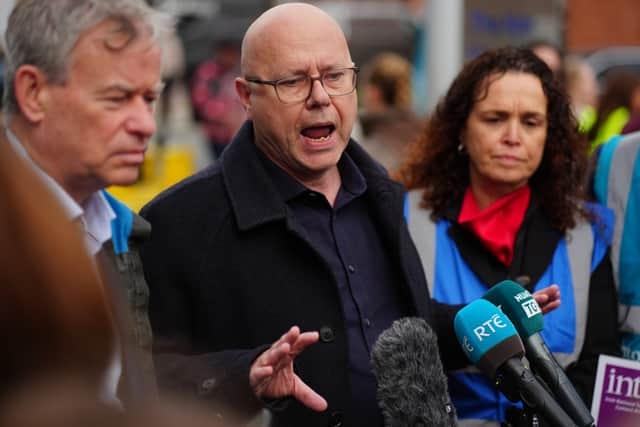
“I have never, in all of the disputes we’ve had in nursing and midwifery, seen nurses take that decision lightly.
“If the Government are serious, we’ve already said, that if the Taoiseach now really wants to bring about a meaningful engagement, the ball is in the Government’s court, and we listen to what they have to say.”
Taoiseach Micheál Martin said the Government will do “everything we possibly can” to reach an agreement with the unions.
“First of all I welcome the tone and sort of disposition of Kevin (Callinan) and other trade union leaders, towards being open to an engagement and being open to a process that could lead to a resolution of this,” Mr Martin said.
“But I’m not going to comment specifically on any one particular initiative, other than to say that with goodwill on all sides, I think we can move this into a better space in terms of getting a resolution to all of the outstanding issues.”
He said that Mr Chambers and his officials are “working very hard” to enter dialogue and negotiations.
Speaking at an international summit on AI in Dublin, Mr Martin told reporters: “I understand fully the pressures public servants are on and workers are on so our focus is on trying to get a process going that can lead to a satisfactory outcome in terms of a new national pay agreement, which is what we want to put in place.”
Mr Martin said budgetary decisions provided “a very strong foundation and platform” for public service pay talks, adding that he detects “good will all round”.
He said: “I think the foundations are there for a very substantive engagement between unions and government, and we certainly will be doing everything we possibly can.”
Siptu deputy general secretary Adrian Kane said: “People can hear the level of support from the public here this morning, and on every picket line that I’ve been on this morning.
“Everybody knows whatever eventually may come out of any prospective talks, will have a huge impact on earnings across the entire economy, and that’s why the workers right across this country are with the public sector workers here today.”
Sinn Féin leader Mary Lou McDonald accused the Government of playing a game of chicken with the hundreds of thousands of workers.
Speaking outside Leinster House where a large crowd of civil service staff stage a picket line, Ms McDonald said: “I think they have played a really terrible and disrespectful game of chicken with 300,000 workers that we all rely on.
“We rely on them to take care of us when we’re sick. They educate our children. They run our services, and indeed, they run the building and the system behind us (Leinster House) that we serve in here as elected representatives of the people.
“I think you can feel the really strong sense of public support for all of the workers.
“These are pay negotiations that need to happen. So the very idea that the Government is playing a game of semantics, or a game of chicken and brinkmanship with workers, and refusing to acknowledge that pay will in fact be the core item and the first item up for discussion is absolutely incomprehensible to me.
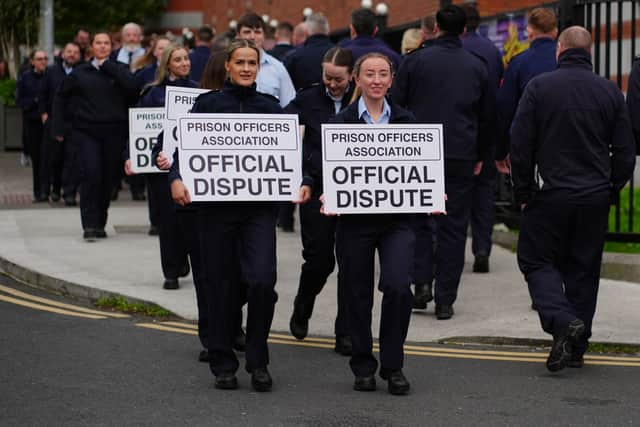
“We’re calling on the Government to act. I think at this stage the Taoiseach needs to intervene.”
Labour leader Ivana Bacik also appealed to the Taoiseach to intervene in the dispute.
Speaking outside Leinster House on Wednesday morning, she urged him: “Get involved in this. Push Jack Chambers to engage meaningfully. Make sure that pay talks are about pay, because that’s what the unions want.”
Ms Bacik said public support for today’s strike has been significant.
She said: “People understand that many public sector workers are very lowly paid, and that in particular there’s a real concern with the rising cost of living, with rising inflation, that public sector pay is not protected against inflation.
“And that’s why the Government needs to engage on national pay. That’s what’s so hard to understand, why they let the last national pay deal lapse since June.
“We find it extraordinary that Minister Jack Chambers recklessly let a national pay deal lapse for several months before making any sort of positive signs that he’s willing to engage and put pay squarely on the table.”
Independent Ireland leader Michael Collins said that people were left with no choice but to strike.
“At the end of the week, there’s little or nothing left in the pay packet to pay the bills that need to be paid,” he added.
“Mortgage arrears are growing, electricity arrears are out of control, and some people are filling an oil tank with 1,600 euro. That budget is a completely out-of-touch budget built on a thriving country.”
Social Democrats TD Eoin Hayes said: “There is a huge problem in terms of pay and conditions for public sector workers. We all rely on the public sector workers.
“They educate our kids, they make sure we have health services when we get sick and they deserve our support.”
He said he hopes further strike action will be avoided next week.
“I hope the Government does its job on this and hope they make sure these agreements come and are properly negotiating them but that is in the gift of Jack Chambers and Micheál Martin.”
Speaking on Wednesday evening, Mr Chambers described the 1.2 billion euro which was provided for public service pay in Budget 2027 last week as a “starting point”.
Asked if he was happy for pay to be dealt with first in talks, Mr Chambers said: “Absolutely, and I’ve been clear about that.”
Speaking on RTÉ’s Six One News, he added: “Obviously pay is a central context to a public service agreement as well as improving terms and conditions of workers.”
Asked if he was prepared to go above the 1.2 billion euro set aside in the Budget, the minister said: “That’s the starting point for discussions and clearly the only way we can develop that is to ensure that we have discussion.”